RepRap Pioneer Returns With a DIY 3D Printer That Hits Micro-Level Precision

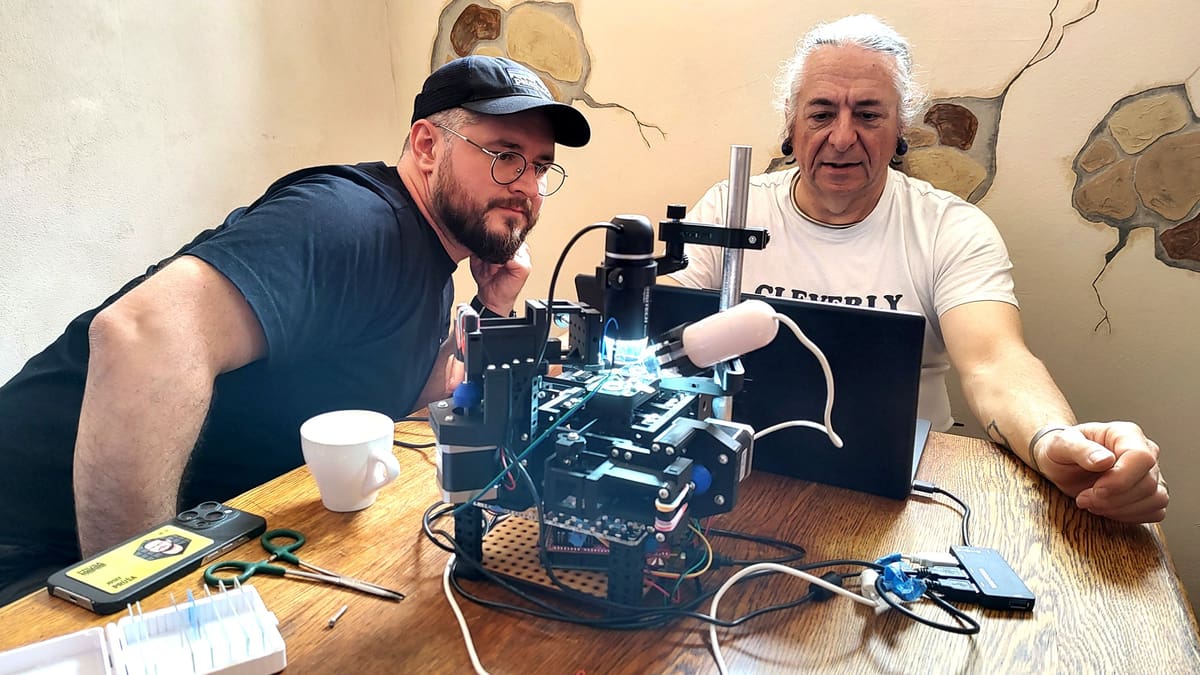
A new RepRap 3D printer that its creator endearingly calls "the next small thing" was presented at Fab25, and its timing is impeccable.
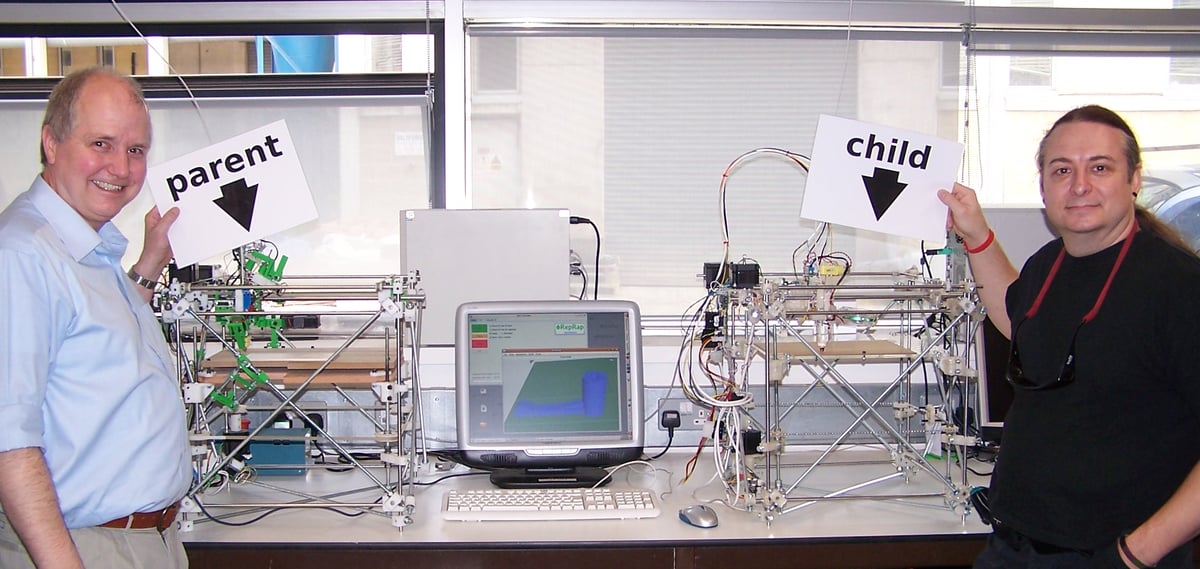
RepRap is back, in a small way. Vik Olliver, the first contributor to the open-source RepRap project that kickstarted hobbyist 3D printing in 2004, gave a talk at Fab25 in Prague to introduce his new project: a DIY 3D printer capable of producing objects with a resolution of just 10 to 20 microns.
It’s called the RepRap Micron. While the open-source device isn’t anywhere near ready for functional applications yet, it’s developing alongside industrial micro 3D printers in stark similarity to the original RepRap machines. And, much like its RepRap predecessors, it could be the first step in democratized micro 3D printing.
One of the more interesting 3D printed components is the Micron’s flexure-based kinematics. Inspired by the OpenFlexure Microscope Project, the single-piece print serves as the Micron’s motion system in the same way linear rails or rods might on traditional 3D printers, driven by a stepper motor and a threaded rod drive screw itself.
“A flexure is basically a flat, wide spring that is too stiff to twist, but flexible enough to bend,” Olliver explained during his Fab25 presentation. “They don’t have any backlash or tolerance issues. So, if you replace all your bearings and pivots with flexures, you can make a machine that has astonishing precision.”
It’s an elegant, simple motion system that is just incredibly demonstrative of the range of applications for a creative 3D print. There are some tradeoffs, of course. Bend the module too far, and it stays bent. That limits the range of motion possible, but isn’t such a problem at the Micron’s scale.
Just Getting Started
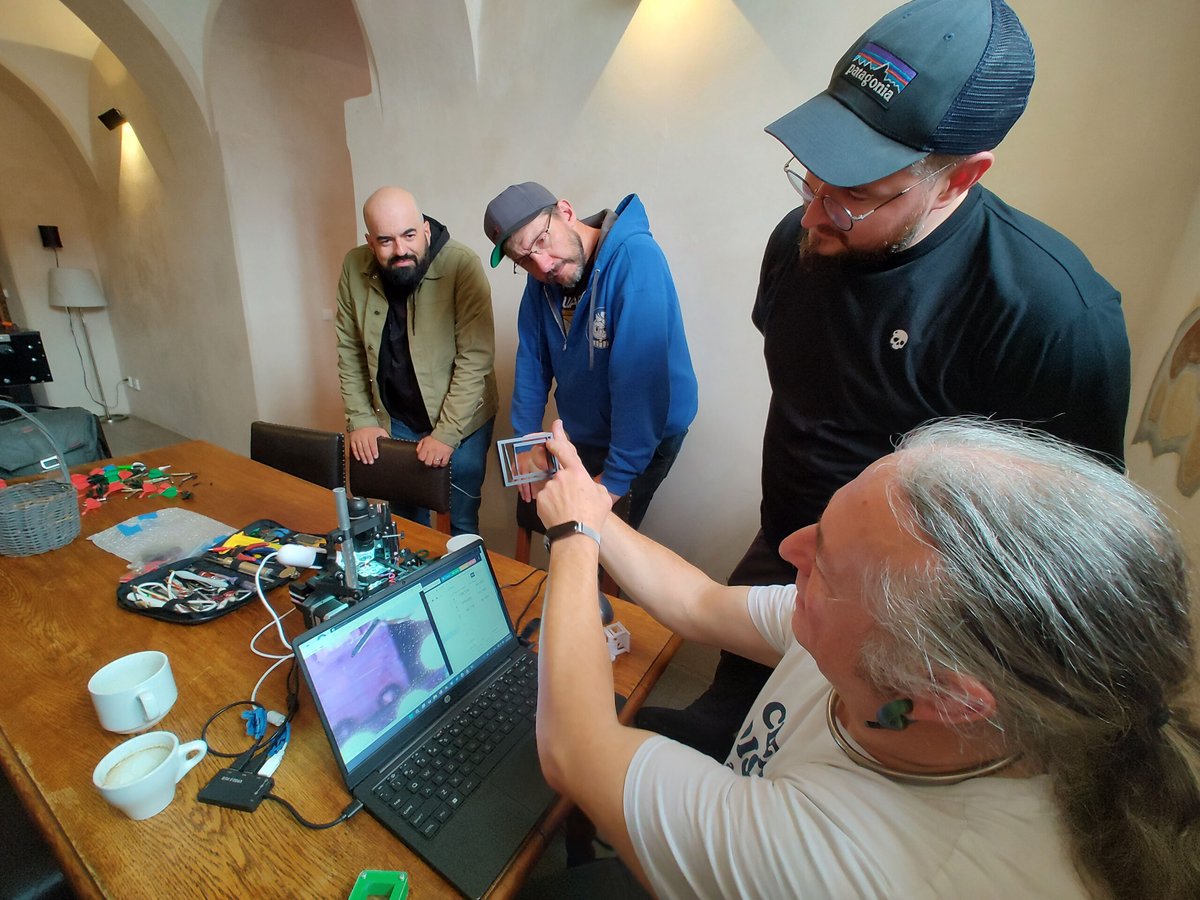
Needless to say, the RepRap Micron is fascinating, and I was fortunate to be part of a small demonstration before Fab25 where a design was etched into Sharpie on a slide – one of Olliver’s earlier proof-of-concept methods.
After watching the machine work, attendees verified the result with a magnifying glass, taking some time to locate the minuscule product through the lens until a crisp “Hello World” and Hackaday “Jolly Wrencher” symbol could be seen. Olliver also produced a Triforce object, printed beforehand in clear resin on a slide and totaling about 300 microns, he says. The results are remarkable for a prototype hardware that Olliver says costs just “a couple hundred bucks”.

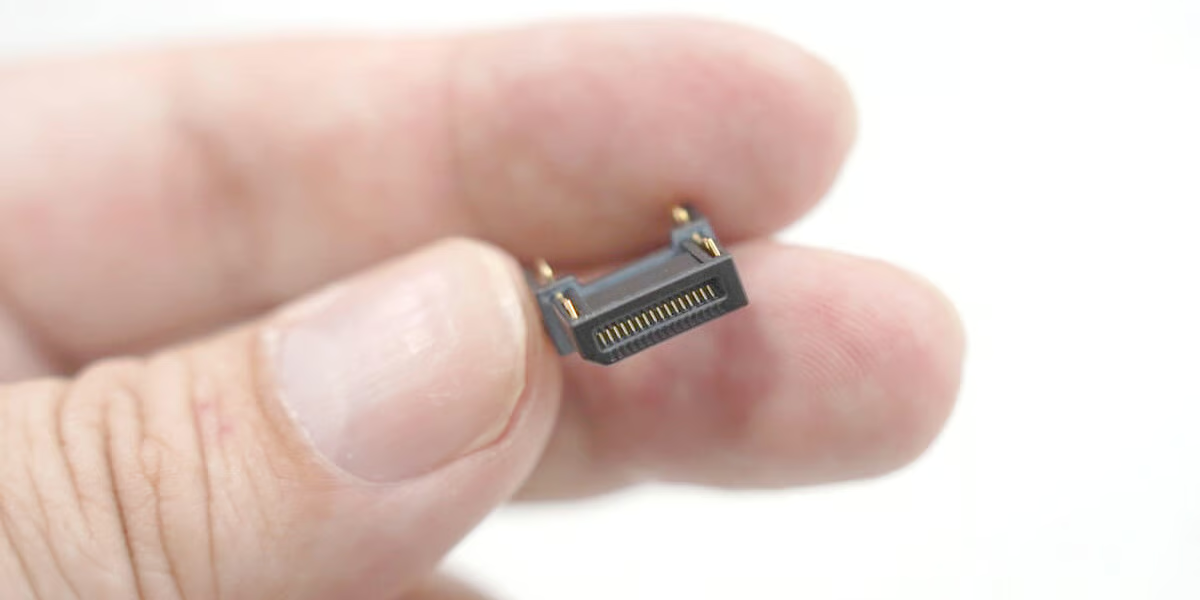
But those professional-grade machines cost upwards of $100K. The Micron represents a new opportunity for democratized manufacturing in these complicated sizes, which could be of astronomical benefit to prosumers, and tight-pursed researchers and innovators alike.
Not that Olliver’s RepRap Micron is exactly on par. It’s still best thought of as a hobbyist contraption in its early stages, and the relatively wide tolerance being from 10 to 20 microns is a far cry from the high-end accuracy of 2 microns that professional brands are achieving. But it is promising. The RepRap Micron is already matching the larger resolutions of professional micro 3D printers, and beating out those possible from consumer resin systems, even as they reach 16K. And there’s so much room to grow.
The deposition-based curing process, for example, is so distinct from the more typical UV curing processes. It could prove to be a bottleneck, but more innovation in the toolhead, and the materials the device deposits, could deliver further progress in time.
For now, you can follow along with Olliver’s developments through the RepRap blog, or check out the RepRapMicron’s GitHub repository to build your own.
Correction – Aug 7, 2025: a caption in a previous version of this article misnamed Adrian Bowyer.
Read more about micro 3D printing:
License: The text of "RepRap Pioneer Returns With a DIY 3D Printer That Hits Micro-Level Precision" by All3DP is licensed under a Creative Commons Attribution 4.0 International License.