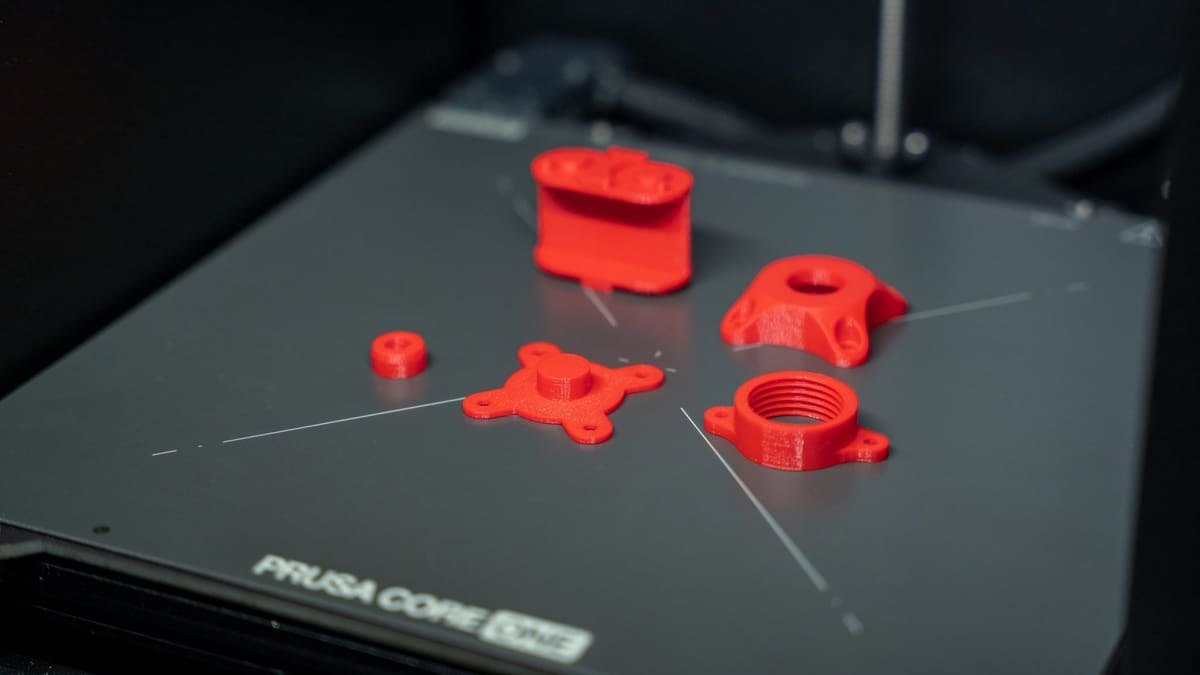
Prusa Launches Its First High-Speed PLA, Promising Up to 40% Faster Prints

New five-color series of high speed PLA filament suitable for the company’s CHT Nextruder nozzles boasts up to 40% print time gains in the right conditions, the company says.
Prusa has never been one to lean into the marketing bull and make speed claims that don’t measure up to real-world use. Usually, if a number is given, it’s backed up with internal testing that contextualizes things.
The release of Prusament PLA High Speed is no exception. A blog post announcing the release even frontloads its claims to numbers with the caveat that, well, it all depends. Available in five colors at launch, including the company’s signature orange and glitter-effect Galaxy Black color, as well as equipped with an OpenPrintTag NFC tag, a 1 kg spool will set you back $30.99.
Depending on the printed model’s size and shape they say you can expect between 20-40 % print time saving, due to PLA High Speed maximum volumetric flow of 28mm³/s (on the Core One+). For context, regular Prusament PLA has a flow of 24mm³/s. It doesn’t sound like much, but the company reasons it’s “all about polymer melt rheology” – rheology being the physics of flow.
The new material has a higher melt flow index than the company’s other filaments, with modified shear-thinning behavior that sees it become less viscous the harder it’s pushed – it performs better at the extremes of the hardware’s capabilities, essentially.
In the technical data sheet for Prusament PLA High Speed we see speed claims comparable to other high-speed PLAs like Polymaker’s Polysonic and even Bambu Lab’s high-speed-by-default PLA Basic – though of course, this doesn’t map cleanly given different machines, print settings, models, etc. To compare within Prusa’s ecosystem, regular Prusament PLA is only recommended for print speeds up to 200 mm/s.
Not a Regular PLA
While the material is still, ultimately, just a PLA – meaning good for prototypes and general low-stress low-temp use cases – its characteristics are notably different to Prusament’s regular PLA, the post says. Expect a glossier uniform finish, and the prospect of slightly more stringing than you may be used to from the regular Prusament PLA. Layer adhesion is stronger, as is overhang performance, the post also claims.
Of course, a high speed PLA is only high speed if the hardware it’s being pushed through can handle it. For Prusa, that means any of its machines equipped with a high-flow CHT nozzle: the Prusa MK4S, or any of the Core One series of printers. The Prusa XL does not ship with high-flow nozzles, so you’d have to equip one yourself before being able to use Prusament High Speed PLA at the intended speeds.
This requirement throws MMU3 users into a grey zone for the material. Prusa steers users away from using CHT Nextruder nozzles in combination with an MMU3 for multi-filament prints because it dramatically increases the purge waste – for the MK4S and Core One/+ users, you have to live with a downgrade of a sort for reasonable multicolor printing. If you want to use PLA High Speed, you’ll have to switch back to the CHT nozzle. It might not be an optimal pairing for anything other than monomaterial printing on such a system.
Prusament High Speed PLA is available now on the Prusa webstore.
Prusament PLA High Speed — At a Glance
- Material: PLA (polylactic acid), 1.75 mm, diameter tolerance ±0.03 mm
- Nozzle temp: 210 ± 20 °C
- Bed: 50 ± 10 °C
- Cooling: 100%
- Print speed: up to 300 mm/s
- Melt flow: MFR 22–24 g/10 min, MVR 20–22 cm³/10 min (210 °C, 2.16 kg)
- Density: 1.24 g/cm³
- Tensile modulus: 2500 MPa / 2300 MPa
- Tensile stress at yield: 68 MPa H / 65 MPa Z
- Tensile strain at yield: 3.9% H / 4.1% Z
- Charpy impact strength (23°C): 17 kJ/m² / 19 kJ/m²
- Charpy impact, notched (23°C): N/A
- HDT A (1.8 MPa): 55 °C
- HDT B (0.45 MPa): 57 °C
- Anisotropy coefficient: 0.60 (Z-vs-XY tensile ratio)
*Tested samples printed on a Prusa CORE One, firmware 6.4.0, 0.4 mm CHT nozzle, PrusaSlicer 2.9.3, 215 °C nozzle, 100% infill at 300 mm/s
License: The text of "Prusa Launches Its First High-Speed PLA, Promising Up to 40% Faster Prints" by All3DP is licensed under a Creative Commons Attribution 4.0 International License.