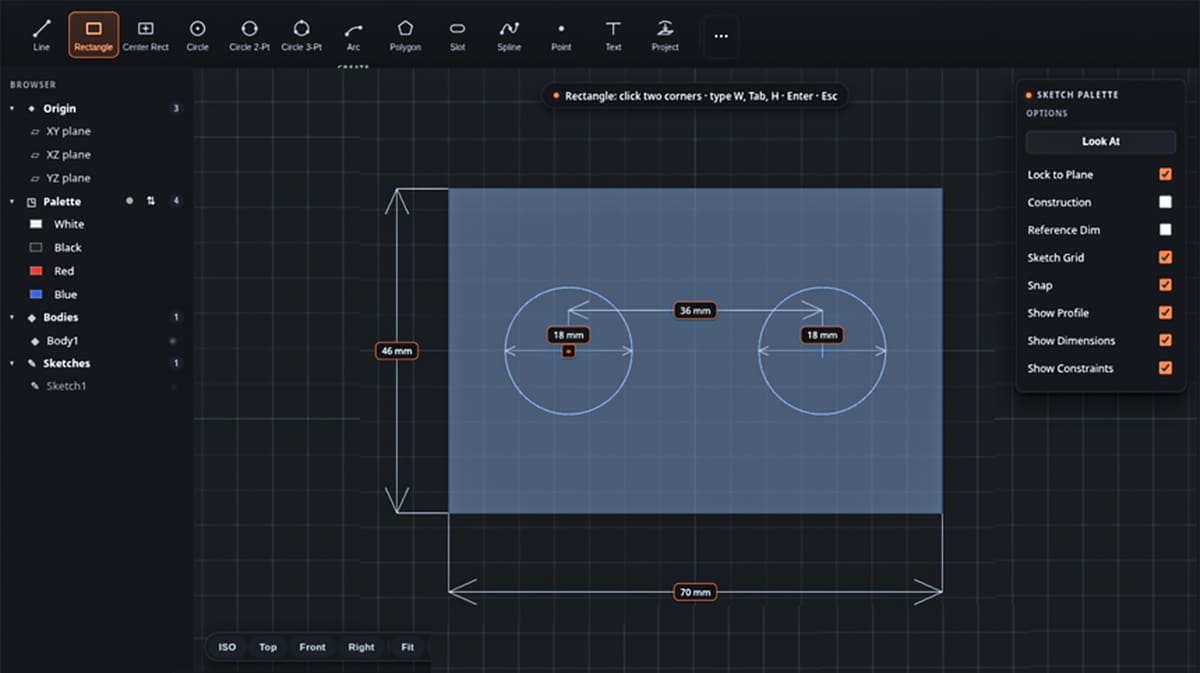
New Free CAD App SindriCAD Beta Makes Surface Textures Real Geometry, Not Just Shading

Step up from TinkerCAD with this open-source parametric modeling tool that turns surface patterns into physical, 3D-printable geometry without needing a subscription—just keep in mind it's still an early beta.
The open-source desktop application targets makers and 3D printing users with editable feature histories, printable surface textures and multi-material export tools.
TinkerAtlas, an independent online community and project-sharing platform for makers developed by Norwegian creator Thomas Haugen, known publicly as MakerViking, just released the public beta of SindriCAD, a free, open-source parametric design application built primarily for makers and 3D printing workflows.
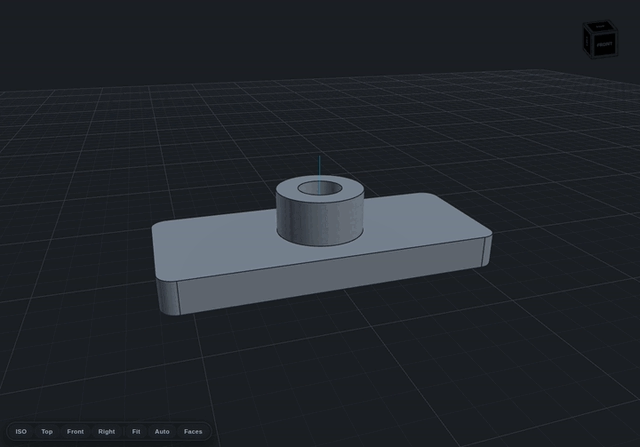
The beta became publicly available on Aug. 2, 2026, with installers offered for Linux, Windows and macOS. The application does not require an account, subscription or trial license, although its developer warns that the current builds are unsigned and may trigger operating-system security warnings.
According to the launch announcement, the project began after Haugen struggled to find a satisfactory replacement on Linux for a professional CAD package used in an existing workflow. The application’s interface and keyboard shortcuts are therefore intended to feel familiar to people who have previously used mainstream parametric CAD software.
Compared with the broader and more technically extensive FreeCAD, SindriCAD prioritizes a streamlined maker workflow. Its standout features include printable surface textures created as real geometry, multi-material 3MF export and an integrated workflow that can transfer models through OrcaSlicer and send print files directly to a Snapmaker U1. FreeCAD offers substantially wider capabilities—including assemblies, technical drawings, CAM, BIM and engineering analysis—but SindriCAD aims to make the path from an editable parametric model to a finished 3D print more direct.
SindriCAD is likely to appeal most to hobbyists and 3D printing users who have outgrown TinkerCAD but do not need—or want to navigate—the full range of engineering tools offered by FreeCAD. It could be particularly attractive to Linux users, multi-color printing enthusiasts who own a Snapmaker U1 since the workflow is tailored to it. The trade-off is maturity: SindriCAD remains a one-developer beta, so it is better suited to experimental and personal projects than work requiring proven stability and comprehensive engineering capabilities.
What Does SindriCAD Do?
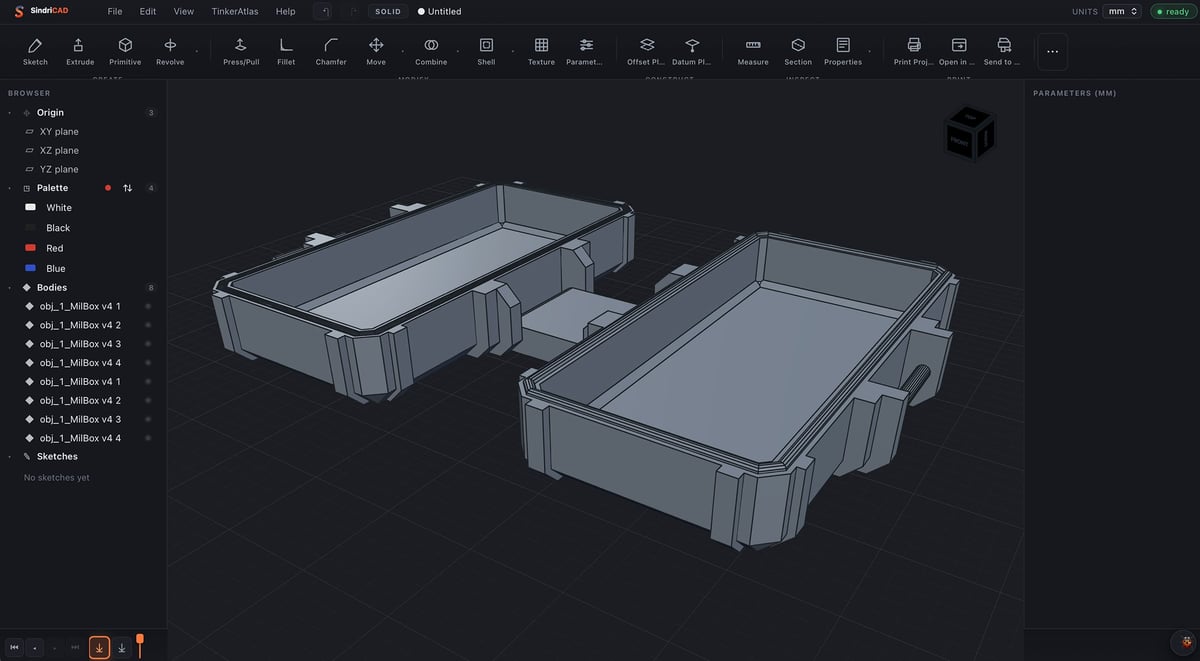
Unlike mesh-modeling programs that primarily manipulate polygonal surfaces, SindriCAD is a history-based solid modeler. Users can create a sketch, turn it into a three-dimensional feature and subsequently edit earlier dimensions or operations through a feature tree. Changes made near the beginning of a model’s history are designed to propagate through later operations.
The current toolset includes extrusion, revolve, loft, sweep, fillet, chamfer, shell, draft, mirror and pattern operations. It also includes constrained sketching, named parameters and mathematical expressions, direct-editing tools, measurements and live section views for inspecting the interior of a part before printing.
One of the project’s more distinctive features is its approach to surface textures. SindriCAD can apply patterns including knurling, hexagons, waves, ribs and Voronoi-style cells as physical geometry rather than as visual-only shading. The developer says this allows textured surfaces to retain their shape when the model is processed by slicing software and manufactured on a 3D printer. Textures can be embossed, cut into a surface or assigned a separate color for multi-material printing.
SindriCAD supports the import of STEP, BREP, STL, 3MF, OBJ and GLB files and can export STEP, STL, 3MF and GLB. It also includes a workflow tailored to the Snapmaker U1: users can assign colors or filament tools, open a project in OrcaSlicer and upload sliced G-code to a printer over a local network. Support for this particular machine is expected to expand as development continues.
Detailing the Open Source

Under the hood, the application uses a Tauri desktop shell and a TypeScript-based interface, according to Haugen. Geometry processing is handled by a Python service using build123d and the OpenCASCADE modeling kernel. The project stores native .sindri documents as JSON containing parameters and an ordered history of modeling features.
The source code is available under the GNU Affero General Public License version 3. The repository’s contribution terms also preserve the maintainer’s ability to offer separate commercial licensing arrangements where required.
The developer is emphasizing that SindriCAD remains beta software rather than a finished substitute for established CAD packages. Users are advised to keep backups of important documents, expect frequent changes and report failures. Windows users may encounter a Microsoft SmartScreen warning, while macOS users must manually approve the unsigned application before it can run.
Development has already continued beyond the initial announcement. A rolling beta identified as version 0.1.84 was published on August 3, adding fixes for startup problems on NixOS and improving diagnostic information when the geometry engine crashes. The project’s release process automatically produces new packages from successful builds of its main development branch.
SindriCAD is currently maintained as a one-person project.
“This is a long haul, not a launch-and-done,” says MakerViking. “If you’d rather wait for the version with the rough edges taken off, there’s a signup on the page for a heads-up when the stable release lands. If you’d rather jump in now and tell me what breaks — even better. That feedback is what shapes the roadmap.”
The developer says operating TinkerAtlas and its related tools costs approximately $335 per month, excluding the value of development time, and is seeking community contributions to sustain continued work. Code signing and notarization for macOS are among the stated funding priorities. These financial figures have not been independently verified.
No target date or formal criteria have yet been published for a stable release. For now, the open beta offers makers an opportunity to test a cross-platform, printing-focused parametric CAD system while also exposing SindriCAD to the reliability, compatibility and usability testing needed to determine whether it can become a dependable long-term alternative.
You May Also Like:

License: The text of "New Free CAD App SindriCAD Beta Makes Surface Textures Real Geometry, Not Just Shading" by All3DP is licensed under a Creative Commons Attribution 4.0 International License.