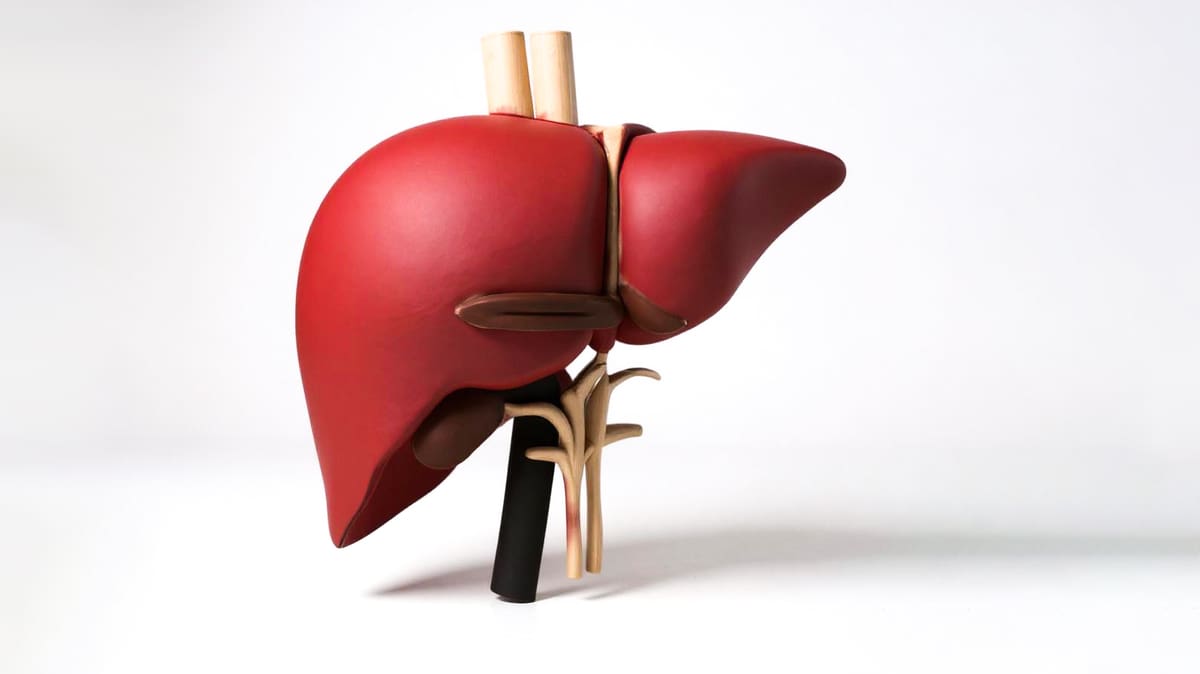
Made-to-Order Organs: New $200M Program Aims to 3D Print Patient-Specific Livers

By reprogramming a patient’s own cells into functional tissue, this multi-year research program aims to eliminate organ waitlists and the need for lifelong anti-rejection drugs forever.
To develop a fully functional, patient-specific, 3D bioprinted liver for transplantation is the ultimate goal of a well-funded group research project with five universities across the U.S.
This project is part of the Personalized Regenerative Immunocompetent Nanotechnology Tissue (PRINT) program funded by the U.S. Department of Health and Human Services, which intends to use state-of-the-art bioprinting technology and a regenerative medicine approach to 3D print personalized, on demand organs, including kidneys, hearts, and livers, that do not require immunosuppressive drugs. In other words, “made-to-order” organs grown from a patient’s own cells.
Ending the Waitlist: How Bioprinting Creates Organs on Demand
“Developing universally matched organs has never been done before in the history of transplantation,” says Alicia Jackson, director of PRINT’s parent agency, the Advanced Research Projects Agency for Health. “Printing a precisely matched, functional human organ will fundamentally change what is possible in transplant medicine and will save countless lives. Through the PRINT program, [we] will strengthen U.S. leadership at the frontiers of biotechnology and biomedical innovation.”
PRINT teams will need to achieve what has to date been impossible in tissue engineering: 3D print a human-sized organ, with all the cells, blood vessels, and tissue materials that allow it to function as a heart, filter blood and produce urine as a kidney, and uphold metabolism as a liver. If successful, the technical advances and platform technologies generated by PRINT will have a tremendous impact on guiding the regeneration of other challenging organs, such as the pancreas and lungs.
Liver failure, a life-threatening condition, claims thousands of lives annually as patients await donor organs. If successful, the project could offer an on-demand source of functional liver tissue for transplantation, potentially saving over 12,000 U.S. patients each year on the waiting list. It could also cut healthcare costs and improve long-term outcomes for those with chronic liver disease.
Beyond Livers: A Future Without Immunosuppressive Drugs
According to study participant Allele Biotechnology & Pharmaceuticals, a San Diego-based technology development and cell manufacturing company: “This innovative approach offers a safe, scalable alternative to traditional transplantation, eliminating the need for donor organs and lifelong immunosuppressant drugs.”
Allele will produce induced pluripotent stem cells, using its patented mRNA reprogramming method in Allele’s GMP facilities dedicated to stem cell–derived therapies. Led by Allele’s founder and CEO, Jiwu Wang, Ph.D., the Allele team will also apply its master gene mRNA platform to generate multiple liver-specific cell types, eventually manufacturing them in quantities reaching tens of billions per organ. mRNA reprogramming uses synthetic messenger RNA (mRNA) to change the fate and function of living cells by instructing them to make specific proteins that alter cell identity and behavior, the ideal cell types for bioprinting.

The joint liver regeneration team is led by Shaochen Chen, a professor at the Univ. of California San Diego Jacobs School of Engineering and an internationally recognized pioneer in 3D bioprinting research and technology.
The project unites specialists in liver biology, imaging, surgery, and artificial intelligence.
“What we are trying to do with PRINT is extraordinarily hard,” says Program Manager Ryan Spitler. “It requires major breakthroughs in cell manufacturing, bioreactor design, and 3D printing technology to reliably build organs that function like the real thing. But if we succeed, we won’t just be giving patients faster access to new organs—we will change the foundation of transplantation itself. The advances from this program could dramatically reduce wait times, eliminate the need for lifelong immunosuppressive drugs, and open the door to bioprinted solutions for many other organs in the future.”
The $26M in funding for Allele and up to $176.8M for the PRINT program is spread over the five-year project.
You May Also Like:


Listen to All3DP’s News Podcast:
License: The text of "Made-to-Order Organs: New $200M Program Aims to 3D Print Patient-Specific Livers" by All3DP Pro is licensed under a Creative Commons Attribution 4.0 International License.