
LS Manufacturing Claims ±0.01 mm CNC Workflow for Medical Implant Components

As 3D printing pushes medical implants into more complex geometries, LS Manufacturing’s latest CNC claims point to the continuing need for machining, inspection, and traceability in implant-related production.
Patient-specific medical implants are often discussed through the lens of 3D printing, particularly for titanium lattice structures, porous bone-ingrowth surfaces, and complex anatomical forms. But additive manufacturing is not the only process shaping the future of custom medical components. For some geometries, materials, and finishing requirements, high-precision CNC machining remains a critical part of the production chain.
China-based LS Manufacturing, an on-demand CNC machining and custom parts supplier, says it has developed a 5-axis CNC workflow for complex medical implant components made from Titanium Grade 23 and PEEK. The company claims the process can achieve tolerances of ±0.01 mm on freeform geometries, with surface finishes down to Ra 0.4 μm.
Those figures are relevant for components where dimensional fit, mating surfaces, screw interfaces, and post-processing requirements are critical. In medical manufacturing, however, tolerance is only one part of the equation. Material traceability, cleanliness, validation, surface chemistry, inspection, and regulatory compliance all determine whether a component can be used in a clinical context.
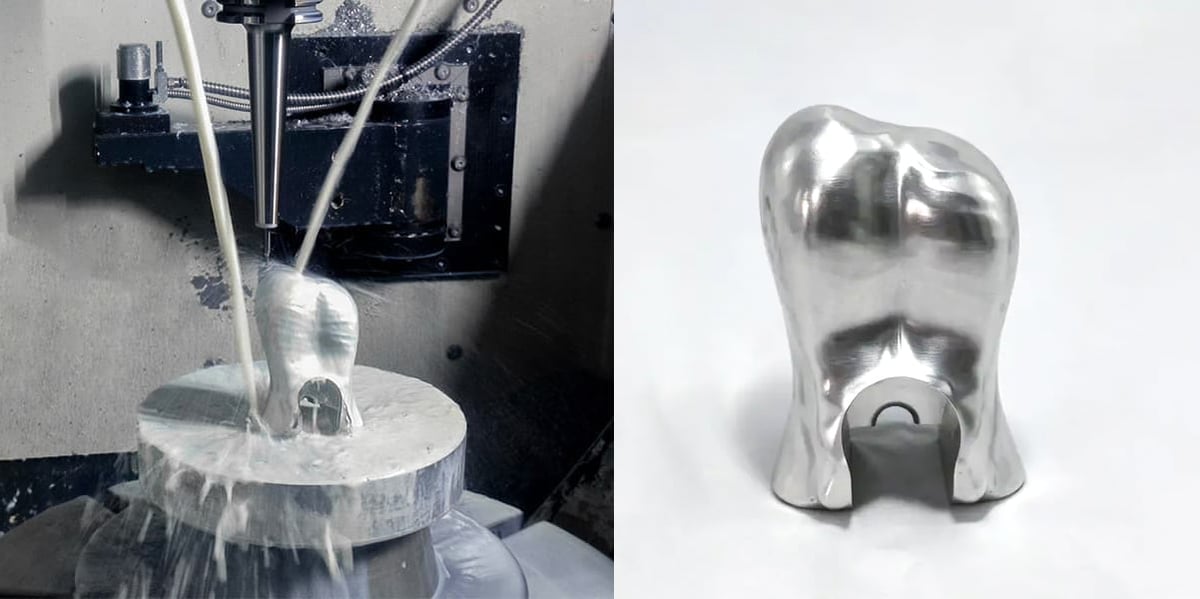
LS says its workflow combines simultaneous 5-axis milling with optimized toolpaths designed for organic geometries, including customized bone plates and joint-replacement-related components. These shapes can be challenging for conventional 3-axis machining because of undercuts, curved surfaces, and the need to maintain tool access across complex anatomical forms.
LS says its quality team includes more than 30 quality engineers and uses more than 20 inspection tools, including coordinate measuring machines, 2D measurement systems, XRF analyzers, and 3D optical inspection, to verify dimensional accuracy and material integrity.
For medical and life-sciences manufacturing, LS lists capabilities across functional prototypes, surgical instruments, orthopedic implants, prosthetic elements, dental apparatus, and other clinical or diagnostic components. The company also says it works with medical-grade PEEK, PPSU, silicones, titanium, and 316L stainless steel.
The development highlights the complementary roles of additive and subtractive manufacturing in patient-specific medical production. Additive manufacturing can create porous structures, internal channels, and highly complex forms that may be impossible or inefficient to machine. CNC machining, by contrast, can deliver tight tolerances, smooth functional surfaces, and repeatable features on dense materials such as titanium and PEEK.
That distinction is especially important in medical manufacturing. A printed titanium implant may still require machining for precision interfaces, while a machined PEEK or titanium component may be preferable when the design does not require additive-only features. In hybrid workflows, CNC can also be used for finishing, drilling, polishing, and bringing critical surfaces within specification.
LS Manufacturing says it produces parts through its own facility as well as a network of manufacturing providers in China.
The announcement points to a broader trend in custom implant manufacturing: even as 3D printing expands what is geometrically possible, precision machining remains central to making complex medical components manufacturable, measurable, and repeatable.
License: The text of "LS Manufacturing Claims ±0.01 mm CNC Workflow for Medical Implant Components" by All3DP is licensed under a Creative Commons Attribution 4.0 International License.