HP Enters the FDM Market with Familiar Hardware

The tech giant wants to offer an affordable entry point. Eagle-eyed engineers will notice the "new" machines look suspiciously like 3DGence workhorses.
HP Additive Manufacturing is branching out. The famed Multi-Jet Fusion maker is adding two filament (FDM) 3D printers to its polymer lineup hoping to lure new customers with a lower-cost entry point to 3D printing.
According to HP, the new machines are aimed at customers in demanding sectors, such as aerospace, oil and gas, medical devices, automotive, rail, and education. In short, they’re going up against Stratasys, Markforged, Roboze, MiniFactory, and Aon3D for the high-temp, engineering-grade filament niche.
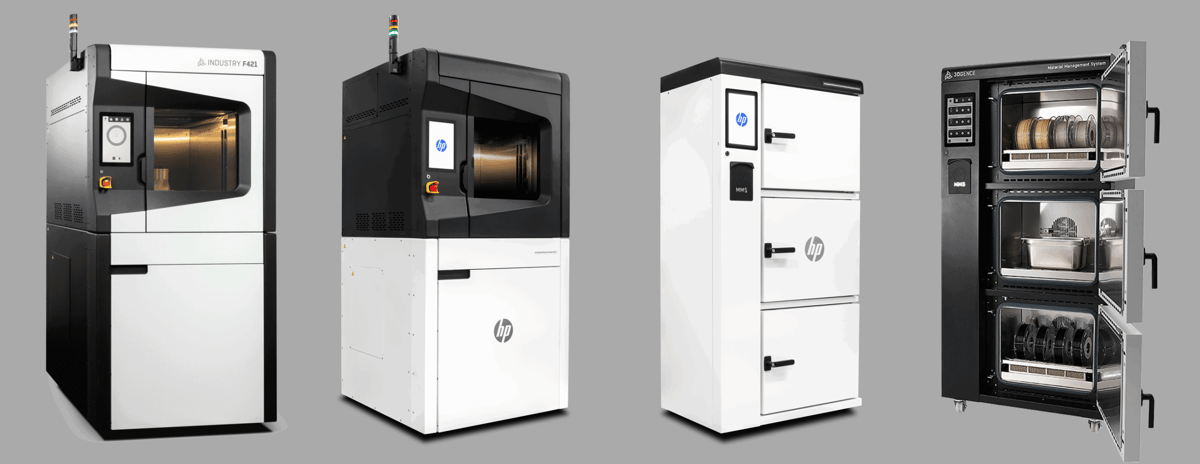
But if these machines look a bit familiar, there’s a good reason: they are from 3DGence. HP told All3DP that it couldn’t disclose whether it was acquiring the Texas-based high-temperature FDM maker or just white-labeling their machines (like they’ve done recently with Peel3D scanners), but they do still look quite the same. On the inside, though, HP says the two new FDMs have certifications and security features that the 3DGence versions do not.
From HP’s point of view, I can imagine that there’s no reason to reinvent the wheel when there’s a perfectly good industrial FDM maker that could certainly benefit from a giant like HP distributing its hardware.
But why enter the increasingly competitive high-temp FDM market now?
HP’s MJF machines are, most often, hardware that companies upgrade to from a starting point like FDM. Controlling that journey may lead more customers to MJF or the company’s Metal Jet offering. By adding high-temp FDM to its portfolio, HP can finally say “yes” to clients demanding certified flight-ready materials (PEEK, Ultem), preventing them from defecting to competitors like Stratasys.
Although, HP machines are prized for volume production, customers must go to a competitor for high-strength tooling or large-format prototypes. By white-labeling proven hardware, HP instantly creates a more complete polymer ecosystem.
If HP is indeed rebranding 3DGence machines, they have bypassed the growing pains of hardware development. They get a mature, market-proven product to test the waters in the FDM segment with virtually zero technical risk, leveraging their massive global sales and support network to scale distribution where a smaller player like 3DGence could not.
These large-build-volume, high-temperature, highly automated machines are capable of printing engineering-grade and composite materials. There’s no word yet if the HP versions of the 3DGence hardware offer any upgrades or modifications.
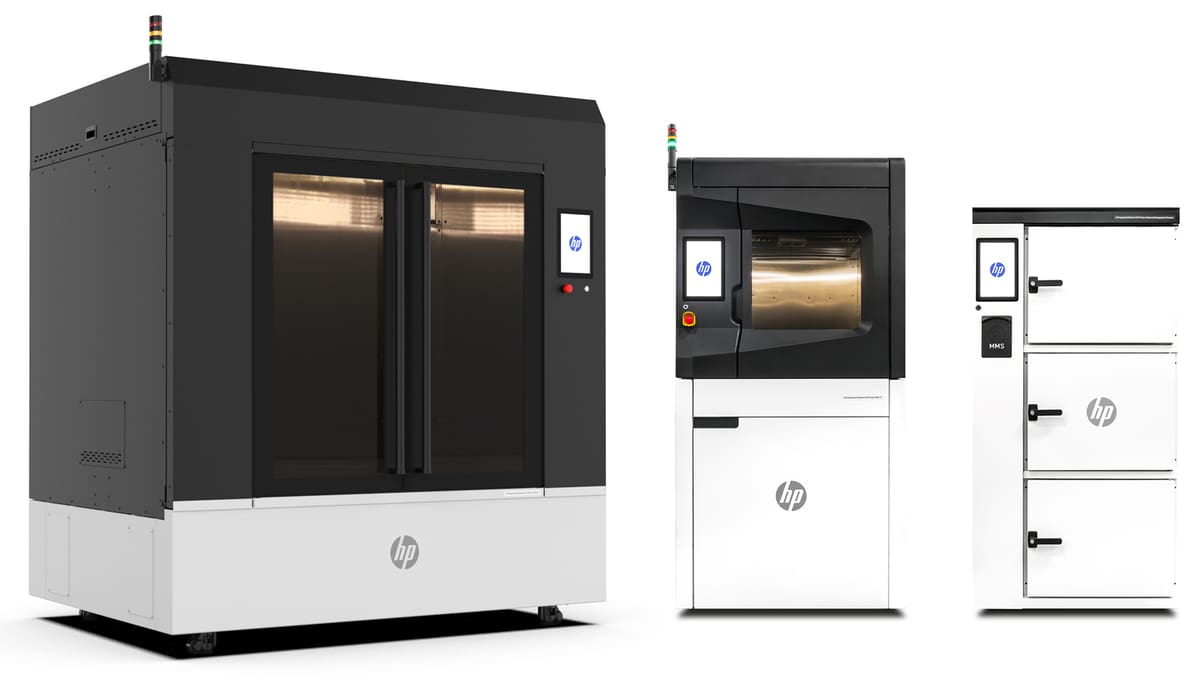
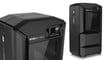
The first printer HP is launching is the HP Industrial Filament 3D Printer 600 High Temperature (or HP IF 600HT for short), shown above, second from left. From the looks of thing, this is the 3DGence Industry F421, launched in 2021.
A distinguishing feature of 3DGence machines are their swappable print-head modules that you can change depending on which engineering-grade material you want to use. This feature enables you to print with everything from PLA to reinforced materials to PEEK on a single machine without having to clean out your print heads. Very convenient.
The F421 is a high-speed PEEK printer boasting a print speed up to 400 mm/s and 1 meter per second of travel time. Like other industrial printers at this level, the F421 offers a heated filament dryer, automatic bed leveling, a heated ceramic build plate, and interconnectivity. There’s also a convenient material manager that automatically detects which filament is loaded and checks information, such as weight, type, color, and amount of remaining filament loaded.
The HP IF 600HT is slated to be available in the first half of 2026. HP hasn’t released a price, but the 3DGence Industry F421 was available for around $80K.
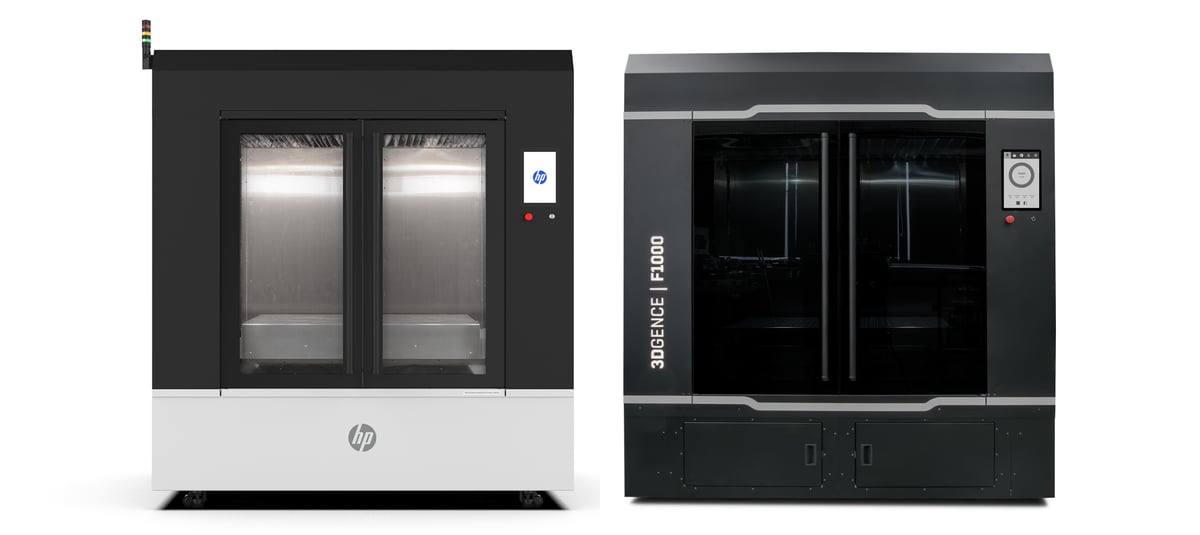
A second system, targeted at producing high-quality large-format parts is the HP Industrial Filament 3D Printer 1000 XL (HP IF 1000 XL). This version is expected to be available in the second half of 2026. If our assumptions are correct, and this is the 3DGence Industry F1000, then it has all the benefits of the F421 but with a roomy 1,000 x 600 x 800 mm build volume. There is also a suite of software available for both machines.
A key element of the lineup, HP says, is the open materials platform designed to give industrial users the flexibility to innovate with a wide range of polymers. 3DGence machines print with Solvey and Victrex filaments, in addition to in-house manufactured materials.
[[Update: This article has been updated to mention the certifications and security features on the HP versions of the 3DGence machines.]]
You May Also Like:

Tired of Reading? Try Listening
License: The text of "HP Enters the FDM Market with Familiar Hardware" by All3DP Pro is licensed under a Creative Commons Attribution 4.0 International License.