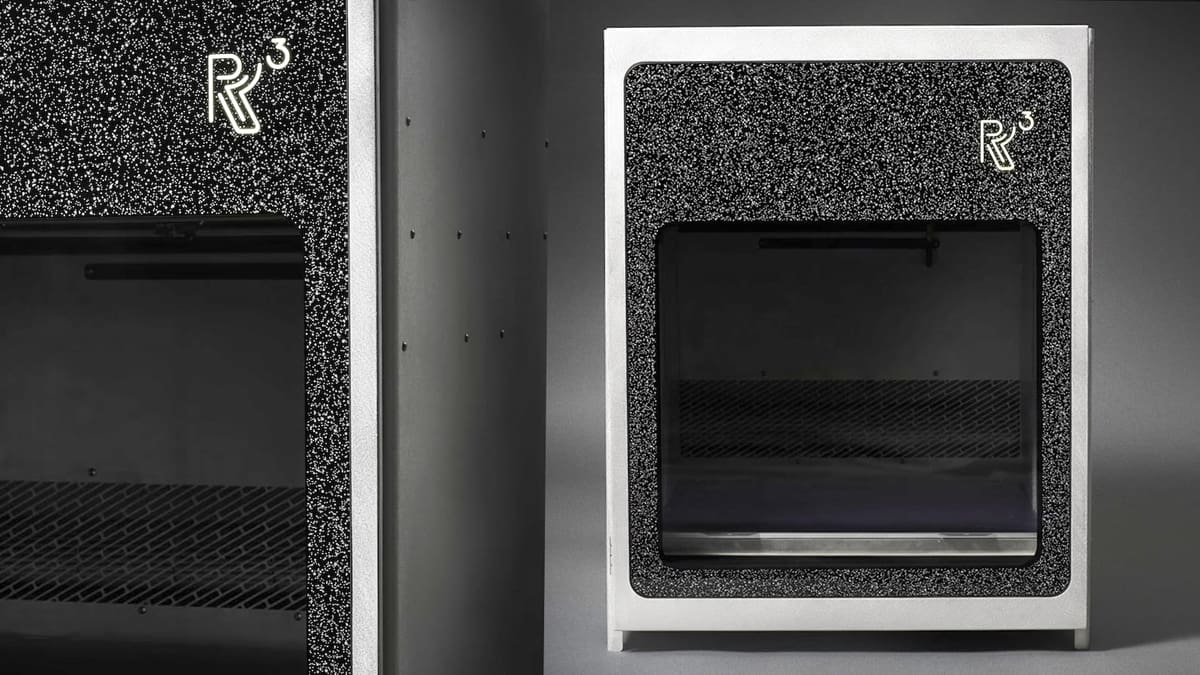
Fed Up With Enterprise FDM, Print Service Owners Built the $29.5K, 500°C R3 Printer to Challenge Market Giants

Los Angeles-based R3 Printing debuts a pair of liquid-cooled, open-material FDMs made in the USA and engineered for reliable, cloud-optional production.
Fed up with unreliable desktop setups and overpriced enterprise systems that lock out smaller businesses, two California 3D printing service owners decided to build their own solution. After eight years in development, Los Angeles-based R3 Printing has just launched a pair of high-temp, dual-nozzle FDM workhorses engineered to “challenge the additive manufacturing status quo.”
Company co-founders Paul Sieradzki and Petra Wood say they experienced firsthand where existing FDM machines fell short in real production environments: “Desktop printers were unreliable and labor-intensive, while enterprise systems were designed and priced for a world that shut out the businesses they were claiming to serve.”
R3 Printing says its two new machines are focused on reliability, usability, and long-term value “rather than feature checklists and marketing claims.”
The R3’s Features
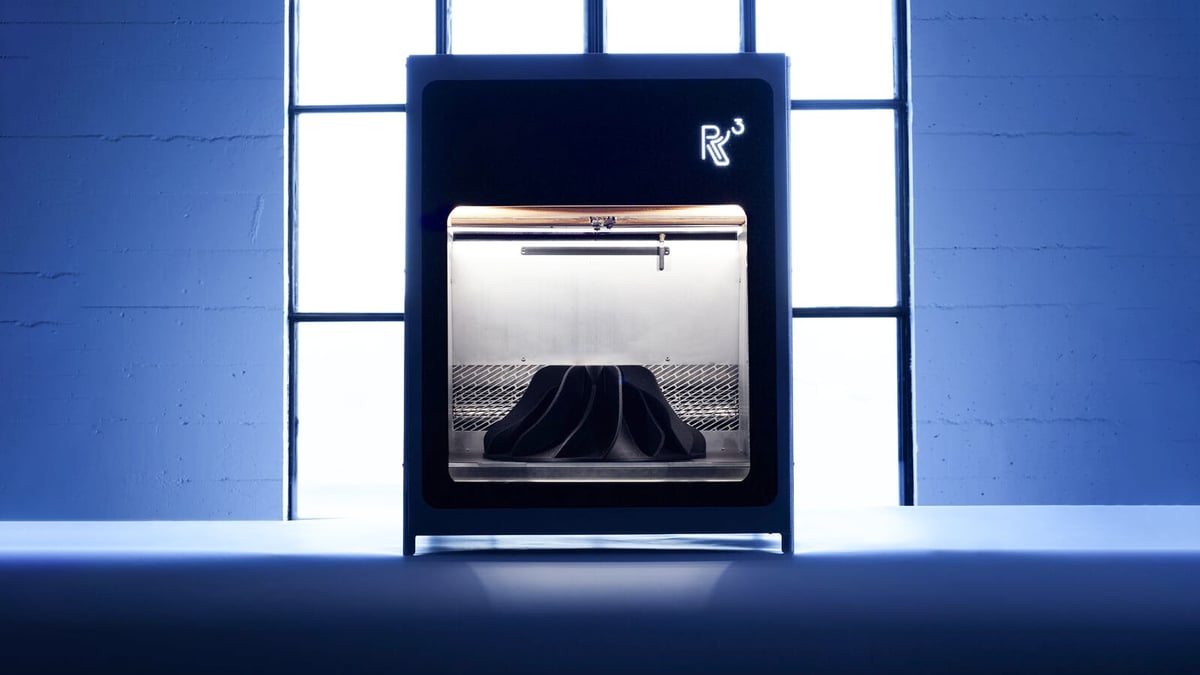
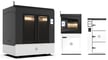
The R3 at $29,500 with a 450 x 370 x 370 mm build volume, is a desktop FDM with dual-nozzles that reach 500 °C accommodating materials including carbon-fiber nylon. There’s an all-aluminum frame and panels, quick swap nozzles, and a liquid cooled print head. It’s a dual-material printer only, no multi-material filament changing by design focusing mainly on production of single-material parts with support material.
Yet, even for a workhorse, it has the automation and detection features FDM users have come to expect. A liquid-cooled print head enables long, uninterrupted production runs even at elevated chamber temperatures, the company says, while “active overheat prevention” monitors for heat creep and other sources of jams. There’s “continuous self-monitoring” that detects issues early and takes preventative action “before prints are compromised, while material runout and jam detection reduce downtime, limit waste, and enable long, unattended print cycles.”
A dedicated chamber heater and actively cooled dual-insulated chassis maintain stable thermal conditions for production 3D printing.
The Higher Temp, PEEK Enabled Ultra
The R3 Ultra at $49,500 is identical to the R3 but with a hotter chamber and build plate to accommodate more advanced materials including PEEK, PEKK, and Ultem.
Both machines are open materials and “built on open foundations and refined for production use”, the company says. Slicer profiles for, presumably Orca Slicer and Prusa Slicer, are provided. Both printers have Ethernet, WiFi, and USB connectivity and can run entirely offline, enabling deployment in secure environments, isolated networks, or tightly managed production floors.
On paper, the R3 Printer’s competition appears high-temperature industrial FDMs like the Intamsys Funmat Pro 410 (~$28K) or the CreatBot PEEK-300 (~$20K) , which both have similar build volumes and temperature profiles. The R3 Printer Ultra, meanwhile, moves into territory more comparable with HP’s new IF 600HT ($100K) and Stratasys’ Fortus 450mc (~$160K) systems, both of which have a much larger footprint.
Notably, the published specifications do not list a touchscreen or onboard control panel. Instead, R3 appears to lean on networked and local computer-based operation, with Ethernet, WiFi, access-point, direct Ethernet, and USB connectivity listed, and all functions available without cloud or internet access.
Technical Specifications
R3 Printer is available now and the R3 Ultra will begin shipping on Aug. 31.
You May Also Like:
License: The text of "Fed Up With Enterprise FDM, Print Service Owners Built the $29.5K, 500°C R3 Printer to Challenge Market Giants" by All3DP Pro is licensed under a Creative Commons Attribution 4.0 International License.