Divergent Bets Big on Defense with Massive New Printer & 64-Machine 3D Printing Super-Factory

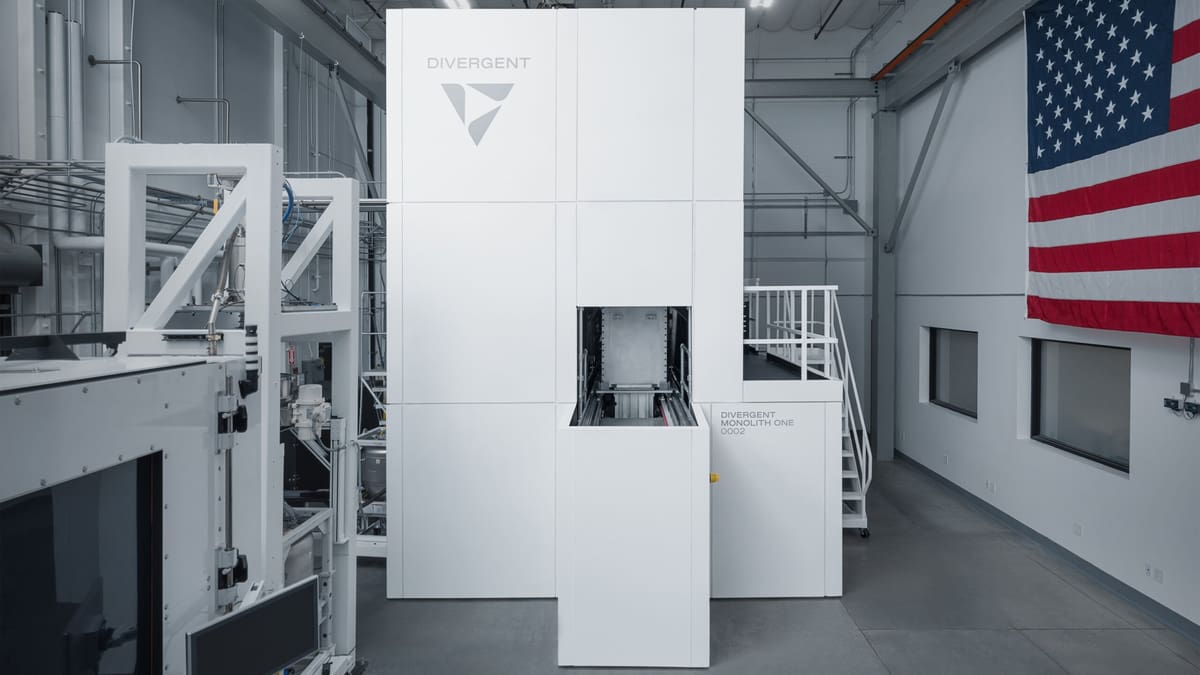
The 'Monolith One' is a laser powder bed fusion 3D printer with 24 kW of laser power, which Divergent plans to use for defense and automotive part production. No, it's not for sale.
California-based Divergent Technologies is betting on a massive volume of defense work, manufacturing cruise missiles and drones for the U.S. government with its new large-format laser powder bed fusion (LPBF) system developed for use within its own factory, plus a planned 430,000-square-foot second facility.
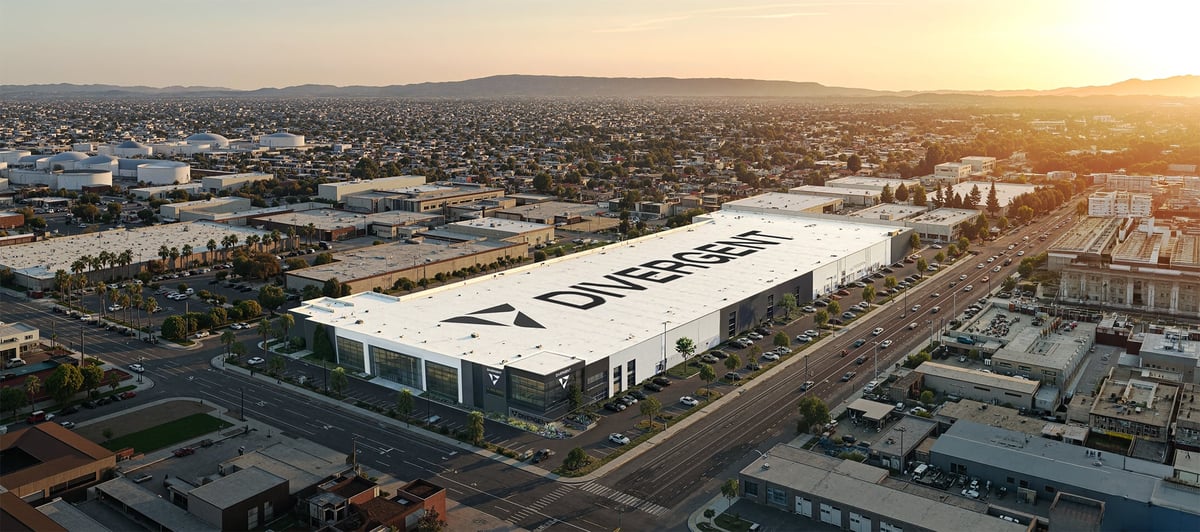
The new Long Beach factory is expected to house a staggering 64 ‘Monolith One’ 3D printers. Divergent says it will bring those machines online over the next 24 months, supplementing six already operating at its Torrance headquarters.
The Monolith One is not being offered for sale or licensing. Instead, Divergent intends to use it as part of its own vertically integrated manufacturing system that combines computational design, additive manufacturing, and automated assembly.
According to the company, each machine has 12 2-kW lasers, providing 24 kW of total laser power in a 700 × 700 × 835 mm build volume.
Divergent says the machine can process common industrial aluminum, nickel, steel, and titanium alloys. Other stated features include four-axis scanners with adjustable laser spot sizes, active build-plate heating and cooling up to 200 °C, interchangeable build modules, closed-loop powder handling, and a gas-flow system rated at up to 1,700 cubic meters per hour.
The company claims Monolith One delivers roughly twice the throughput of “existing printers,” but did not identify the systems, materials, geometries, layer parameters, or measurement methods used for that comparison or who it was comparing to. There is a long list of larger printer and several with more lasers.
Divergent, as a 3D printing service, said the decision to build its own printer as a way to exercise tighter control over the complete production process rather than rely on commercially available additive manufacturing equipment. (Beehive Industries, an American manufacturer of jet engines, this week announced it’s purchasing 30 EOS M4 ONYX metal LPBF systems to service major defense program demand.)
Divergent says its planned the Long Beach operation will contain 400,000 square feet of manufacturing and assembly space. At full capacity, the company expects the site to support approximately 1,000 direct jobs, and manufacture more than 275,000 individual parts, ranging from missile airframes to warhead casings and automotive systems.
Defense is Central to Expansion
Divergent says its platform supplies structures for customers including Lockheed Martin, RTX, and CoAspire, and it repeatedly emphasizes planned capacity for new defense applications. Automotive components remain part of the stated production mix, but the Long Beach announcement places considerably greater emphasis on military manufacturing.
CEO and co-founder Lukas Czinger described Monolith One as the first metal 3D printer designed from the ground up for scaled production of critical hardware. As with the company’s broader superlatives, no market-wide evidence was included.
Nevertheless, the project represents an unusually ambitious example of vertical integration in metal additive manufacturing. Rather than buying machines from an established equipment supplier, Divergent is developing the printer, software, production processes, and assembly infrastructure as one internal system.
Whether that approach produces the claimed improvements in cost, throughput, reliability, and lead time will be clearer once Divergent releases comparable operating data or the Long Beach factory begins sustained production. For now, Monolith One’s specifications are striking, but its most consequential performance claims remain assertions the manufacturer hopes to prove out in the next few years.
You May Also Like:

License: The text of "Divergent Bets Big on Defense with Massive New Printer & 64-Machine 3D Printing Super-Factory" by All3DP Pro is licensed under a Creative Commons Attribution 4.0 International License.