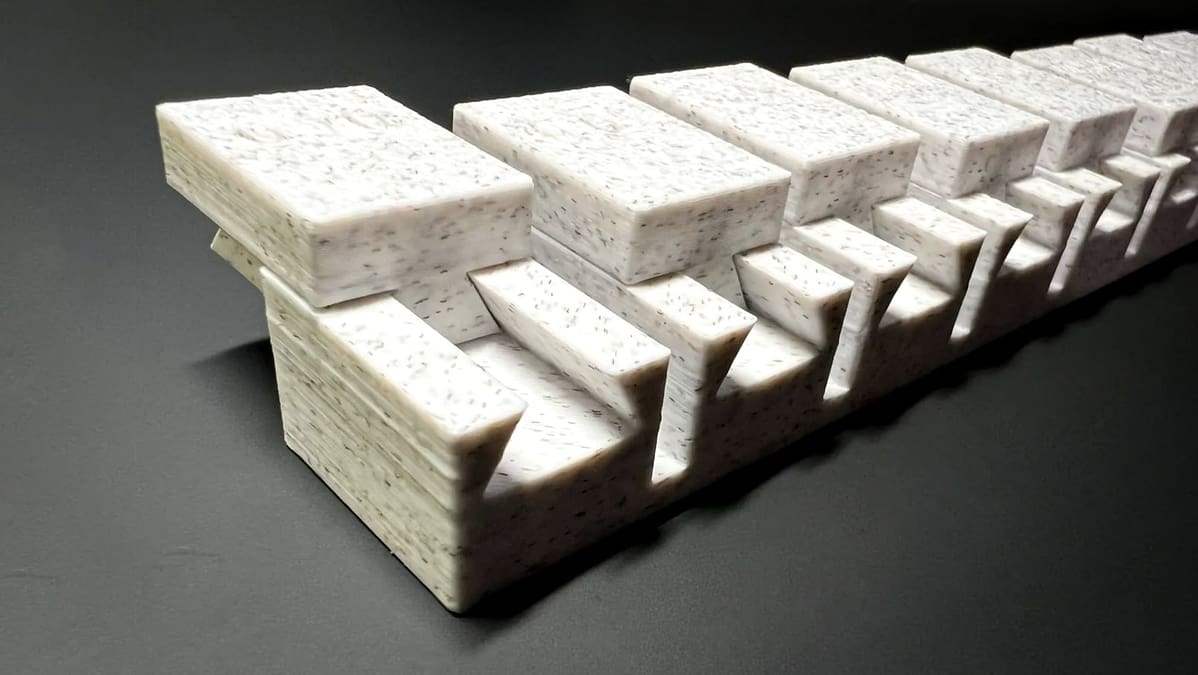
No More Glue? Researchers Find C-Shaped Joints Outperform Dovetails in PLA Prints

Testing three interlocking joint designs for PLA part strength, researchers find that the shape and size of a connection makes a big difference.
What if you could assemble 3D printed parts without reaching for glue, screws, or other fasteners? Researchers in Ireland have taken inspiration from traditional Japanese woodworking to explore how interlocking plastic components might make that possible. Plus, some slicers will already automate this for you.
Borrowing from Woodworking
In a study just published in Results in Engineering, researchers from the University of Galway and Atlantic Technological University investigated three joint designs for PLA 3D printed parts inspired by Japanese joinery: dovetail, C-shaped, and T-shaped connections.
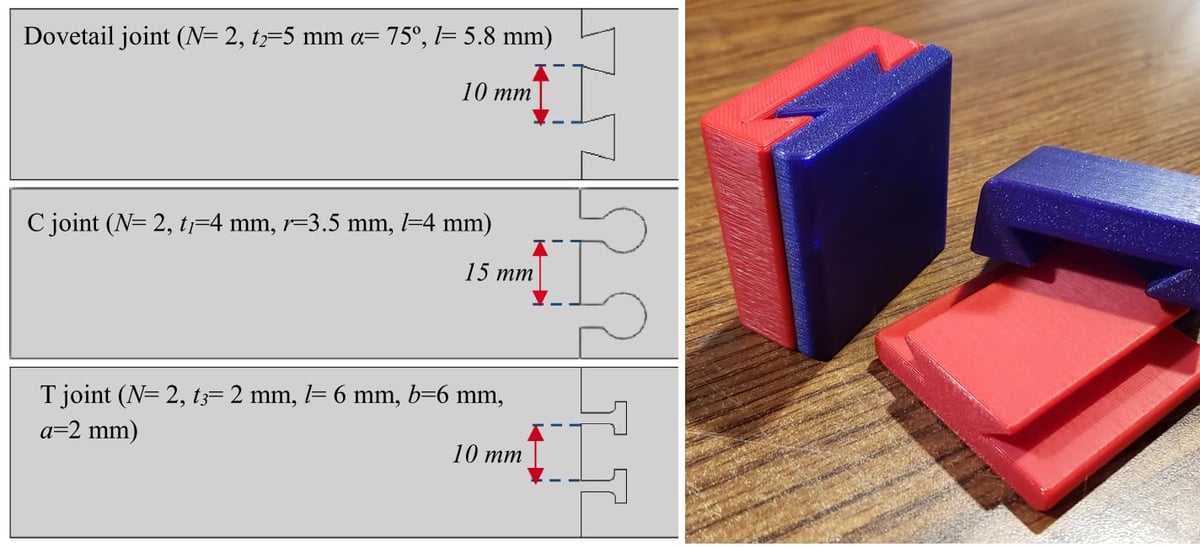
Using a Prusa MK4 and PLA filament, the team produced 135 test assemblies, experimenting with different joint dimensions, angles, and numbers of interlocking features. The specimens were printed at a 0.2-mm layer height with 100% infill before being subjected to tensile tests to see how much pulling force they could withstand.
The C-shaped joint emerged as the strongest of the tested configurations. A version with a 5-mm neck thickness achieved a tensile strength of 7 MPa, outperforming the T-shaped and dovetail designs.
Interestingly, bigger wasn’t necessarily better. Increasing the C-joint’s neck thickness to 7 mm actually reduced its tensile strength. Adding more interlocking features also produced mixed results, improving some joint designs while weakening others.
The C-shaped joint with a 5-mm neck proved the strongest, achieving a tensile strength of 7 MPa, although that's still just 15.8% of the strength of a continuous, unjoined PLA specimen.
There’s a significant catch, however. Even the strongest joint achieved only about 16% of the tensile strength of a continuous, unjoined PLA specimen, which reached 44.4 MPa.
For 3D printing enthusiasts, the research offers useful insights into designing modular objects, replaceable components, and assemblies that don’t require additional hardware. However, to make C-joints, you’ll need CAD software since most automated tools currently lack this specific design.
Your Slicer Will Make Dovetails
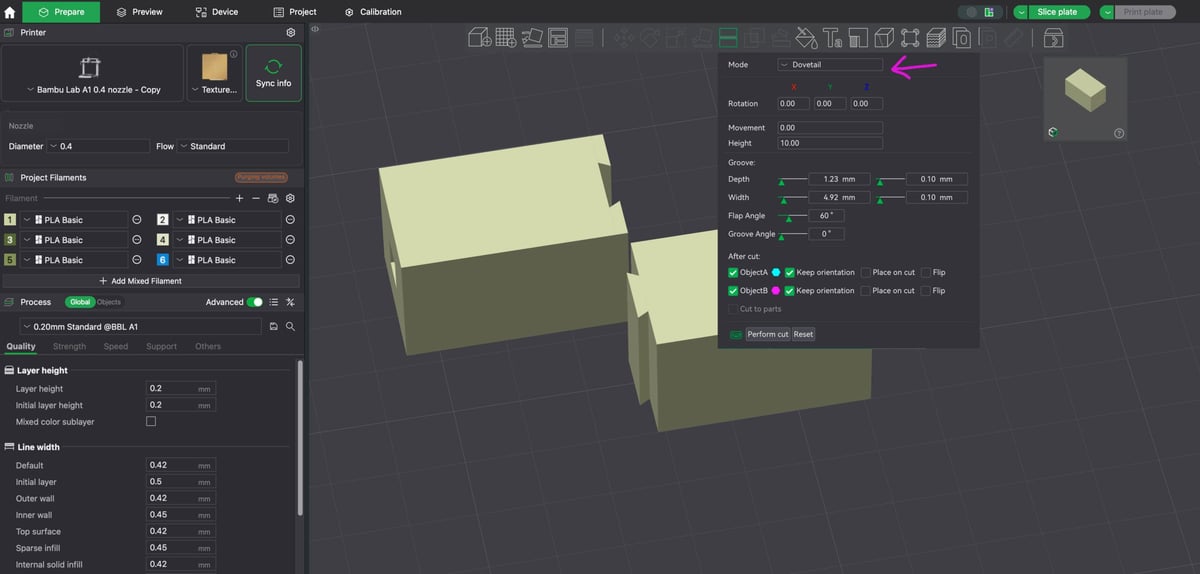
For hobbyists interested in experimenting with interlocking joints, some of the necessary tools are already available in popular 3D printing software. PrusaSlicer, OrcaSlicer, and Bambu Studio all feature a dovetail cutting mode that can automatically generate matching dovetail connections when splitting a model into printable parts. Cura users can access similar functionality through third-party plugins.
The increasingly popular automated model-splitting tools, like Meshy, Tripo, and ModelSplitter, however, offer much simpler dowel or plug connections that require glue.
The C-shaped and T-shaped joints investigated in the study are a different matter. These geometries aren’t currently standard options in popular model-splitting software, meaning hobbyists would need to design them manually using CAD software. The research could eventually help developers introduce more sophisticated joint-generation tools, potentially allowing users to choose connections based not just on ease of assembly, but also on their mechanical strength.
So while Japanese-inspired joinery isn’t about to replace every screw in your printed projects, the study offers some interesting design lessons for anyone looking to make parts that fit together.
You May Also Like:



License: The text of "No More Glue? Researchers Find C-Shaped Joints Outperform Dovetails in PLA Prints" by All3DP is licensed under a Creative Commons Attribution 4.0 International License.