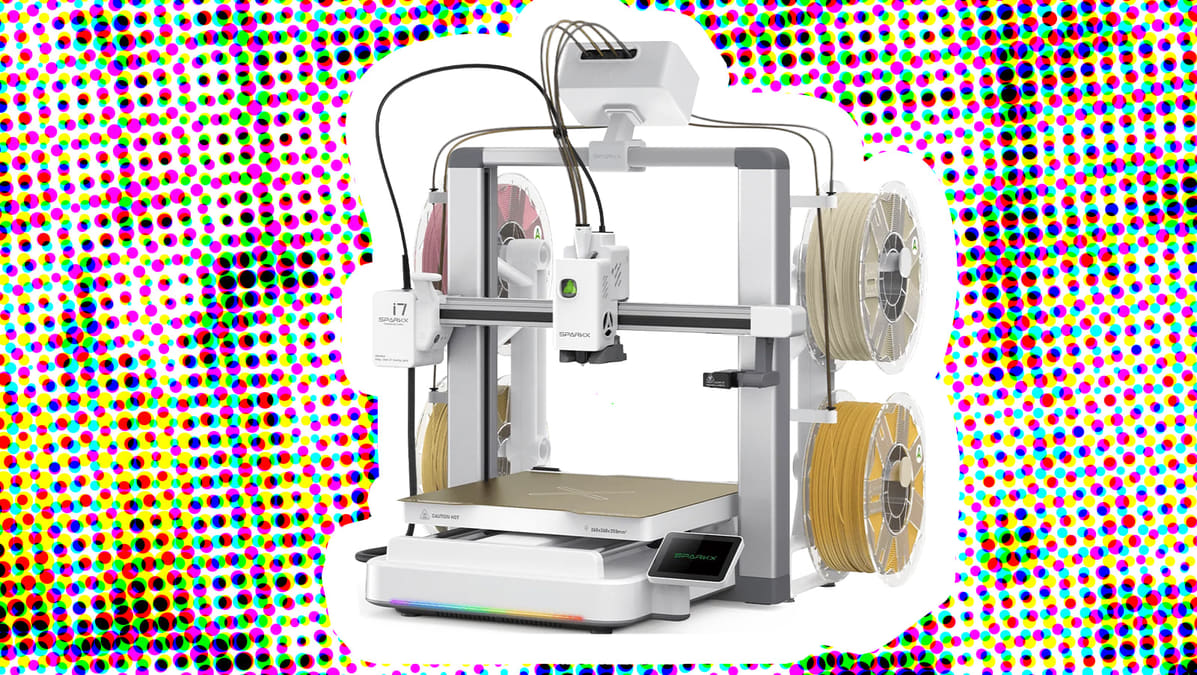
Creality’s New SparkX i7 Nano Packs Four-Color Printing Into a $299 Package

Creality’s new Nano shrinks its multicolor setup by 37%, but sacrifices enclosed filament storage and support for flexible materials like TPU.
Creality just added another machine to its beginner-focused SparkX lineup, launching the SparkX i7 Nano ($299), a four-color-capable desktop 3D printer built around a more compact filament setup than the original i7 Color Combo that launched in January.
Despite the name, the “Nano” treatment doesn’t mean a smaller printer or reduced build volume. Creality’s current product page groups the SparkX i7 Nano Combo alongside the Color Combo, Autofill Combo, and standalone SparkX i7, and even notes that Nano Combos may ship as an “i7 + CFS Nano i7 Kit.” In other words, the main news here is the filament-handling hardware around the existing i7 platform.
A 37% Smaller Multicolor Setup
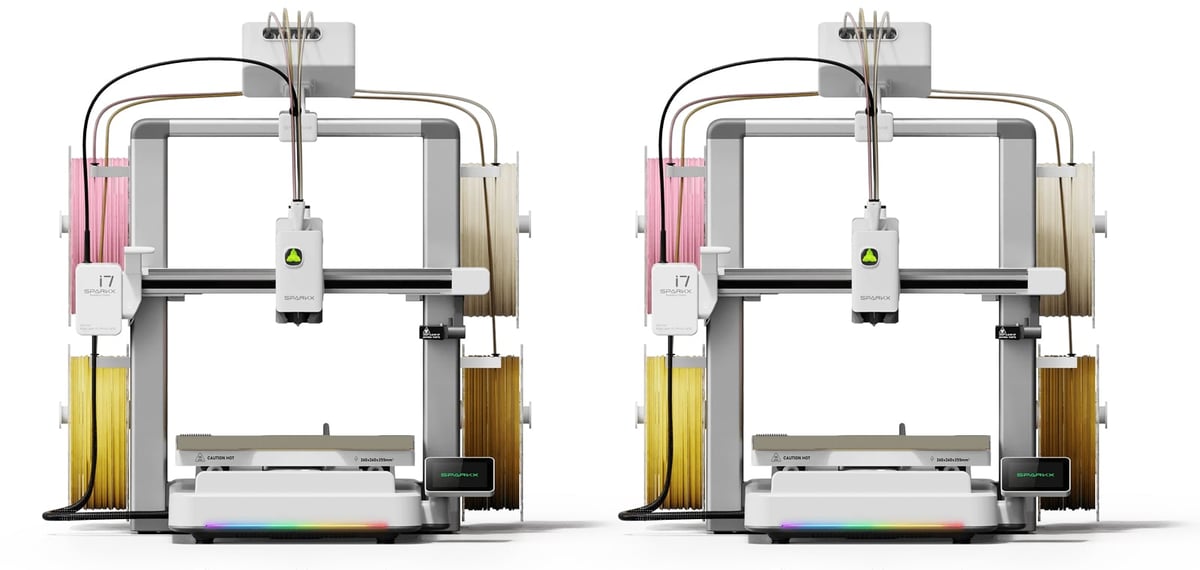
The most obvious change is the filament layout. Instead of relying on the large CFS Lite enclosure positioned beside the printer, the Nano uses an integrated, snap-on spool-holder arrangement and an optimized filament path. Creality says the change reduces the desktop space needed by 37% compared with the external CFS Lite box.
Four-color printing is handled by the new CFS nano, or Creality Filament System nano, which mounts above the printer. Creality describes it as a dual-motor system: one motor selects between filament channels, while another handles filament feeding and retraction. The company’s specification table accordingly lists one filament-feeding motor; the second motor performs the channel-switching job.
The CFS nano has four filament slots and supports automatic filament loading and unloading, runout detection, pre-loading, and automatic filament refill. Creality’s launch announcement also specifies RFID filament reading for the Nano setup as optional. The CFS nano itself measures just 127 x 85 x 65 mm and weighs 445 g, with the filament spools stored openly rather than inside an enclosure.
The i7 Underneath Is Familiar
The printer retains the SparkX i7’s 260 x 260 x 255 mm build volume, with a claimed maximum print speed of 500 mm/s. Creality’s current specification sheet also gives it acceleration of up to 10,000 mm/s².
A hardened-steel nozzle comes fitted as standard. The hotend reaches 300 °C, while Creality supports 0.2, 0.4, 0.6, and 0.8 mm nozzle diameters. The build plate is a dual-sided textured PEI sheet, the bed reaches up to 100 °C, and the printer uses full-auto leveling alongside input shaping and Pressure Advance.
The i7’s toolhead is also designed with maintenance in mind. Creality lists a tool-free quick-swap hotend along with easily replaceable extruder-lever and filament-cutter components. The printer uses direct-drive extrusion and includes filament runout detection, power-loss recovery, and cutter-wear monitoring.
There’s plenty of automation beyond the mechanics, too. The built-in 720p AI camera monitors prints, with Creality specifically calling out spaghetti and air-printing detection in the Nano announcement. Its current i7 specifications additionally list filament-tangle and build-plate detection. There’s also a rotating privacy cover for the camera.
Creality’s CubeMe feature also returns, using AI to turn 2D portrait images into multicolor 3D models. The i7 additionally has a 2.85-inch color touchscreen, Wi-Fi and USB file transfer, 8 GB of internal storage, programmable RGB status lighting, and Creality OS. Creality Print 6.3 or newer is listed as the supported slicer.
So, What Changed From January’s SparkX i7?
The January SparkX i7 Color Combo used the CFS Lite, and that filament system is where the meaningful differences lie. The CFS Lite measures 362 x 227 x 364 mm and weighs 3.42 kg, compared with 127 x 85 x 65 mm and 445 g for the CFS nano. Creality’s January documentation recommended allowing 876 mm of horizontal space for the i7 Color Combo and its separately positioned CFS Lite.
Shrinking the system does involve some trade-offs.
The CFS Lite encloses its four spools and uses desiccant for filament storage, while the CFS nano leaves its spools open. The Lite also has four dedicated feeding motors and supports PLA, PETG, PLA-CF, and sufficiently hard TPU. Creality lists the Nano for PLA, PETG, and PLA-CF. Both systems support up to four-color printing and automatic filament refill, and neither can be expanded by connecting multiple matching CFS units.
That makes the Nano less a replacement for the SparkX i7 than a more compact way of configuring it for multicolor printing: it trades the CFS Lite’s enclosed filament storage and broader listed material support for a much smaller and lighter filament system.
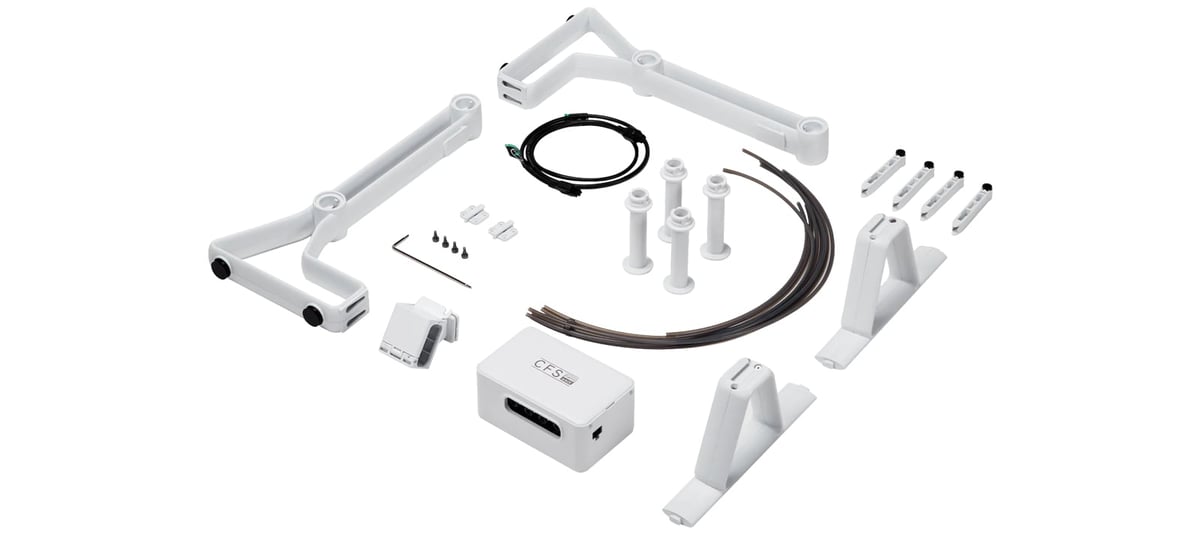
Existing i7 owners don’t have to replace their printers to get the new setup, either. Creality says the CFS nano can be installed on existing SparkX i7 units without extensive modification, and its support documentation includes a dedicated retrofit procedure. Firmware released in July added CFS nano support to the i7. Creality’s US store also lists the standalone Spark i7 CFS Nano Kit for $69, including the CFS nano, mounting bracket, spool-holder assembly, cable, PTFE tubes, installation hardware, and other fitting parts.
Price and Availability
Creality announced the SparkX i7 Nano with CFS nano Kit for $299 in the US, effective August 15. The company’s US store currently also lists the Nano at $299, although the product listing carries an August 28 ETA at the time of writing. The separately sold $69 CFS Nano Kit is likewise currently marked with an August 28 ETA.
For owners of the original i7, that $69 retrofit option may ultimately be the more interesting part of the announcement: Creality hasn’t really made the i7 itself Nano. It has made its four-color filament setup a whole lot smaller.
You May Also Like:

License: The text of "Creality’s New SparkX i7 Nano Packs Four-Color Printing Into a $299 Package" by All3DP is licensed under a Creative Commons Attribution 4.0 International License.