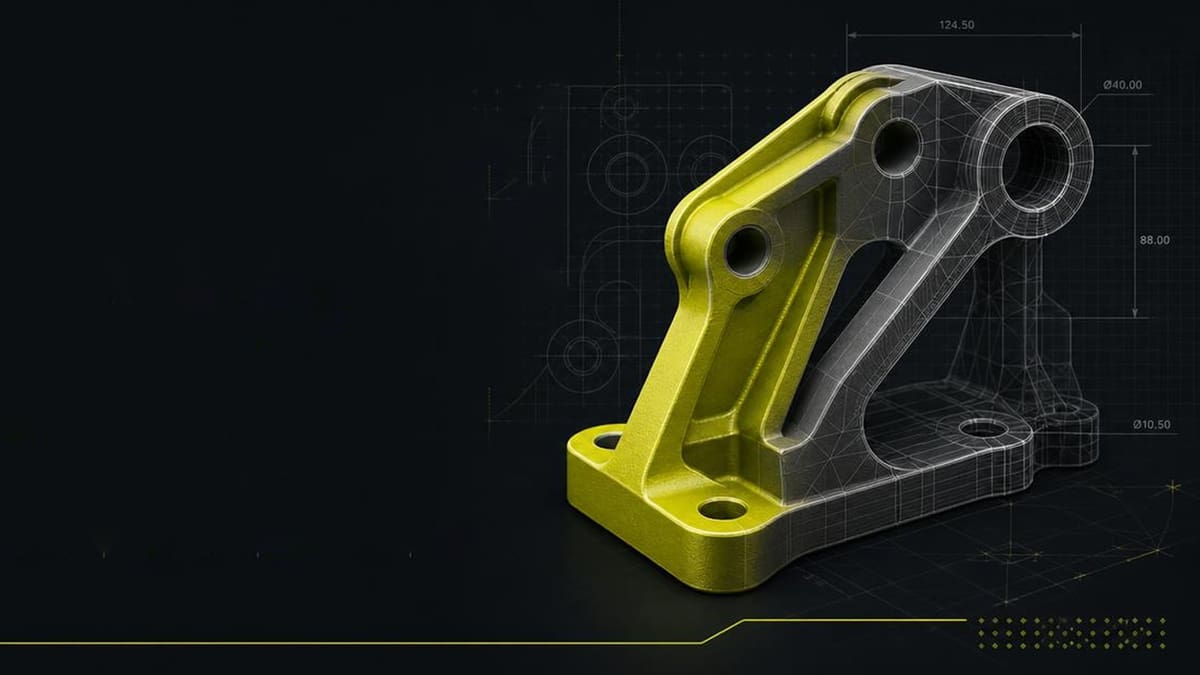
Can This New AI Tool Actually Reverse-Engineer Spare Parts from Technical Drawings?

3D Spark’s new Voluminate platform promises to turn old drawings, DXFs, and even photos into useful 3D models in minutes. That sounds ideal for obsolete spare parts, so we tried it.
There are plenty of workshops with a drawer full of old drawings and no corresponding 3D CAD files and plenty of regular people who just want to recreate an odd old part from a broken bracket to a vacuum cleaner attachment.
That is the problem Voluminate, a new browser-based tool from Hamburg manufacturing-software company 3D Spark, is trying to address. Unlike AI image to model generators more on the creative side, like Meshy, Hi3D, or Tripo, Voluminate (which I always want to pronounce with a flick of my wand) aims to position itself primarily around industrial spare parts, maintenance, repair, and operations: cases where the original supplier or CAD data may be gone, but a drawing, DXF, scan, or photograph still exists.
I was eager to try it because the use case makes immediate sense. If a workshop could take the information it already has, reconstruct a missing part, and move directly toward 3D printing, machining, or sourcing, that could save a lot of manual CAD work and eliminate the need for 3D scanning altogether.
Voluminate became publicly available in late last month and is currently being offered with beta pricing with higher prices taking effect October 1. It offers three free tries, so we gave it a spin.
What Voluminate Actually Does
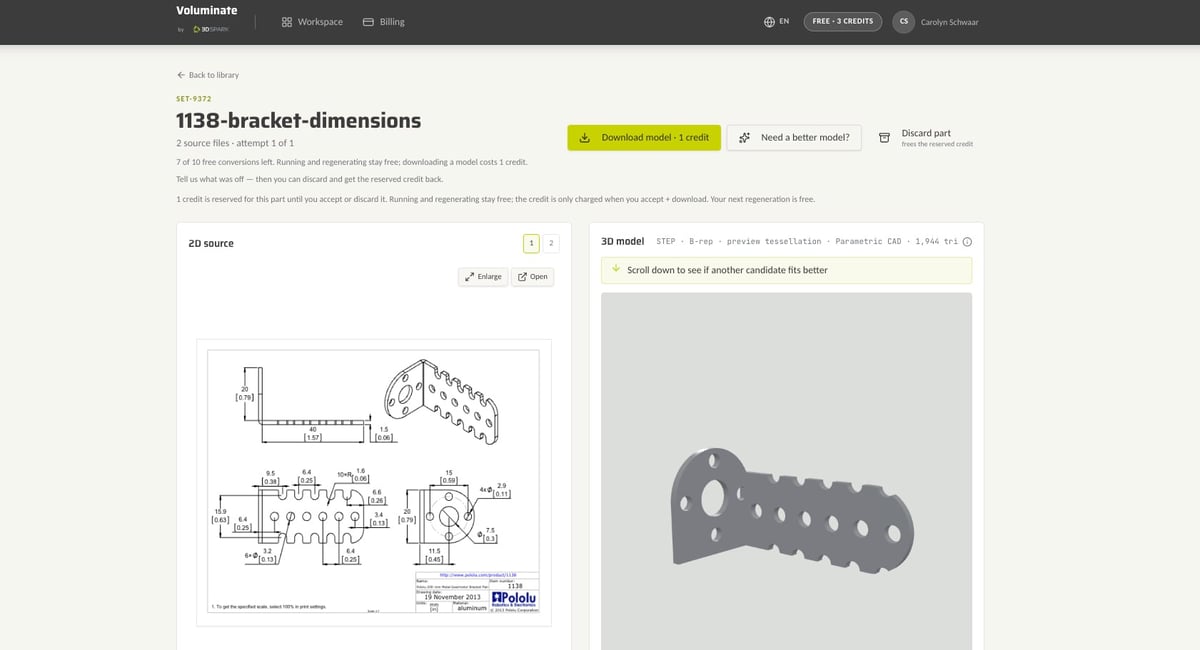
The workflow is nicely straightforward.
Upload PDFs, images, DXF/DWG files, SETP file and other part information like measurements and a text description. Multiple sources can be grouped together (up to 8), so you might provide a drawing plus photographs of the physical component. Voluminate then generates 3D candidates that can be inspected in an interactive browser viewer. The current site says a reconstruction run can return four candidate variants, along with geometry information and a feedback system for rerunning the reconstruction.
That wasn’t exactly our experience. One attempt only returned one variation, while another experiment delivered one model then said two other models were still being generated, but the platform timed out without delivering the two others.
Update: Then, after this article published yesterday, the other models appeared via email notice. So eventually all the promised versions were accessible.
That feedback loop is an interesting part of the platform. You can rate a result and describe what is wrong, and Voluminate says the next reconstruction takes that criticism into account.
Voluminate is in “early beta” according to the company so if you give it a spin, fill out those evaluation boxes that are offered after each iteration of your model.
3D Spark describes its automatic result as an NNS Model, or Near-Net-Shape Model. It can be supplied as STL and an AI-generated STEP solid. But the company makes an important distinction here: the automated STEP is not dimensionally verified simply because it is a solid CAD file. According to Voluminate’s own documentation, NNS models are intended as fast AI reconstructions whose quality depends on the input.
For customers who actually need verified production CAD, Voluminate offers a second level called Hi-Fi CAD. In that workflow, 3D Spark’s reverse-engineering team manually refines and verifies the model. During the beta period, a 10-credit pay-as-you-go pack costs €100; an automated NNS reconstruction costs one credit to download, while an engineer-verified Hi-Fi CAD job costs three.
That distinction matters for this test. Voluminate’s broader marketing talks about getting from missing CAD to usable geometry in minutes and reducing reverse-engineering effort, but its technical material is more cautious about what the platform delivers. 3D Spark itself says AI-generated geometry can contain missing or incorrectly inferred features and positions the automated model particularly for screening, costing, manufacturability checks, and early evaluation.
So, with that context in mind, I wanted to see what the automatic reconstruction actually produced.
Test One: Rulmeca KL20
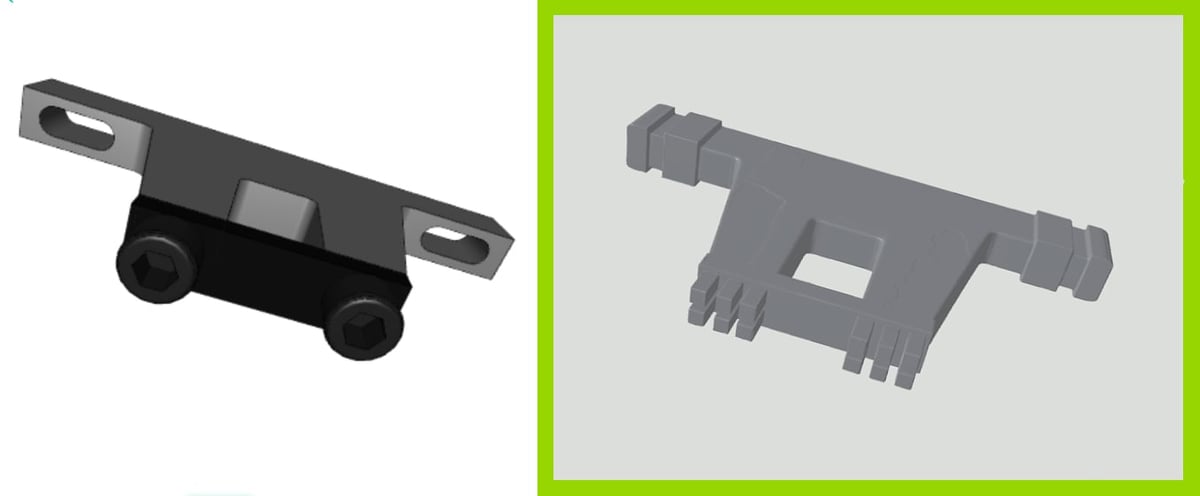
My first test was a Rulmeca KL20 mounting bracket, an industrial aluminium component used with drum motors.
For this experiment, I uploaded a DXF, not a PDF or image of the technical drawing. Voluminate recognized it as a vector source and parsed the geometry during conversion.
The first result got one thing impressively right: scale. Most everything else was wrong.
Rulmeca specifies a maximum dimension of 103 mm, and Voluminate reported: 103.0 × 10.5 × 57.8 mm for the model’s bounding box. Its measured maximum dimension was exactly 103.0 mm, matching its 103 mm target.
The geometry itself was another matter.
The returned model contained a large rectangular opening through the center and several stepped, tooth-like features that did not correspond to the original bracket. The broad proportions were there, but the physical shape was substantially different.
I then tried it again and gave Voluminate considerably more help. This time I supplied Rulmeca’s full published dimension set. The second result still showed essentially the same problem.
The overall dimensions remained close, but adding the complete set of measurements did not make the reconstructed geometry correspond to the original bracket.
Update: The Rulmeca part delivered as version 2 via email after the session timed out was a significantly more accurate. Sessions timing out before you get your models is, I'm guessing, a bug high on the fix list.
I can only speculate about why. My assumption is that Voluminate was able to establish the scale of the DXF but had more difficulty interpreting how its 2D linework related to the actual 3D features. Either way, what came back was not a close representation of the Rulmeca part.
Test Two: Pololu 20D Bracket
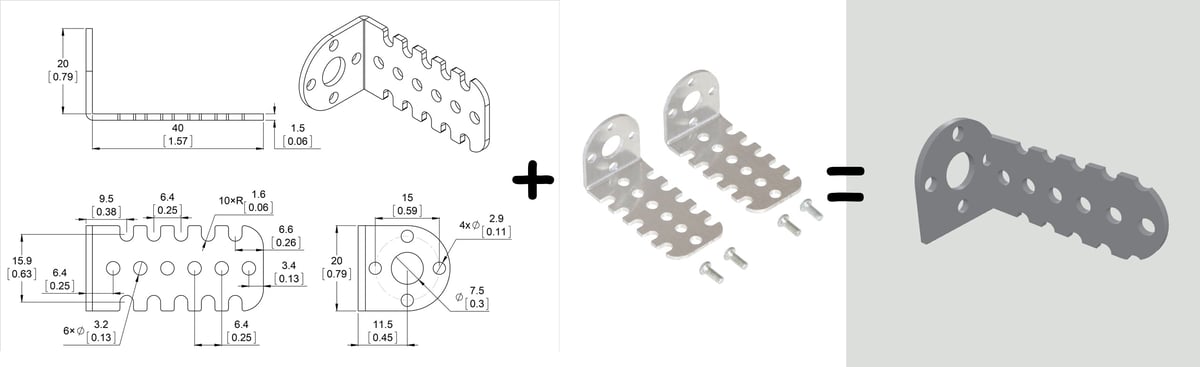
For the second test I deliberately chose a simpler component: the Pololu 20D mm Metal Gearmotor Bracket.
This is a single-piece bent aluminium bracket, and Pololu publishes both a clean dimensioned PDF and a reference STEP model.
I did not give Voluminate the STEP file. This time I gave it more of the sort of information a workshop might realistically have:
- Pololu’s official dimensioned PDF
- a photograph of the actual bracket
- a short description identifying the component
- a maximum dimension of 40 mm
The description told Voluminate that it was a single-piece aluminium bracket and instructed it to use the drawing for dimensions and the photograph to understand the form. The result looked considerably better than the Rulmeca reconstruction.
At first glance, it was recognizably the same bracket. Voluminate produced the bent L-shaped form, the row of six holes along the plate, the notches along its edge, and the perpendicular motor-mounting flange with a larger central hole surrounded by four smaller holes.
But once I compared it closely with the original drawing, differences became apparent.
The notches along the side did not extend far enough into the plate. The final notch near the rounded end was particularly shallow. The four smaller holes around the large motor opening were also not located correctly. In the original, one small hole beneath the large bore sits on the same centerline. In Voluminate’s result, it was shifted sideways. That also broke its expected alignment with the row of holes in the long plate.
There was another outline error: an edge that is rounded on the original part was rendered flat.
So the second model was far more recognizable than the first, but several relatively small geometric features did not match the manufacturer’s drawing.
Promising Idea, Early Results
These were only two tests, and they used different source material. They therefore shouldn’t be treated as a formal benchmark of every type of input Voluminate supports. Once we get to Voluminate version 2 or 3, I’ll sit down with it again and see what it’s learned. AI is developing so fast that I wouldn’t be surprised if this platform is noticeably better shortly.
It is also worth repeating that 3D Spark itself does not describe the automatic result as engineer-verified production CAD. Its own documentation says the geometry can range from conceptual to genuinely near-net-shape.
That makes Voluminate an interesting proposition. For rapidly turning legacy documentation into something that can be visualized, screened, costed, or taken into CAD for further work, I can see why 3D Spark is pursuing it.
I went into the test particularly interested in the next step: could a workshop use it to recover an old spare part without first rebuilding everything manually in CAD? Without 3D scanning?
From these two automatic reconstructions, my impression is that it may still be a little early for that expectation but with the pace of change when it comes to AI, keep an eye on Voluminate.
License: The text of "Can This New AI Tool Actually Reverse-Engineer Spare Parts from Technical Drawings?" by All3DP Pro is licensed under a Creative Commons Attribution 4.0 International License.