Can Palm Leaf-Filled PLA Filament Compost in Your Backyard?

Hembased says its plant-based FDM material is designed to break down in open-air compost, yet scientific analysis and certification details remain unclear.
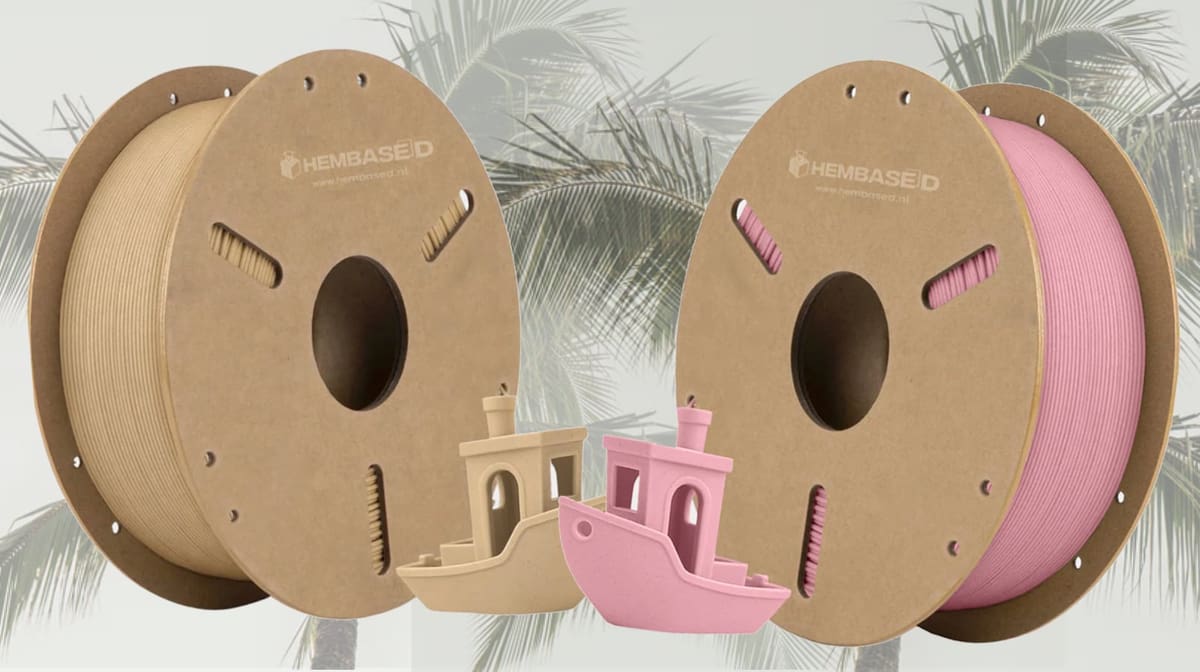
Dutch materials company Hembased just launched a 3D printer filament made using fallen palm leaves that it says you can compost in your backyard instead of throwing in the trash.
While most all PLA is plant based (typically sourced from corn or sugar), it still requires industrial processing to break it down in order to be compostable. The lack of access to these types of recycling facilities for most users results in the vast majority of PLA ending up in landfills where it will break down in several decades to about 100 years. It’s an issue more material companies are aiming to tackle with new PLA formulations.
“3D printing is a powerful tool for rapid innovation, but the materials used do not yet meet the demands of the future,” Hembased says on its website. “Now that sustainability claims are being assessed increasingly critically, we opt for clarity, practical applicability, and communication that stands up in practice.”
Yet, the company hasn’t yet published any independent verification or scientific studies backing up its composting claims.
Rather than reporting validation of the finished filament, Hembased appears to be relying on studies done by HemCell, the company supplying the palm-leaf biopolymer granulate that’s used in the filament. HemCell makes at least two relevant composting claims, but neither is directly related to Hembased filament.
First, HemCell’s patent describes a 50/50 palm-sheath and PLA formulation that reportedly absorbed 10-15% water, became rough, and had thin sections that could be broken after 30 days in humid conditions. HemCell claims test results of 100% for home composting at 20–30 °C, but labels its home-compost certification as “Pending.”
At its core, Hembased says the palm-leaf component changes how the entire PLA-containing material interacts with water and microorganisms. That structure could increase moisture penetration and accelerate PLA hydrolysis and breakdown.

According to Hembased, once a printed part is no longer needed, users can simply break it into smaller pieces and add it to their backyard compost pile, in with the yard waste, food waste, and coffee grounds. Moisture, temperature, microbial activity, the compost mixture, and the thickness of the part will all affect how quickly it disintegrates.
The company is targeting both individual makers and professional users, suggesting the material for prototypes, educational models, studio work, packaging-related development, and functional end-use parts. It is also offering bulk supply, recurring deliveries, pilot programs, and R&D support for businesses developing new applications. Hembased says its engineering team can assist with prototyping, testing, material validation, and the assessment of different end-of-life scenarios.
For makers and businesses, Hembased presents an intriguing proposition: print an object on familiar FDM hardware, use it normally, and give it a biological rather than purely waste-based destination when it reaches the end of its useful life. Independent testing will be needed to establish how consistently that promise translates from carefully managed compost conditions to the average user’s backyard pile, but ultimately it’s a step in the right direction for PLA material.
How to Print with Hembased
Despite the unusual feedstock, the filament is intended for standard FDM printers. It’s priced at about $36/kg and Hembased recommends a relatively large 0.8-mm nozzle, a nozzle temperature of 170 to 190 °C, a 30 °C print bed, 30% part cooling, and print speeds between 30 and 80 mm/s.
The company also advises drying the filament for 12 hours at no more than 50 °C, particularly before long prints or the production of larger parts. Each spool contains 1 kg of filament, excluding the 154-g spool itself.
You May Also Like:

License: The text of "Can Palm Leaf-Filled PLA Filament Compost in Your Backyard?" by All3DP is licensed under a Creative Commons Attribution 4.0 International License.