No Industrial Composting Needed: Is This $27 “Regenerative” PLA+ a Sustainability Game-Changer?

Even plant-based PLA often marketed as "green" requires industrial composting facilities to truly decompose. This new material breaks down in ordinary landfills in under five years.
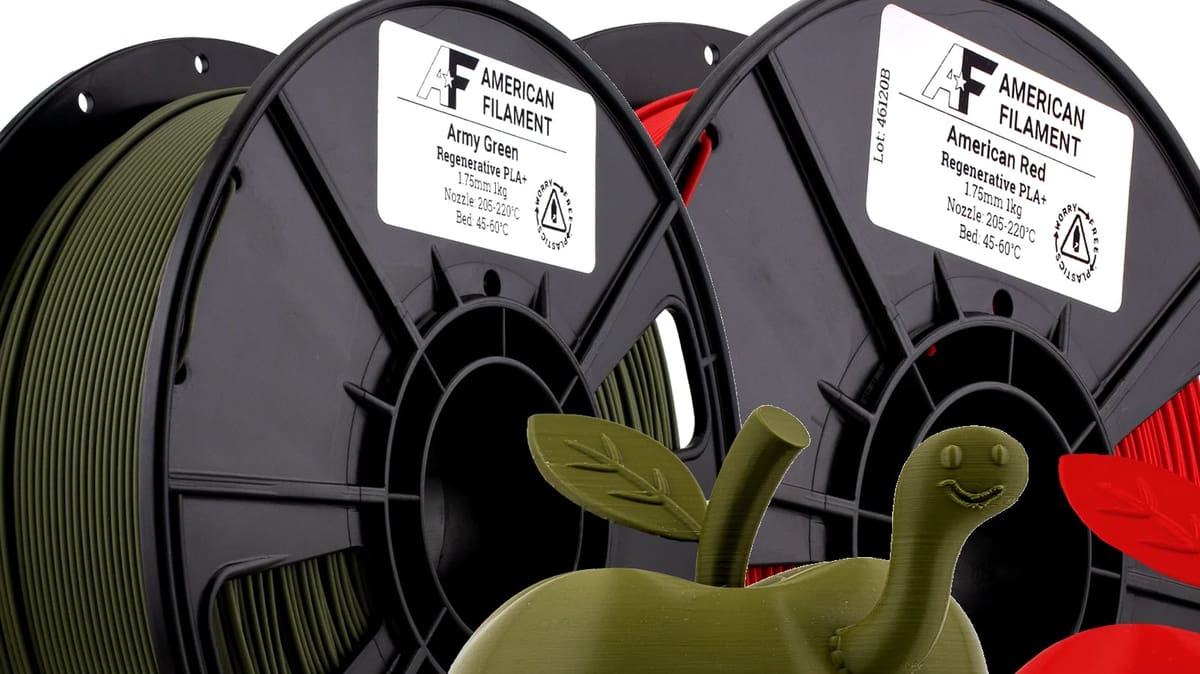
It’s always exciting to find a 3D printing filament aiming to address the plastic pollution problem and the guilt we all feel throwing failed prints and prototypes into the trash. A South Carolina start-up called Worry Free Plastics just launched Regenerative PLA+ ($26.99/kg), a filament it claims breaks down in common landfills in just a few years with no special processing. This is big step forward from the 100s of years it takes typical PLA to biodegrade in a landfill.
Contrary to the belief often associated with plant-based PLA, which is typically made from corn or other organic materials, it is only compostable with industrial processing, a step not offered in most communities, and the vast majority of 3D printed PLA scrap ends up in the trash.
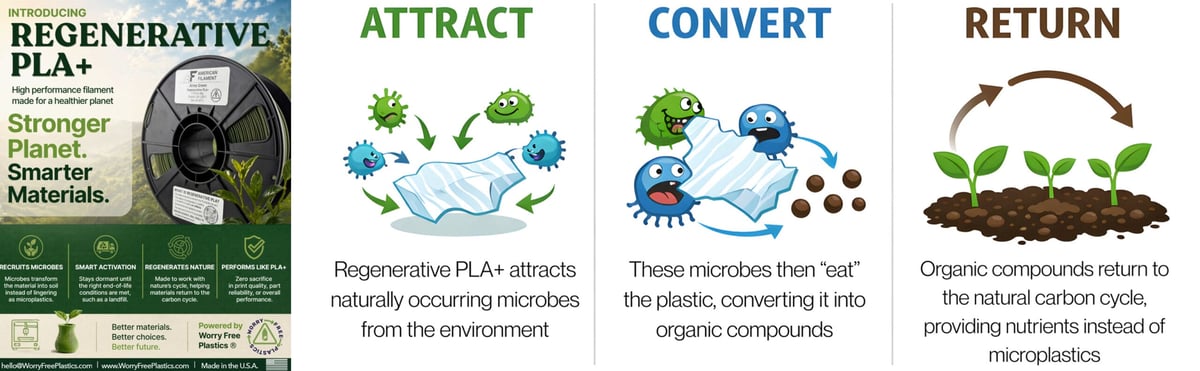
Regenerative PLA+ is a PLA+ filament that “harnesses the power of regenerative depolymerization to allow plastic waste to be bio-assimilated as a natural food source for microbes and mycelium to be completely consumed and converted back into humus in terrestrial, marine, and landfill environments, all in fewer than 5 years.”
The end-of-life component, by design, stays dormant until the material reaches a microbe-rich disposal environment such as a landfill. There, naturally occurring microbes are meant to consume and convert the polymer into organic compounds, a process the documentation says contributes to soil formation and returns the material to the natural carbon cycle.
Regenerative PLA+
- No Microplastics
- Accelerated Water and Landfill Biodegradation within a few years
- Fully Recyclable
Worry Free Plastics is a materials company just now starting to work with manufacturers and compounders. It says it’s tech can be used in any plastic, giving it the ability to bio-assimilate in any environment. Currently there’s a Worry Free Plastic synthetic textile that behaves like natural fibers when it ends up as pollutants in the environment, the company says, and a partnership with furniture maker Heller, which in 2025 began promoting furniture made with Worry Free Plastics technology.
Chalk it up to our skeptical nature, but if you not only claim to have a product that achieves something no other product on the market does, but you also say you have numerous industry certifications and have passed rigorous scientific testing — show us. It is a bit of a disappointment that the Worry Free Plastics website doesn’t link to a single scientific study, published research, or certification.
Print Performance
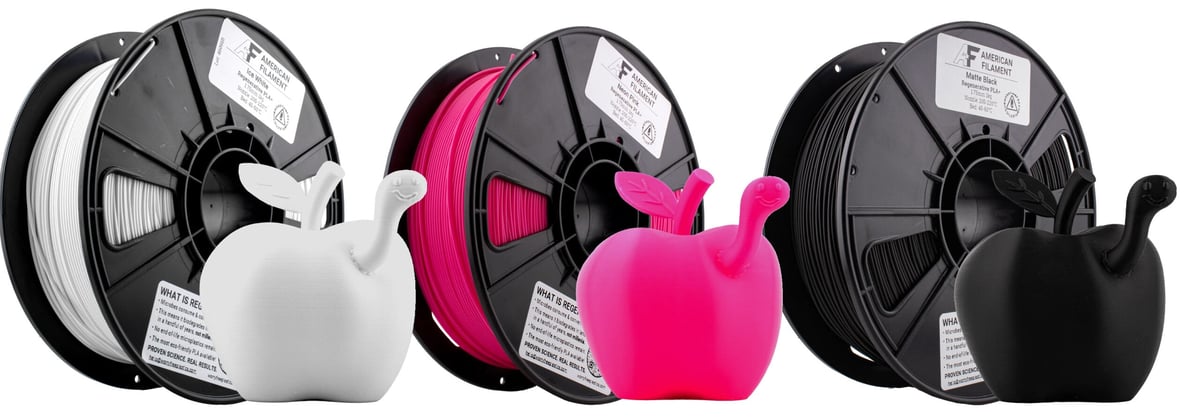
Although the filament is listed on the Worry Free Plastics website, it’s actually purchasable via the Huntsville, Alabama-based American Filament in 10 colors.
American Filament co-founder Megan Brooks spoke to YouTuber JJ Shankles about the filament and explained that the elements that help the filament breakdown do not affect the colors or the printability and the material performs like standard PLA+ throughout its useful life. American Filament also says the new material is meant to fit into existing workflows without requiring specialized hardware or changes to print processes. The company describes Regenerative PLA+ as a direct replacement for standard PLA+, with the same ease of printing, strong layer adhesion, attractive surface finish and compatibility with familiar setups, including multi-material stations.
On strength and handling, Brooks said the company has not yet conducted standardized testing, but early in-house results have not shown a meaningful tradeoff.
The material’s pitch is likely to resonate most with users who generate frequent print waste: makers and hobbyists, schools and STEM programs, product designers and prototyping teams, and businesses or brands looking for more credible sustainability claims without sacrificing consistency in production.
Product Specs
Mechanical Characteristics: n
- Not available but said to be that of typical PLA+
Printing:
- Nozzle Temperature: 205 – 220°C
- Bed Temperature: 45 – 60°C
Spool:
- 1kg Spool Dimensions (AMS-Compatible)
- Filament Weight = 1 kg
- Filament Diameter = 1.75 mm (+/- 0.05 mm)
- Spool Inner Diameter (ID) = 52 mm
- Spool Outer Diameter (OD) = 200 mm
- Spool Width (W) = 67 mm
- Spool Weight = 220 g
- Colors: Gunmetal Gray, Matte Black, Ice White, Army Green, Forest Green, American Red, American Blue, Neon Pink, Burnt Orange, Coyote Tan
- Price: $26.99/kg
You May Also Like:


Update: May 27, 2026
Worry Free Plastics has now provided laboratory documents to All3DP showing partial biodegradation of “Bio-Batch”-related materials under controlled aerobic and anaerobic conditions, plus limited toxicity testing suggesting no obvious toxicity in the specific tests performed. However, the documents do not independently prove that the commercial Regenerative PLA+ filament fully biodegrades in ordinary landfills within five years, leaves no microplastics, biodegrades in water, or is fully recyclable.
In related news:
University of Edinburgh researchers have just demonstrated a one-step chemical process that can convert certain polyester plastics into sulfur-containing polythionoesters, which have weaker chemical bonds and may degrade more easily. The work was shown using polycaprolactone and is described as potentially scalable and adaptable to other plastics, but it is early-stage research rather than a commercial recycling or biodegradation solution.
License: The text of "No Industrial Composting Needed: Is This $27 “Regenerative” PLA+ a Sustainability Game-Changer?" by All3DP is licensed under a Creative Commons Attribution 4.0 International License.