BigTreeTech Launches Panda Sense Pro Home Assistant-Compatible Air Quality Monitor

Available now for $89.99, the self-billed 8-in-1 air quality monitor covers a broad spectrum of 3D printing emissions, though not all.
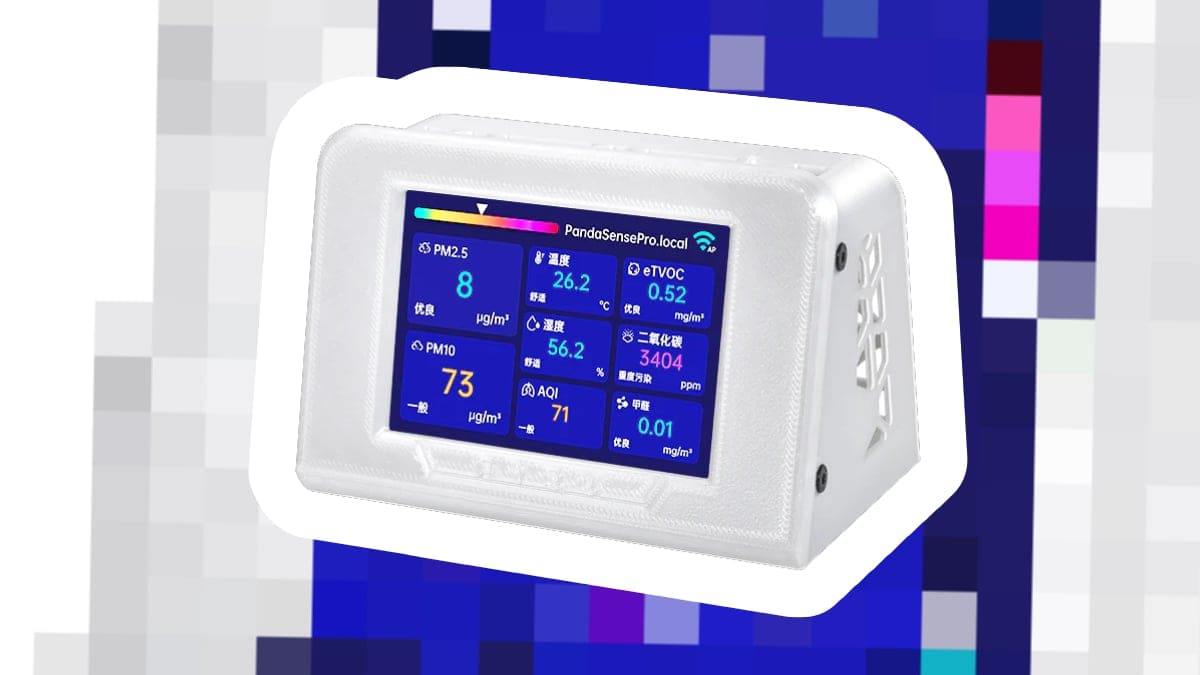
While I’m still personally waiting for innovations like the Panda Cyborg to make an appearance, BigTreeTech is not sitting still. The latest accessory to launch in the company’s long-running Panda series of accessories for Bambu Lab machines is the Panda Sense Pro, an $89.99 USB-powered air quality monitoring system.
While the name suggests it’s a Bambu-exclusive peripheral, the Sense Pro is actually accessible for Home Assistant networks over MQTT, letting you hook its data streams directly into any home dashboard you use, as well as set threshold-based automations or, say, add its data points to a Moonraker-enabled web interface for your Klipper 3D printer.
The Panda Sense Pro ships as a kit for self-assembly, comprising a 3.5-inch color TFT display, the Sense Pro board itself, an external temperature sensor, USB power cable, the vitamins to assemble it all (provided you’ve printed the case) plus the obligatory BigTreeTech rubber ducky. BigTreeTech provides the files to 3D print the case for yourself on GitHub, for you to customize as you see fit.
What Can the Sense Pro Detect?
The Sense Pro is marketed as an 8-in-1 system. But what are the “8” things it’s sensing? Of the physical sensors it names, it includes: a laser particle sensor, NDIR CO₂, electrochemical formaldehyde sensor with temperature compensation, and a separate temperature and humidity sensor. This directly covers six of the eight readings – there are a couple of derived values, too. In all, the Sense Pro covers:
- PM2.5
- PM10
- Formaldehyde
- eTVOC (derived)
- AQI (derived)
- CO₂
- Temperature
- Humidity
The PM2.5 value is a reading of the volume of particulate matter up to 2.5 micrometers in diameter in the air. Measured by how the particles scatter the light from the laser particle sensor, PM2.5 emissions are typically the result of combustion, the melting of things. This is, more directly, the read on some of the emissions from filament in a 3D printing context.
PM10 is detected the same way as PM2.5, distinguishing particles up to 10 micrometers in diameter. These are larger particles, typically thought of as dust and mold spores, though in a 3D printing context, this could be debris from mechanical wear on the parts of the 3D printer.
Formaldehyde is a highly toxic and carcinogenic volatile organic compound. It is typically detected through minute levels of conductivity in an electrochemical circuit – with higher conductivity indicating a higher level of formaldehyde in the air coming into contact with the circuit.
The eTVOC value – estimated total volatile organic compounds – gives you an estimated, big-picture number for volatile organic compounds in the air around the sensor. One caveat – such a value doesn’t distinguish between harmful and harmless VOCs. We’d chalk this one up as a situationally useful indicator – in a sealed room with only a printer running, you can assume the readings are specifically impacted by the printing process. In a mixed use setting, just peeling an orange near the sensor would spike this value.
BigTreeTech doesn’t name a dedicated VOC sensor, so the value for the eTVOC must be being derived from the numbers the Senso Pro does have and extrapolated out. How exactly the sensor arrives at the value is not communicated. The AQI – air quality index – is also a calculated value, taking into account all of the other readings to give you a read on the general air quality.
BigTreeTech does not make any overreaching claims with the Panda Sense Pro, and is upfront about its limitation of only being able to detect particles down to 30 micrometers in size. As ever with anything regarding safety it’s important to be realistic. Studies show 3D printing is an emission source of ultra-fine particles – particles so small they can cross directly into your bloodstream. We’re always surrounded by them, but the Sense Pro cannot detect changes in the levels of them – neither can any consumer home solution that we’re aware of.
While 3D printing manufacturers increasingly get their printers and materials Greenguard certified,p it’s generally good practise to have your 3D printer in an enclosure with ventilation or air filtration.
The Sense Pro is a logical, complementary follow-up to last year’s release of the Panda Breath – a separate in-chamber heater and HEPA air filtration device – and one of the many networked accessories BigTreeTech has created to exist as a complementary layer on top of your 3D printing setup or, as is certainly the case for the Sense Pro, conveniently slot into your own existing smart home system.
The BigTreeTech Panda Sense Pro is available now.
Read more recent news:
License: The text of "BigTreeTech Launches Panda Sense Pro Home Assistant-Compatible Air Quality Monitor" by All3DP is licensed under a Creative Commons Attribution 4.0 International License.