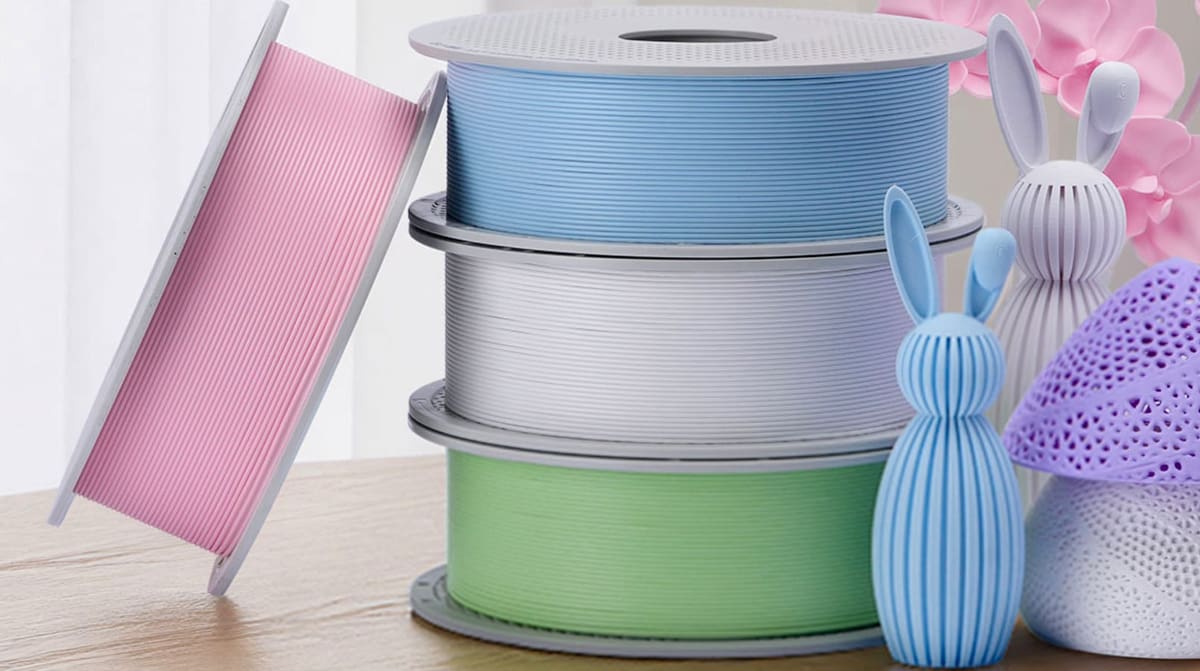
Bambu Lab Launches PETG Matte, Promising PLA-Like Printing With PETG Durability

The new filament combines a subdued finish with improved humidity resistance, easier support removal, and the toughness expected from PETG.
Bambu Lab just added a new material to its filament range: PETG Matte ($13.99) formulated to offer the understated surface finish of a matte filament (i.e. hiding layer lines) without giving up the practical advantages associated with PETG.
Bambu Lab wants you to think of this PETG Matte as an all-rounder rather than a specialist material. The pitch is straightforward: make PETG easier and more forgiving to print, while retaining the toughness, moisture resistance, and weather resistance that make the polymer useful for functional parts.
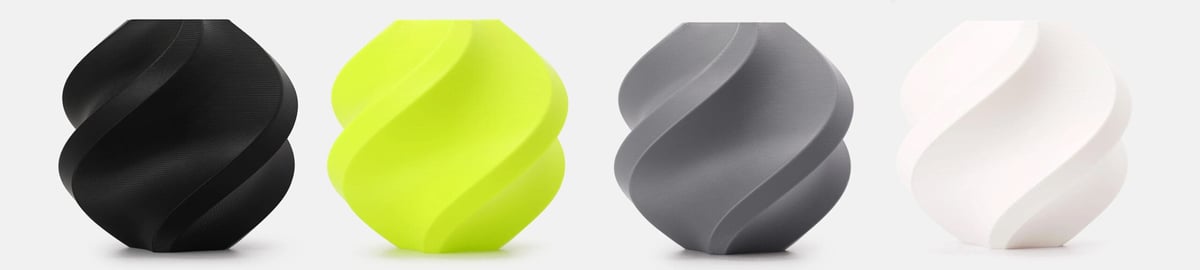
That combination is particularly interesting because conventional PETG can be a little temperamental: stringing, blobs, oozing, and sensitivity to absorbed moisture are familiar headaches.
Bambu says its new formulation has improved resistance to ambient humidity, which in turn is intended to reduce that stringing, clogging, and unwanted blobs during printing. The company goes as far as describing the printing experience as “PLA-like”.
That doesn’t mean PETG Matte suddenly stops caring about moisture. Bambu still recommends drying the material if it has been exposed to relative humidity above 50% for more than 72 hours. Rather, the claim is that the new material should be less troublesome during normal handling and printing than traditional PETG.
Matte by Name, Functional by Nature
The most immediately obvious difference is, naturally, the finish.
Bambu says PETG Matte produces a smooth, low-gloss surface designed to disguise layer lines and give printed parts a more uniform appearance. At launch, the material is available in eight colors, with the company highlighting Baby Blue, Avocado Green, Pink, and Violet among the selection. We’re fans of the matte-ness of Bambu Lab’s carbon fiber PLA, but this PETG has no fiber additives.
It’s also not being marketed purely as a decorative filament.
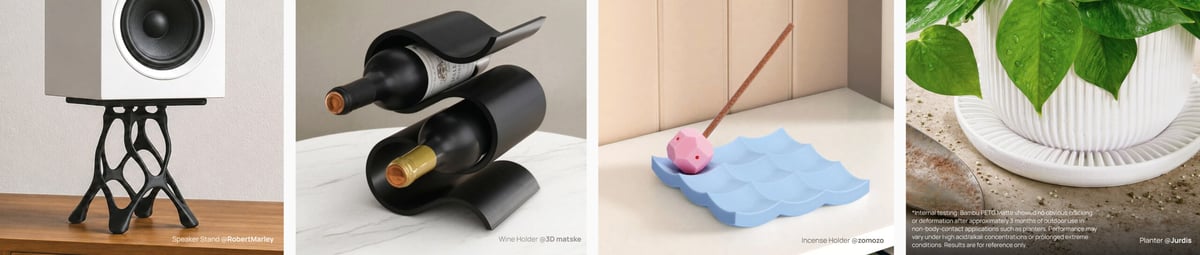
Bambu is pitching PETG Matte for functional objects including load-bearing hooks, shelves, bathroom organizers, soap dishes, and outdoor planters. In other words, parts where PLA’s ease of printing may be attractive but greater resistance to heat, moisture, and outdoor conditions is desirable.
The company also claims the new material maintains strong interlayer adhesion despite its altered formulation.
Supports Without the Fight?
One of the more interesting claims concerns support material.
PETG has a reputation for sticking enthusiastically to itself, which is excellent when you want strong layer adhesion, less excellent when the material forming your supports refuses to part company with the model.
Bambu says PETG Matte has been tuned to make supports easier to remove without requiring a dedicated interface material. According to the company, supports can be peeled away by hand even around steep overhangs and recessed features, while leaving a relatively clean surface behind.
If that behavior holds up across different geometries and printer settings, it could be one of PETG Matte’s more useful qualities. Being able to print functional PETG parts with complex supported features without loading a second support filament would simplify both single-material jobs and AMS workflows.
Made for the Bambu Ecosystem
As expected for one of Bambu’s own materials, PETG Matte is designed to slot directly into the company’s hardware ecosystem.
Bambu says that the filament is compatible with its printers, AMS systems, build plates, and nozzle options. Printing information is also encoded in the spool’s RFID tag, allowing a compatible AMS to identify the material and retrieve the corresponding settings automatically. That convenience remains one of Bambu’s main arguments for buying first-party filament: there’s less setup between opening a spool and starting a print.
Of course, the first thing we’d print is a temperature tower. PTEG is famous for going from matte to glossy as the temperature increases, making us wonder is this may behave the same.
PETG Matte is available now through Bambu Lab’s store. The company has also included the new material in its current filament bulk-sale program, though pricing and offers vary by region.
On paper, PETG Matte occupies an appealing middle ground. It promises the subdued surface appearance usually associated with aesthetic filaments, the relatively painless printing experience users expect from PLA, and enough PETG toughness for parts that actually have a job to do.
Whether it achieves all three without significant compromises will take independent testing to establish. But for Bambu users who liked the idea of matte PETG more than the reality of printing it, the company has clearly identified the problem it wants this spool to solve.
What the Numbers Reveal
The standout feature in the technical data sheet is that PETG Matte isn’t merely PETG Basic with a duller surface, it’s actually one the stiffest of Bambu Lab’s PETGs while also showing the high elongation before break.
That combination is the most interesting part of the data. PETG Matte posts a Young’s modulus of 3,349 MPa in XY and 3,174 MPa in Z, versus 2,780/2,550 MPa for PETG Basic and 2,460/1,340 MPa for PETG-CF. In other words, by Bambu’s own figures, Matte is substantially stiffer than even the carbon-fiber-filled variant in tensile loading.
At the same time, Matte has the highest reported breaking elongation: 13.8% in XY and 6.5% in Z. Basic comes in at 9.5%/5.2%, while PETG-CF is 10.4%/4.7%. So the Matte formulation appears, on paper, to combine greater stiffness with more stretch before failure — an unusual and potentially useful pairing.
A note on the numbers: These figures are useful for comparing materials, but they are not all directly interchangeable. Bambu Lab and Prusa use different specimen orientations, printing conditions, and in some cases different reported properties. In particular, Prusa reports tensile yield strength rather than the tensile-strength figure reported in Bambu Lab’s sheets, while its moisture-absorption measurements use different environmental conditions.
You May Also Like:



License: The text of "Bambu Lab Launches PETG Matte, Promising PLA-Like Printing With PETG Durability" by All3DP is licensed under a Creative Commons Attribution 4.0 International License.