
Anycubic Shows off Three New Printers, Plus A New ACE 2 Pro Filament Changer at Formnext

The major hardware announcements mark expansions into engineering-competent large-volume desktop printing, plus an upped game in resin performance for Anycubic. Co-founder and CTO James Ouyang tells us all.
This year’s Formnext feels a little muted compared to previous years. With rumours plenty of hotel spaces going cheap still available around the halls of Frankfurt Messe, you could be forgiven for thinking things were down in the doldrums.
Not so in the desktop space, where business skips from strength to strength year on year, powered in no small part by the small handful of household names in inexpensive desktop printing, including Anycubic.
At this year’s show, the company has three major releases to talk about, a milestone that coincides with the company’s tenth anniversary. Jetlagged, but still on the floor to deliver the company’s keynote presentation and talk with All3DP was Anycubic cofounder and CTO, James Ouyang.

Besides the Anycubic Kobra S1 Max, a new larger-volume all-enclosed higher-temp printer than we’re accustomed to from the company, Anycubic is also showing off the previously unseen Kobra X, which Ouyang say sets a “new standard for an entry-level open frame 3D printer capable of multimaterial and multiolor printing without a filament box”. Rounding things off is the Photon P1, a grown-up Photon that leverages what Anycubic calls “industrial” grade fixtures for higher precision and accuracy in its prints.
Past users of Anycubic’s multicolor printing experiences may eye the S1 Max and Kobra X with scepticism. Reliability issues plagued Anycubic’s ACE Pro filament changer, and the delayed support for 8-color printing sowed some mistrust in the Anycubic die-hard. It’s a feeling Ouyang acknowledges, saying specifically that “stability and repeatability” were hard lessons learned.
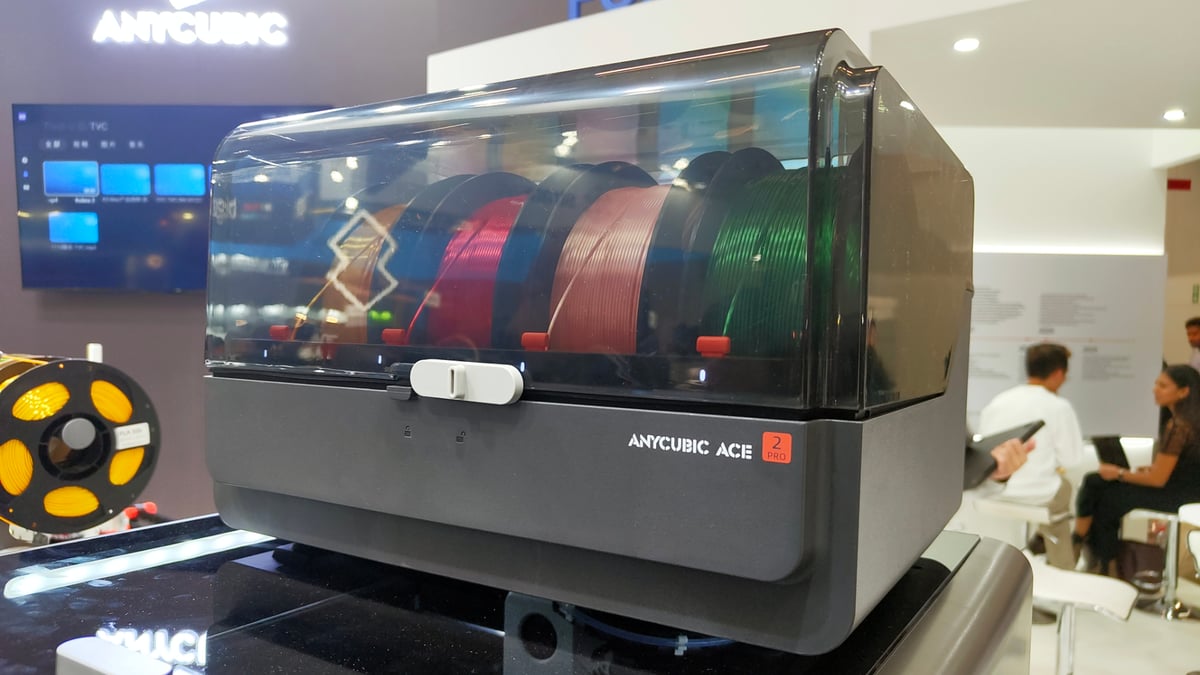
“This time around, we’ve spent more time testing at every stage.” Where the original multicolor generation of devices used the ACE Pro, a four-filament feeder that used a dual barrel-style selector and only two motors at the filament side to engage and feed filament, a design born out Anycubic navigating IP issues, Ouyang says, the new ACE Pro 2 uses a much more familiar structure. Four brushless motors, one for each filament feed. “The delivery is smoother, and we can achieve faster filament changing as well, saving maybe half of the time of the previous generation.”
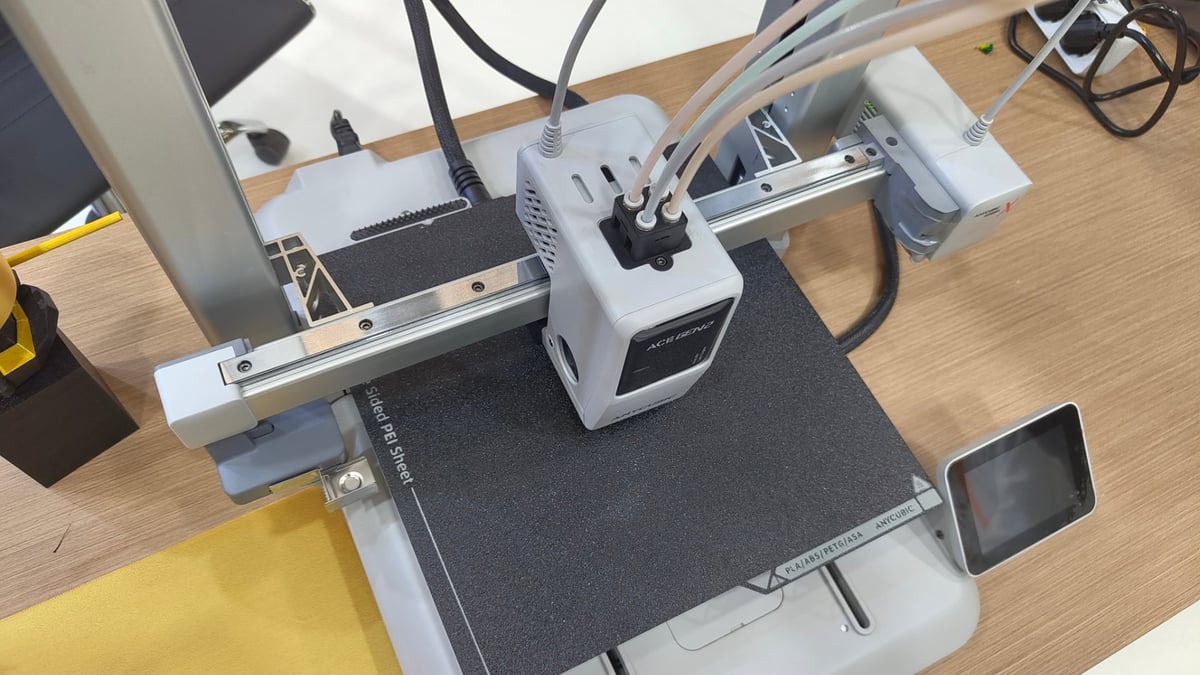
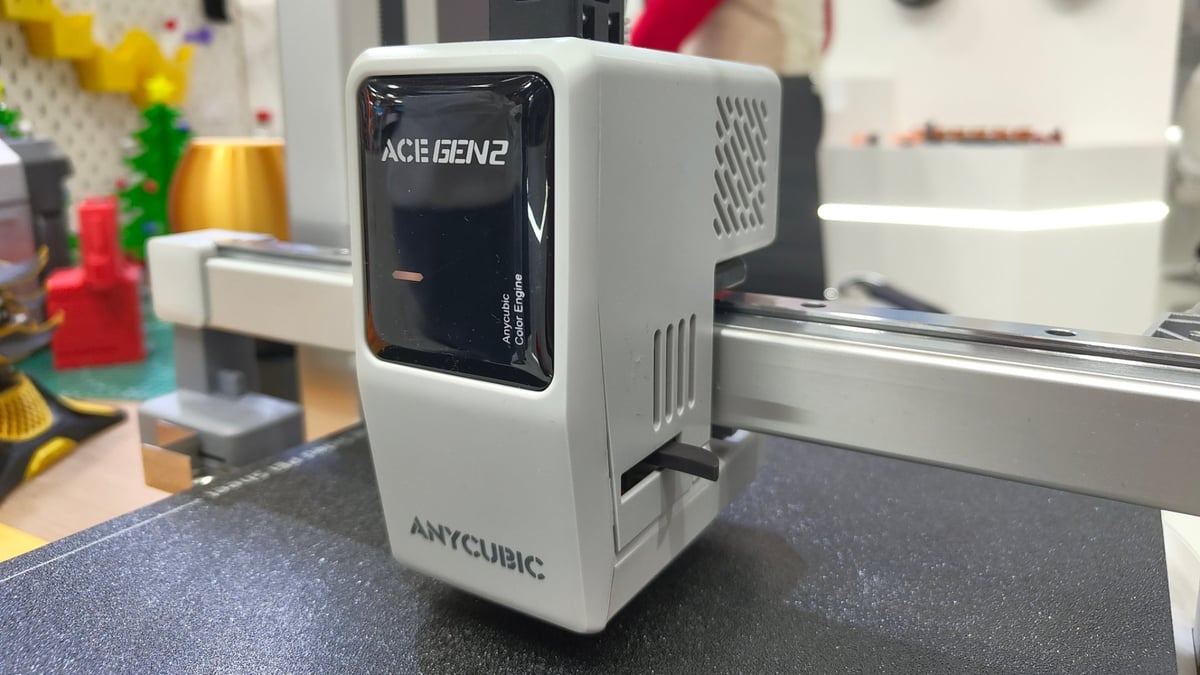
In addition to the ACE Pro 2 box-fed Kobra S1 Max, is the Kobra X, an all new multicolor, multi-material capable bed-slinger that shrinks the footprint over the Kobra 3, and introduces some new innovations in its printhead to achieve more efficient filament changing. “We did some research and engineering and eventually came up with the idea to put all the things inside the printhead to shorten the filament changing path and reduce the purging molten section.” It’s a simple premise, but the changes potentially bring 60% time saved on filament changes and 80% material saved on purges against [other] single-nozzle systems.
Another novelty of the Kobra X is it’s dynamic tensioning system, which adjusts the feed force on the filament according to its type, a feature that, in theory, improves printing reliability between softer and firmer filaments and potentially means the Kobra X could be a highly capable single-nozzle multi-material machine.
Also new is the Photon P1, a resin 3D printer that, on paper, bares many similarities with the company’s preview flagship release, the M7 Pro. Asked about its differences, Ouyang points out the first major difference that may be easy to miss, is the light source, which has been “improved to make it more uniform than before.” Another subtle but potent change is the printer’s approach to peeling. “We’ve introduced a ‘wavy’ structure on the screen, which can reduce the peeling force by at least 60%.” This physical feature of the LCD screen helps air rush in beneath the vat during peeling.
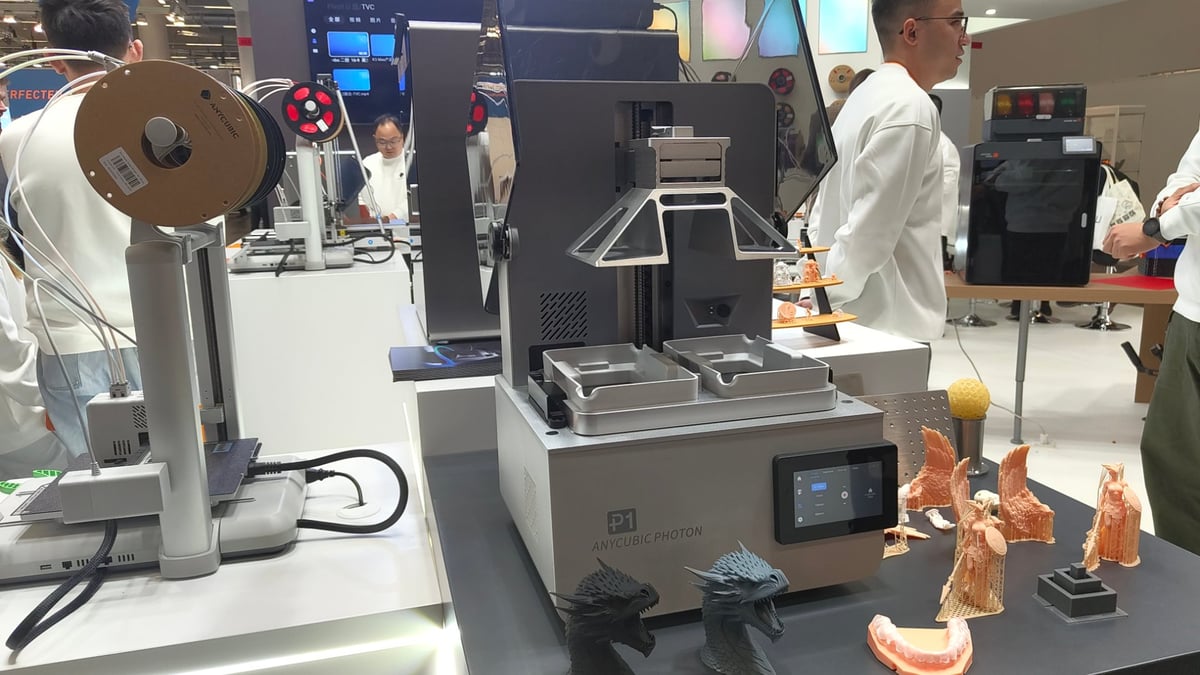
One advantage this system brings, Ouyang says, is the ability to easily print thick, viscous resins that, while possible to print on the company’s previous machines, would have been unreliable and require trial and error efforts to achieve. Complementing this higher performance ceiling will be new Anycubic resins, including technical flexibles that’ll allow P1 users to print, for example, shoes on the device.
A notable feature of the P1 is its dual resin vat accessory which splits the larger P1 build volume into two smaller volumes that can be used independently. It’s the result of a specific dental industry demand, Ouyang says. “They use expensive resins, don’t want a large resin vat, and don’t want to buy multiple different size machines.”
Read more recent news:
- Prusa’s Purgeless Nozzle Swapper is (Almost) Here, and It’s Powered By Bondtech
- The Bambu Lab H2C is Here, Bringing Versatile No-Waste Multicolor/Multi-material 3D Printing
- Anycubic Seeing Double With the Photon P1, a Prosumer Resin 3D Printer With Dual Build Volumes
Tired of Reading? Try Listening
License: The text of "Anycubic Shows off Three New Printers, Plus A New ACE 2 Pro Filament Changer at Formnext" by All3DP is licensed under a Creative Commons Attribution 4.0 International License.