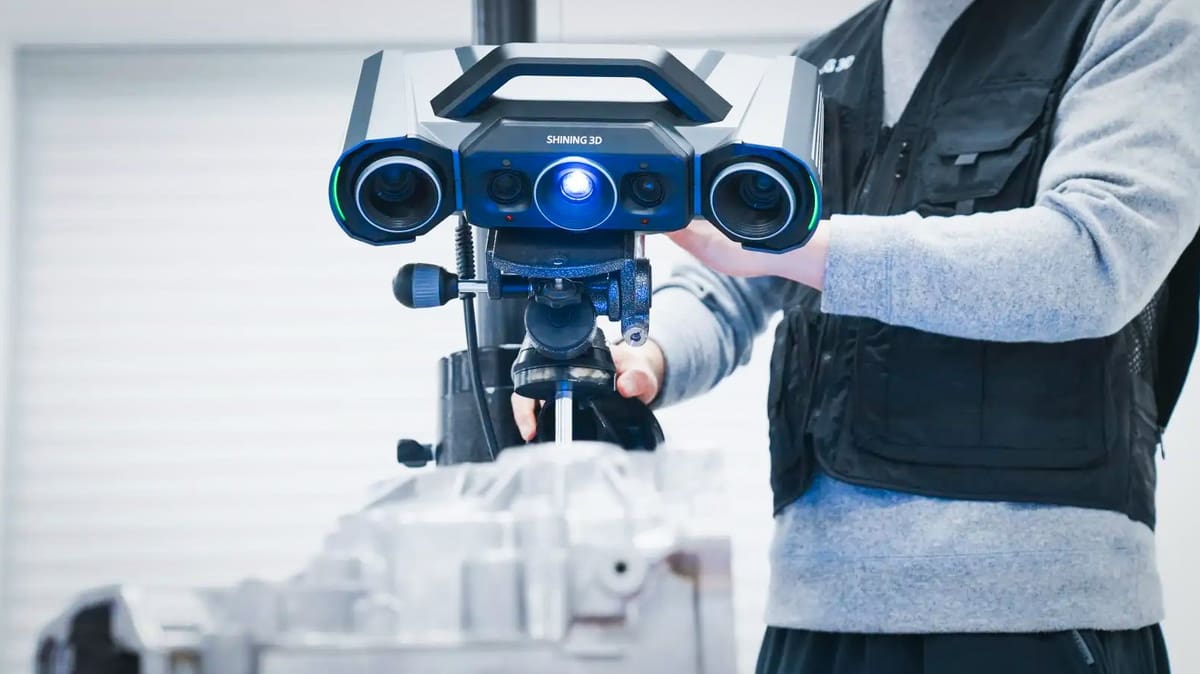
A Closer Look at Shining’s New “Reverse Engineering” 3D Scanner

With up to a 0.005 mm accuracy, the OptimScan Q12 is Shining 3D's most accurate scan tool to date.
Among the possible applications of the new OptimScan Q12 3D scanner from Shining3D is reverse engineering, which is critical at a time when manufacturers are looking for a way to reproduce the molds and tools they had been using at factories overseas. With an eye on reshoring manufacturing, not just in the U.S. but worldwide for a wide range of reasons, a tool to deliver accurate digital twins and manufacturable models is critical.
Shining3D had this in mind with the launch of its new industrial 3D scanner and software. The OptimScan Q12 is the flagship tool in the company’s new “metrology” line under a new sub-brand called Shining 3D Metrology. 3D scanning and metrology are closely related, but while 3D scanning is primarily used to capture the shape, texture, and color of objects in a mesh or point cloud, metrology moves more towards the science of measurement and focuses on accuracy, precision, and traceability. Both are used for reverse engineering, with some offering more detail than others.
What the Q12 offers is detail, with an accuracy up to 0.005 mm.
With this move into metrology, Shining 3D is upping its game, building on its experience in 3D scanners, having launched dozens of machines over the years. Shining makes entry-level scanners, like the Einstar Vega, and a wide range of professional scanners. We feature the company’s new EinScan Libre in our Best 3D Scanners guide, so let’s take a quick look at how the OptimScan Q12 compares.
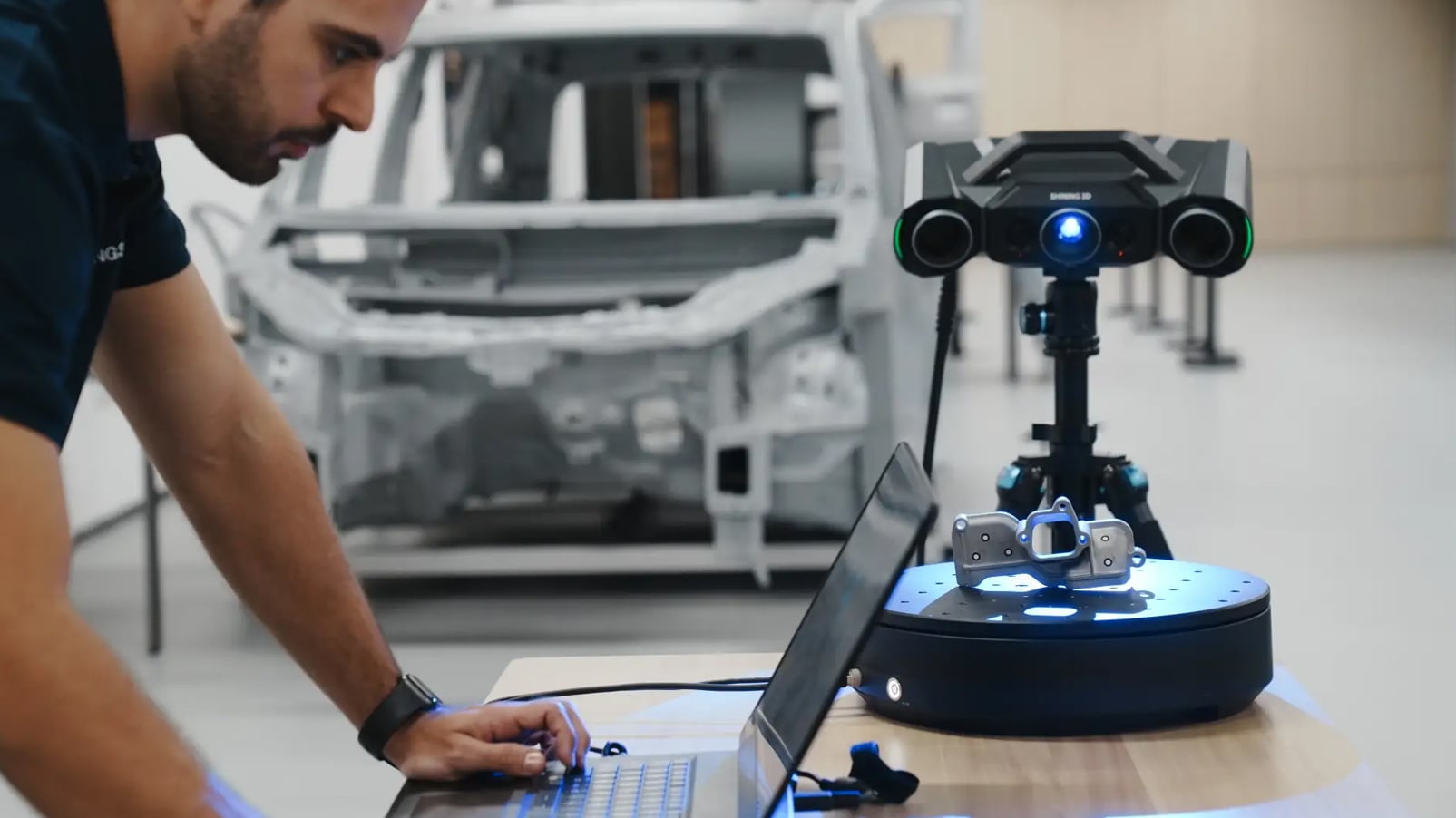
The Q12 can be a handheld 3D scanner, but put it on a tripod or robotic arm for boosted accuracy. It’s equipped with four 12.3 megapixel cameras, and you don’t need scan-markers with the Q12, but you can use them to up the accuracy.
The OptimScan Q12 has two scan ranges — near and far-ish — that can be switched with a single click. This feature is not novel but combine it with software that can fuse data from different ranges into one final 3D model, and you boost efficiency tremendously. Targeting reverse engineering, the size of scannable objects are small to medium, such as engine parts and manufacturing molds.
Errors in scanning can occur when the setting is too dark or there are reflective services so there’s often a menu of settings to master but Shining 3D says its auto exposure takes care of that by adjusting the setting based on what it sees that your scanning. There are manual overrides if you’re not happy with the auto mode.

We loved the full color of the EinScan Libre, but, typical of metrology scanners, the OptimScan Q12 doesn’t record color.
The OptimScan software guides you through the 3D scanning process and includes algorithms and tools for optimizing scans into 3D models. It’s compatable with Geomagic Design X and Control X and well as Polyworks.
Shining 3D hasn’t released a price yet, but we estimate in the mid-five-figures to start.
You May Also Like:


License: The text of "A Closer Look at Shining’s New “Reverse Engineering” 3D Scanner" by All3DP is licensed under a Creative Commons Attribution 4.0 International License.