Glass Transition Temperature of PLA, PETG & ABS: What It Means for Your Prints

The real reason plastic goes soft before it melts, and what that means for anything you print in PLA, PETG, or ABS
If your first layer won’t stick to the print bed, or your finished part later softens and deforms in a hot environment, temperature may be part of the problem, or more specifically, glass transition temperature (Tg). In both cases, it helps to understand what happens to a plastic as it warms up: At a certain temperature range, it becomes noticeably softer and less rigid, affecting both how it behaves during printing and how well the finished part holds its shape.
This is referred to as Tg and is the point where a plastic switches from rigid to soft and bendable, without melting. Below that temperature, a material holds its shape well, but push it too far and it can crack rather than flex, the same way a rubber band left in the freezer snaps instead of stretching.
Tg can influence the way you print something, but don’t conflate it with heat deflection temperature (HDT), a related but different measurement. This is the more useful number for judging how a finished part actually holds up under real-world heat and load, but more about that later.
Tg is the term you’ll run into on filament spec sheets and material data sheets.PLA, for example, generally has a lower glass transition temperature than PETG or ABS, which is one reason it’s less suitable for parts that will spend time in hot environments. But Tg isn’t a single fixed value for every filament with the same material label. Different PLA formulations can have different glass transition temperatures depending on their composition, additives, and processing.
Tg also helps put bed temperature into context. Heating the print surface can keep the first layers in a state that promotes adhesion and reduces warping, while excessive heat can leave them too soft and contribute to defects such as elephant’s foot.
Understanding Tg therefore helps with two practical questions: Will this material survive where I plan to use the part, and what temperatures will help it print reliably? In this article, we’ll look at what glass transition temperature means, why it varies, and how PLA, PETG, and ABS compare.
The table below sums this up for PLA, PETG, and ABS, alongside melting point so you can see just how far apart the two thresholds are:
Why It Matters for Your Printed Part
Below Tg, a part is stiff but can shatter if it’s stressed too hard, like that frozen rubber band. Above Tg, the chains have enough energy to move past each other, and the material goes soft. But “soft” doesn’t automatically mean “sags”. Whether a part actually bends or fails at that point depends on more than temperature alone: how much load is on it, how much crystalline structure the material has, and how it’s formulated all play a role.
Tg only describes the material itself. When it comes to how well a part resists deformation under heat and load, HDT is a better measurement. The two terms are not interchangeable, and how closely they track each other depends on the material.
PETG and ABS are amorphous, meaning they have no crystalline structure to complicate this relationship; their Tg and HDT sit relatively close together. PLA is semi-crystalline, so the gap between the two can open up much wider, which means Tg alone tells you a lot less about how a PLA part holds up under load.
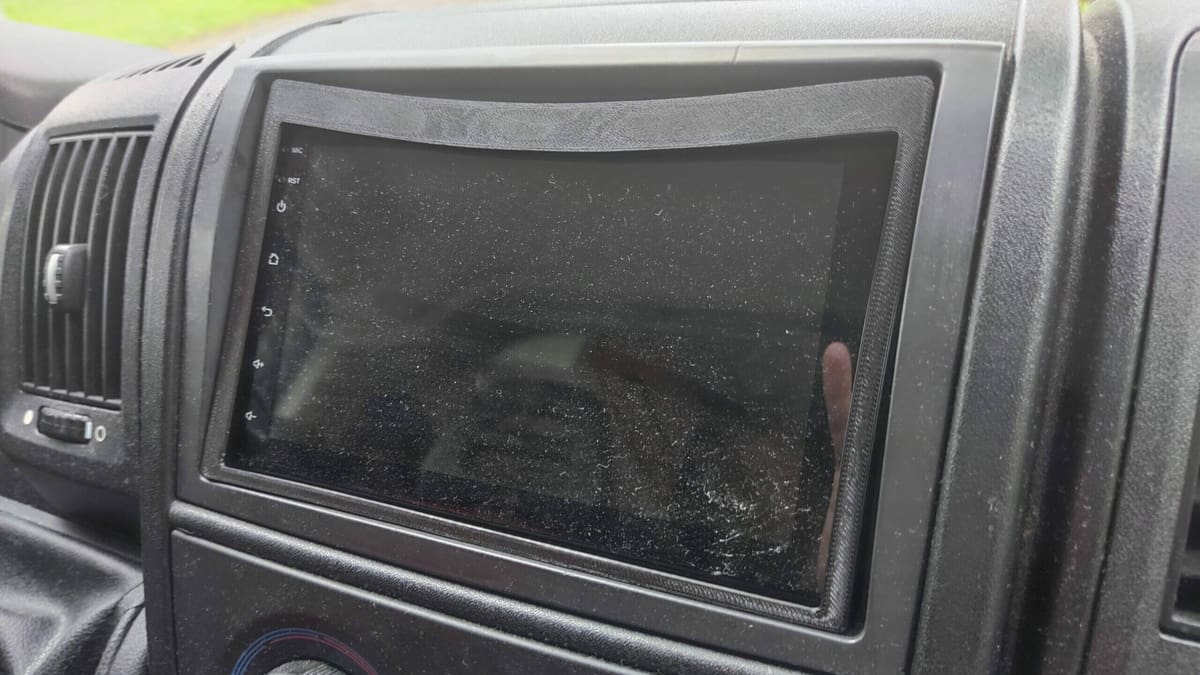
To delve into it a little deeper, PLA’s amorphous regions become more pliable when heated, which is what lets a part like the dashboard trim pictured above sag under nothing but its own weight. Its crystalline regions, though, don’t melt until a much higher temperature, so they can still hold the part’s overall shape together like a scaffold. That’s what creates the gap between Tg and HDT. PETG and ABS don’t have this option: they’re essentially fully amorphous, so once their chains loosen up past Tg, there’s no scaffold left, which is why HDT tracks close to Tg for both.
This characteristic of PLA means it can be specifically formulated to build in even more of that crystalline structure from the start. Polymaker’s HT-PLA is a good illustration of just how big a gap this can create: its Tg is about 60°C, yet the manufacturer says an unloaded print can hold its shape at temperatures up to 150°C. Under mechanical load, though, its as-printed HDT is only around 59–61°C — barely different from standard PLA. The difference illustrates exactly why Tg is useful, but isn’t by itself a heat-resistance rating.
That’s also why PETG and ABS are the usual recommendation for anything that’ll sit in a hot car or near another heat source under load; their glass transition sits well above the roughly 69°C (157°F) a dashboard can reach after an hour in direct summer sun. Push far enough past even those thresholds, though, and the same creep shows up: an ABS bracket mounted near an engine bay, or a PETG part left in a dishwasher’s heated dry cycle, can succumb to the same kind of heat-driven sag PLA shows on a hot dashboard, it just takes considerably more heat to get there.
Glass Transition Temperature During Printing
Tg also explains a few printing behaviors that otherwise seem arbitrary.
Bed temperature recommendations track Tg closely. PETG and ABS beds are usually set close to their Tg so the bottom layers stay soft enough to grip the bed and bond to each other, instead of seizing up rigid and popping loose or warping as they cool unevenly. Push the bed too far past that point, though, and the bottom layers stay so soft they squish under the weight of the layers printing on top of them, one of the mechanisms behind elephant’s foot.
PLA is the outlier, and now it’s clear why: room temperature is already close to, or below, its Tg, so it doesn’t need much help from a heated bed to begin with. That’s a big part of why PLA has a reputation as the easy, beginner-friendly material.
ABS takes the opposite problem a step further, and needs an enclosure for the same underlying reason: its Tg (100–110°C) sits so far above room temperature that an open printer lets the top of a tall print cool through Tg and lock rigid long before the bottom does, and that mismatched shrinkage is what causes ABS’s characteristic warping and cracking. An enclosure keeps the surrounding air warm for longer, so the whole part cools through Tg more evenly. PETG sits in between; its Tg is close enough to typical bed and ambient temperatures that it’s usually forgiving enough to skip the enclosure, which is part of why it’s treated as the “easier” alternative to ABS.
Raising the Ceiling
If a part needs to survive heat above a material’s stock Tg, there are two routes. One is annealing: deliberately warming a finished PLA print to around its Tg after printing, which lets those molecule chains reorganize into a tougher, more heat-resistant structure.
The gain is mostly about heat resistance, not raw strength. Tensile strength ticks up modestly, but PLA doesn’t get meaningfully more flexible from annealing. PETG and ABS don’t get the same benefit as both are essentially fully amorphous, so there’s no crystalline structure for the heat to build up and annealing doesn’t raise their heat ceiling the way it does for PLA.
The reason to anneal PETG or ABS is different: relieving the internal stress built up during printing, which improves dimensional accuracy and reduces the warping and cracking both materials, ABS especially, are prone to.
The other option, for PLA specifically, is reaching for a heat-modified filament instead of relying on a separate annealing step. Polymaker’s HT-PLA uses nucleating agents to encourage the same kind of crystal growth annealing produces, which is why it can hold its shape at temperatures standard PLA can’t.
You May Also Like:



License: The text of "Glass Transition Temperature of PLA, PETG & ABS: What It Means for Your Prints" by All3DP is licensed under a Creative Commons Attribution 4.0 International License.