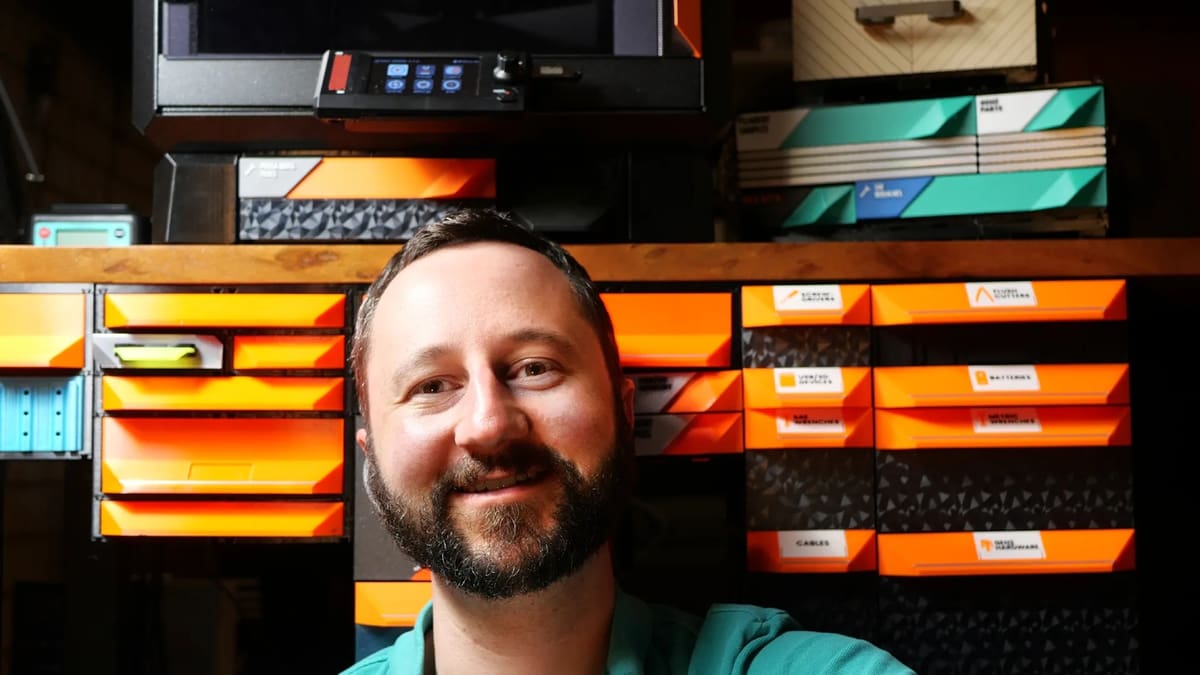
Designer Spotlight: Joey Gasper (Jerrari)

Looking for *the* modular system to organize your workspace? Joey Gasper, a.k.a. Jerrari, has many useful designs you'll want to check out.
This week’s Designer Spotlight shines a light on Joey Gasper, a.k.a. Jerrari.
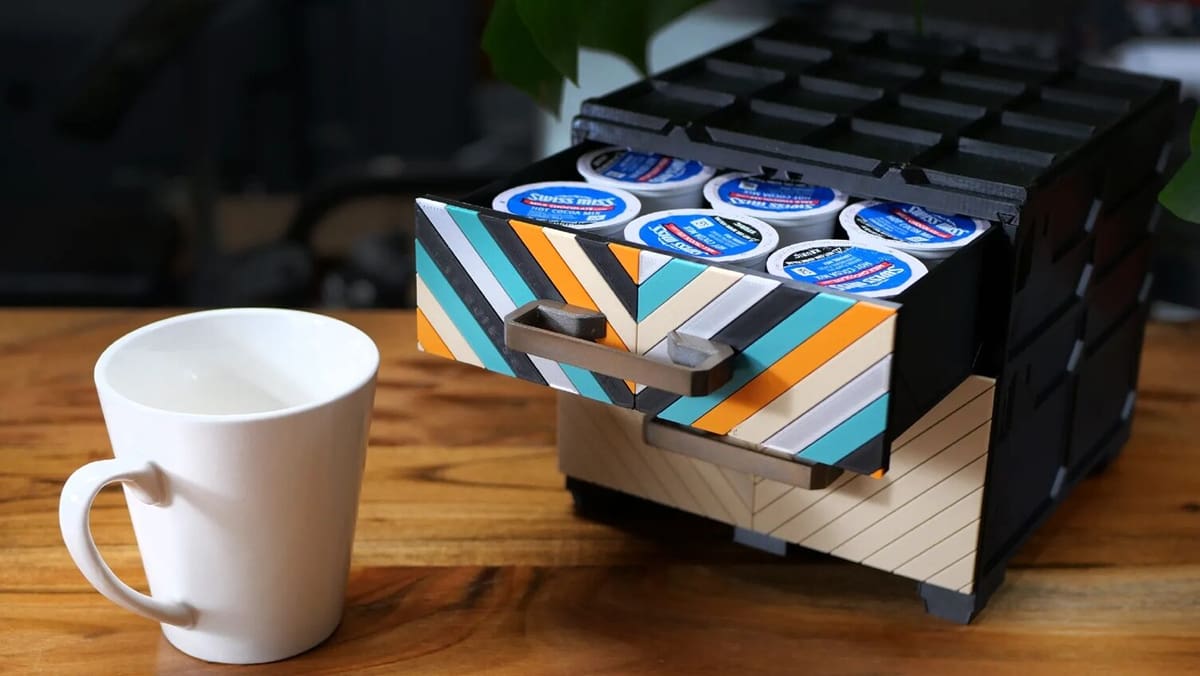
A designer whose Printables Club boasts almost 250 members, Joey’s shared over 150 designs that are meant to bring order to any workspace. In true maker fashion, these can also be remixed to suit individual setups and needs, although the almost 130 designs from the GEN2 Modular Storage System and around 80 options from the GEN2 Decor Series Drawers will more than likely include what you’re after.
How did these comprehensive collections (and many more designs) come to be? Let’s find out, straight from the creator.
Q&A
All3DP: Tell us a little about yourself – what’s your background?
Joey: When I was a kid, I loved building practical structures out of K’Nex and Legos. That hands-on creativity eventually transitioned to digital creation when we got our first computer, a Windows 95. I was fascinated by what it could do, and that’s what sparked my interest in 3D graphics.
As a teenager, I got into 3D modeling and rendering, but after a few years, I stepped away from it when I couldn’t find many practical applications for the skill. I eventually studied graphic design in college and later worked at an embroidery company as a digitizer. That job gave me hands-on experience with machine-driven processes, which I later realized shared a lot of similarities with 3D printing workflows.
After more than a decade away from 3D modeling, discovering 3D printing brought everything full circle. It reignited that early excitement I had for both physical making and digital design and gave me a way to combine all the skills I’d developed.
How do you get the ideas for your designs?
My designs usually start from a need, something simple like a tool hanger, or what kicked off my largest project, creating a simple drawer back in 2019. What I love about 3D printing is that is allows for constant improvements; I’ve revisited that original drawer design multiple times over the past six years to transform it from something pretty simple to a fully modular system that snaps together and can be reconfigured in seconds.
Other ideas branch unexpectedly from other innovations. For instance, I was trying to modify my drawers to print the face separately, so that the body could be printed with less expensive filament and the face with a more expensive material. It was then that I discovered how much I could customize them. Today, this is known as my GEN2 Decor Series, and it’s become one of my favorite parts of the project. It gives me a creative outlet to explore aesthetics and expression beyond just designing for function.
Having a club and a growing community around the project has also greatly helped, as there are requests and ideas coming faster than I can design them now.
How much does the technical side of 3D printing (e.g. supports, a design that requires assembly or one that’s printable in one piece) come into play when you’re designing? Or is your designing entirely independent from 3D printing and you later figure out how they work together best?
I want it to be as easy as possible for anyone to print, whether you’re a seasoned hobbyist or someone just starting out. Ideally, it should be as simple as loading the file and pressing “Print”. I design with the goal of avoiding supports entirely and keeping everything compatible with default slicer settings. I’m also always testing ways to reduce material usage while maintaining structural integrity. You can see this approach in my GEN2 drawer cases, where thin shell walls are reinforced with internal beam structures to balance strength and efficiency.
Of all the things you’ve created, which are you most fond of and why?
The GEN2 Modular System, especially the QuickLock mechanism. That one feature changed the whole system, it turned assembly and swapping from a minutes-long process to a few seconds. It might look simple, but it had a huge impact on usability and set the tone for the rest of the system’s evolution.
Beyond the function, what I’m most proud of is how people use it. Seeing others remix it, expand it, or adapt it for totally different workspaces tells me I’ve made something flexible and genuinely useful.
If you could step back in time and give yourself some advice from the beginning, what would it be?
Get involved with the community sooner. Some of the most rewarding parts of this journey have come from conversations with other makers, sharing ideas, getting feedback, and just having that mutual excitement around what we’re building. If I had started connecting earlier, I think it would’ve helped me grow even faster.
Rapid Fire
- Favorite CAD software? Fusion – it’s been my go-to for years, and I’m just now starting to explore Blender too.
- Favorite slicer? Mostly PrusaSlicer. I’ve used it since it was Slic3r, it’s both simple and powerful and constantly improving.
- Favorite 3D printer? It’s hard to choose, but I still have a soft spot for my old Prusa MK2. The sound of it printing is nostalgic. That said, the Prusa XL with its multi-tool capabilities has really unlocked new possibilities for me.
- Favorite filament material to print with? Wood-filled PLA. It’s fun to experiment with, and when you stain it lightly, it can really look like wood furniture.
- Favorite filament brand? Proto-Pasta. Their line of metal filled filaments are fascinating to use.
Find Him On
Do you want to be reminded of the next designer profile? Sign up for our newsletter.
License: The text of "Designer Spotlight: Joey Gasper (Jerrari)" by All3DP is licensed under a Creative Commons Attribution 4.0 International License.