We Found 7 Game-Changing 3D Printers at Rapid + TCT 2026 & the Tech Trends That Actually Matter

From Anycubic’s surprise reveals to HP’s new entry-level industrial power, we hit the Boston show floor to identify the machines—and the shift from speed to material mastery—shaping the next year of 3D printing.
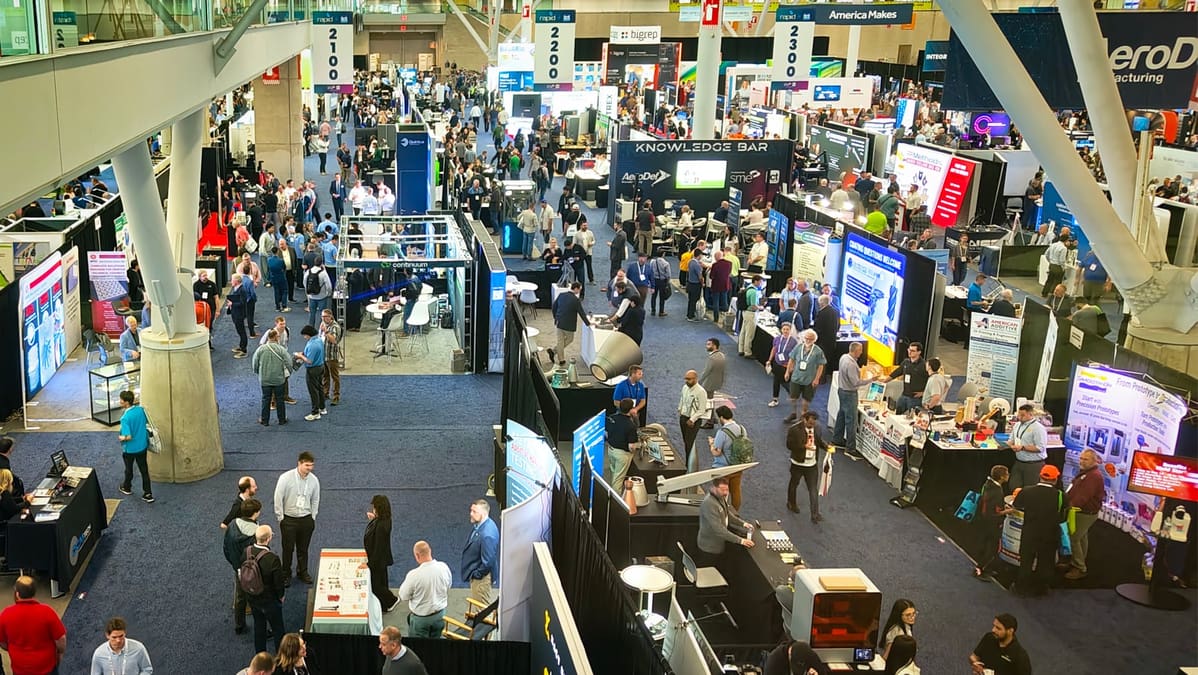
Rapid + TCT 2026 just proved that the race for ‘faster’ is over. The new battle is for material mastery. From surprise reveals that challenge Bambu Lab’s dominance to industrial breakthroughs now within reach of smaller shops, we hit the floor in Boston to find the tech that actually matters. Here are the standout 3D printers that stole the show.
As always, the event features a mix of consumer and industrial brands along side materials, software, and 3D scanners.
As consumer brands push upmarket with larger, faster, and more feature-packed machines capable of higher temperatures and greater throughput, key industrial players are moving in the opposite direction: toward accessibility.
HP and Stratasys, in particular, appear to be responding to demand from manufacturers that have long coveted their category-leading technologies (Multi Jet Fusion and PolyJet), but aren’t ready to dive into a mid six-figure investment.
All eyes were on HP with the launch of its smaller and cheaper entry point to Multi Jet Fusion, the MJF 1200, while Stratasys’ aimed for the sweet spot between capability and cost with a version of PolyJet focusing on functional prototyping.
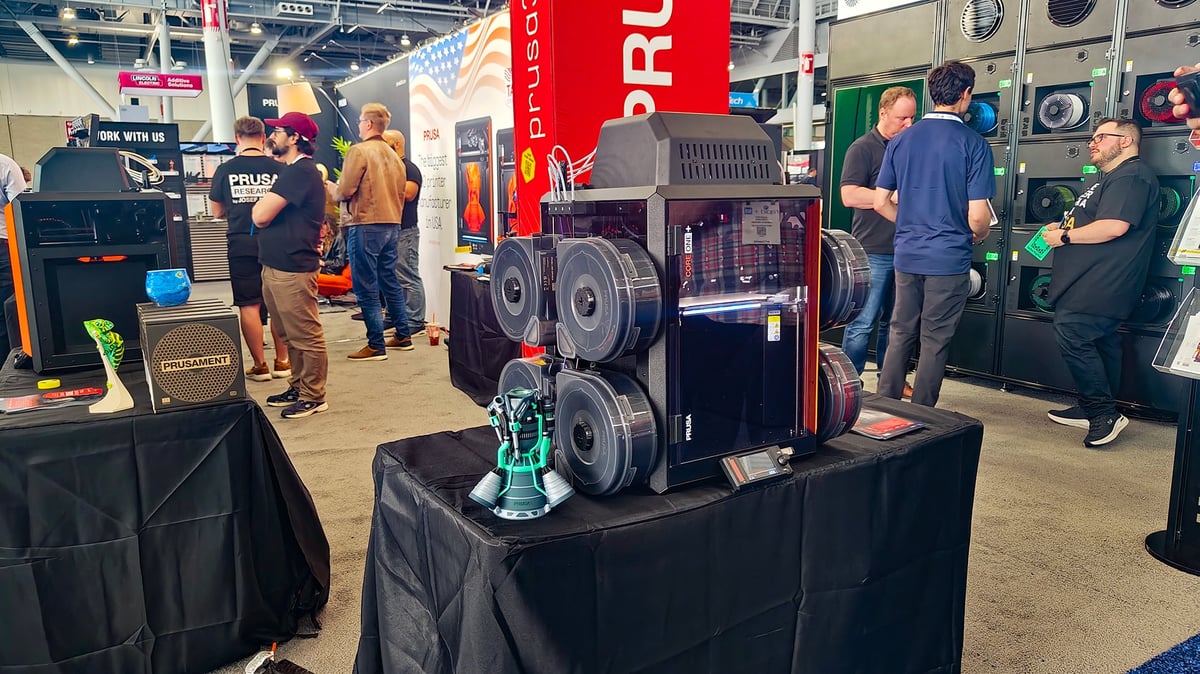
The top consumer brands (Elegoo, Creality, Prusa) were present with significant launches that focus on tool changers and larger build volumes. Although Bambu Lab was notably absent from the event, it launched its new X2D this week anyway just to steal some headlines, which is certainly did.
Keep in mind that many of these machines are currently unavailable. They’ll be rolled out with more detail in the next three to eight months.
New FDM 3D Printers
The new FDM machines in this lineup span nearly the whole desktop market, from affordable consumer models like the Anycubic Kobra 4 and Elegoo Centauri 2 to more ambitious, feature-heavy systems such as the Flashforge Creator 5, Atomform Palette 300, and Prusa’s Core One with INDX. Taken together, they suggest that the current battle is no longer just about print speed or bigger build volumes.
The real focus is shifting toward smarter material handling, more enclosed and polished hardware, and easier multi-color or multi-material printing. One notable surprise is how strongly multi-material printing shows up across the category, but with very different approaches depending on price point: lower-cost machines lean on add-on filament systems, while higher-end models push toward more advanced multi-tool or industrial-style setups.
BigRep One.5X
BigRep is pivoting its flagship large-format FDM 3D printer toward a more accessible future. The new One.5X isn’t just 10% faster; it introduces a game-changing pellet extrusion system (later this year) designed to slash material overhead for full-scale industrial parts. The One.5X has technical upgrades aimed at solving persistent pain points in large-scale printing, such as manual calibration and high material overhead.
The One.5X preserves the defining characteristics of the platform – most notably its one-cubic-meter build volume – while introducing automated XYZ calibration, adaptive mesh bed leveling, pre-configured material profiles, auto-sequential job execution, and Relay Mode, which transfers print operations to a secondary extruder when material depletion occurs.
Atomform Palette 300
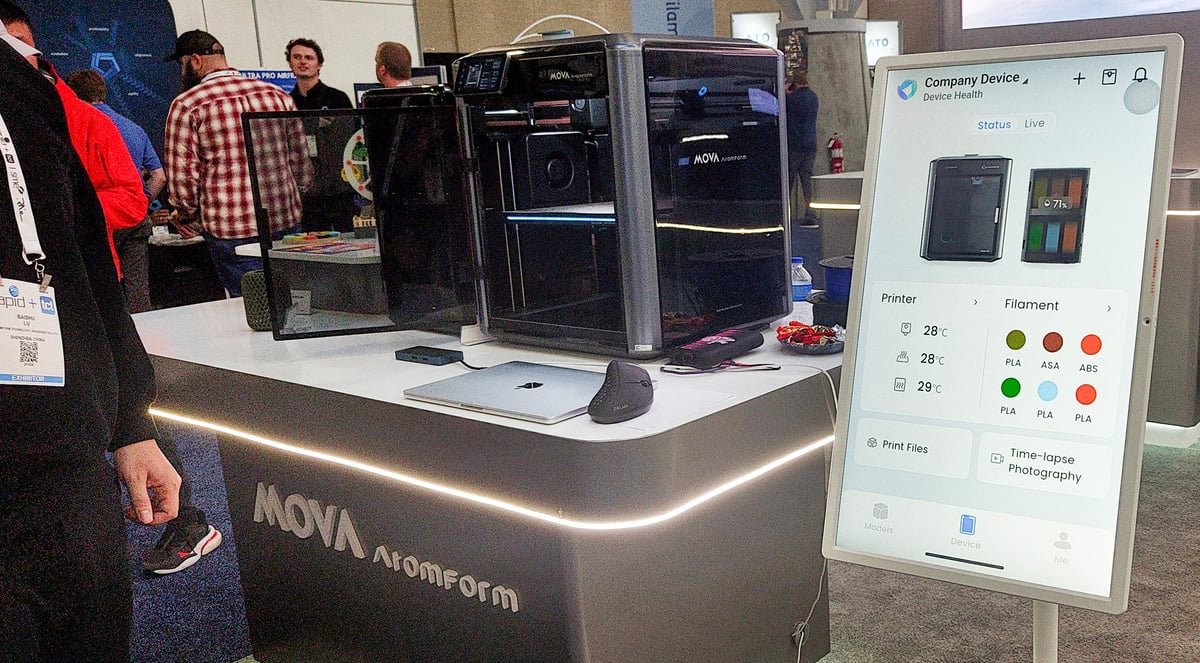
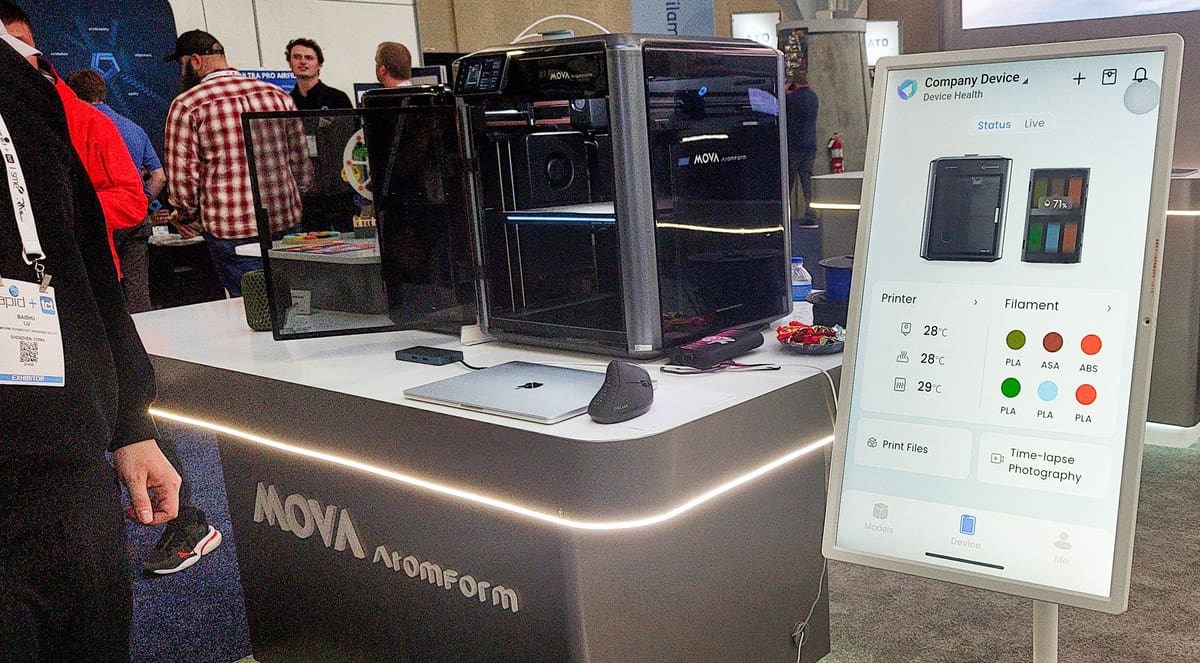
Newcomer Atomform brought its Palette 300 twelve (yes, twelve) nozzle-changing 3D printer to Rapid with a statement booth all the more conspicuous for Bambu Lab’s absence. Atomform is clearly gunning for Bambu Lab, with a software experience that takes heavy cues from, and in some ways possibly improves on, the incumbent.
Expected to launch in June, AtomForm is pitching the Palette 300 as a different take on multi-material FDM: instead of relying on a single toolhead and purge-heavy filament swaps, the enclosed 300 x 300 x 300 mm machine uses auto-swapping nozzles and a ReadyPrint feed system to line up the next material before the change happens. The company told us that setup enables printing with up to 36 colors or materials in a single job, cutting swap time by 50% and waste by 90% compared to single-nozzle systems that require the nozzle to be purged (the Palette 300, to a degree, doesn’t).
Beyond the headline feature, the specs place it firmly in the high-speed desktop category, with a claimed 800 mm/s print speed, 25,000 mm/s² acceleration, a 350 °C hotend, 65 °C heated chamber, and support for materials ranging from PLA and PETG to PC and PPA. AtomForm is also bundling in a strong automation story, including camera-based nozzle verification, ±0.02 mm nozzle-center compensation, active auto-leveling, vibration compensation, app-based monitoring, and an optional RFD-6 six-spool drying, storage, and feeding unit.
Our demo saw the printer hiccup changing nozzles multiple times, though in every case the machine worked its way though the issue to continue on. One we’re watching with great interest.
Anycubic Kobra 4
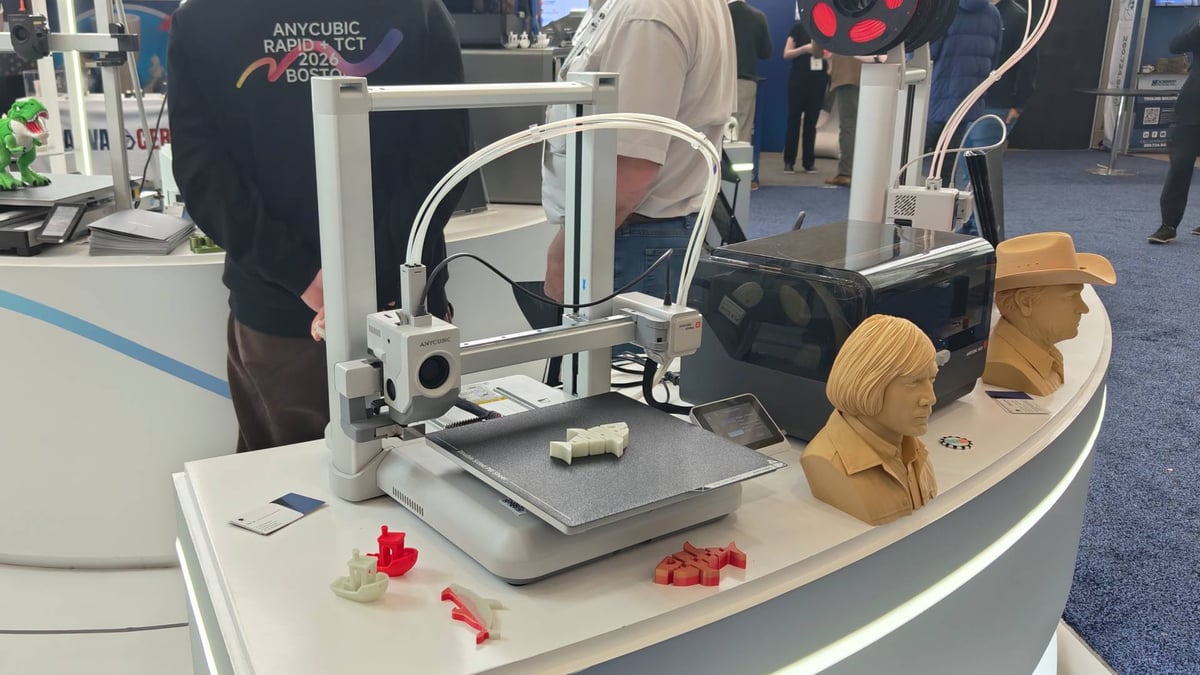
Anycubic’s Kobra X appears to have served as the platform base for the company’s surprise reveal of the Kobra 4. A full number update over the Kobra 3 (obviously) the 4 ditches the bare aluminum looks of its predecessor for the clean, white, bubble-like Kobra X. Despite the similar looks, the Kobra 4 drops the experimental dual channel print head – which gave purge and time savings at filament changes – for the traditional print head with four-filament-channel multiplexer. Compatibility with the company’s second generation ACE filament boxes is standard, with the ability to chain a couple together.
We were told the 4 has been the most reliable Kobra the company has ever put out at a trade show, requiring little to no intervention from the engineers who flew over from China with it. That bodes well.
Expect to see it sometime in the next couple of months, with the company aiming for a sub-$300 price tag for the base printer.
Elegoo Centauri 2
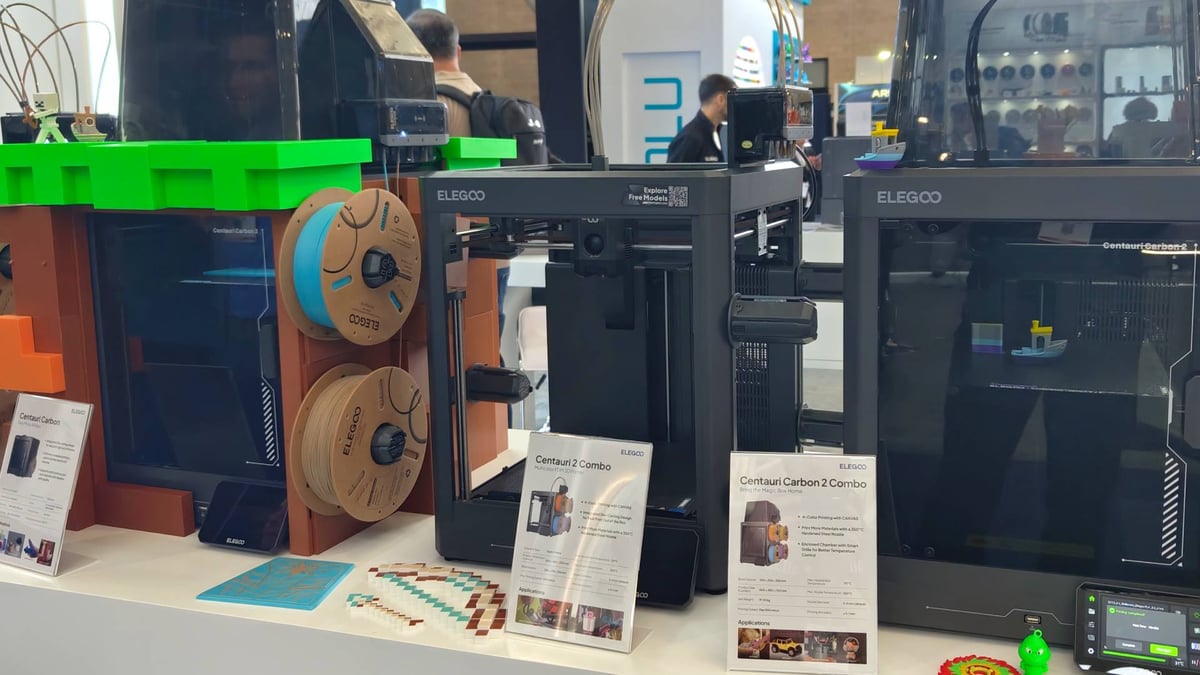
Elegoo’s budget friendly iteration of the Centauri Carbon 2, called the Centauri 2, got its debut at Rapid. Like the original Centauri to the Centauri Carbon, the Centauri 2 3D printer loses the camera and sensor suite along with the walls and door, leaving it a raw printing experience with a lower performance ceiling for higher temp materials.
Available as the Centauri 2 Combo with the new Canvas filament changer that feeds up to four colors or materials into a given print, the printer is expected to launch in Q2.
Flashforge Creator 5
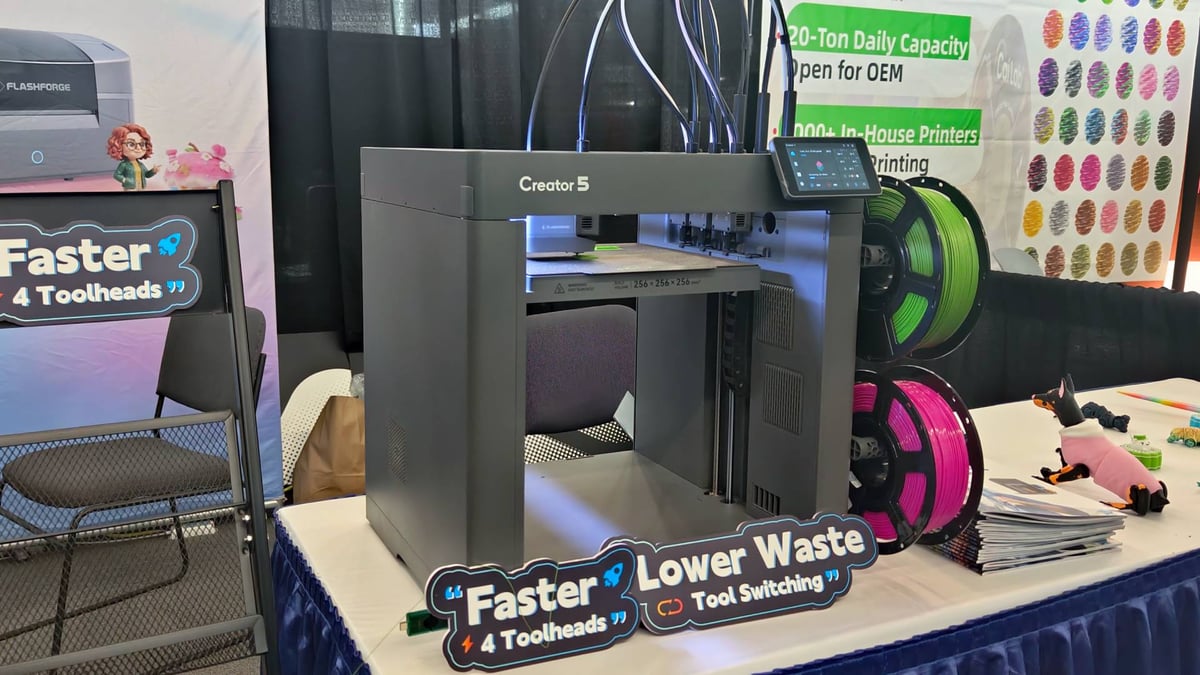
Making its second showing since Rapid +TCT Asia, Flashforge’s new four-tool toolchanger, the Creator 5, was on hand and printing away, showing it’s no slouch. As we mentioned in our coverage last week, The Creator 5 is another of the new wave of purgeless multicolor printers, Flashforge’s recent announcement of the Creator 5 points the way to a new race to the bottom on price. Its $649 launch price tag is a gloved slap at the $899 Snapmaker U1 that we’re sure will be emulated by others.
Prusa Core One+ w/ INDX
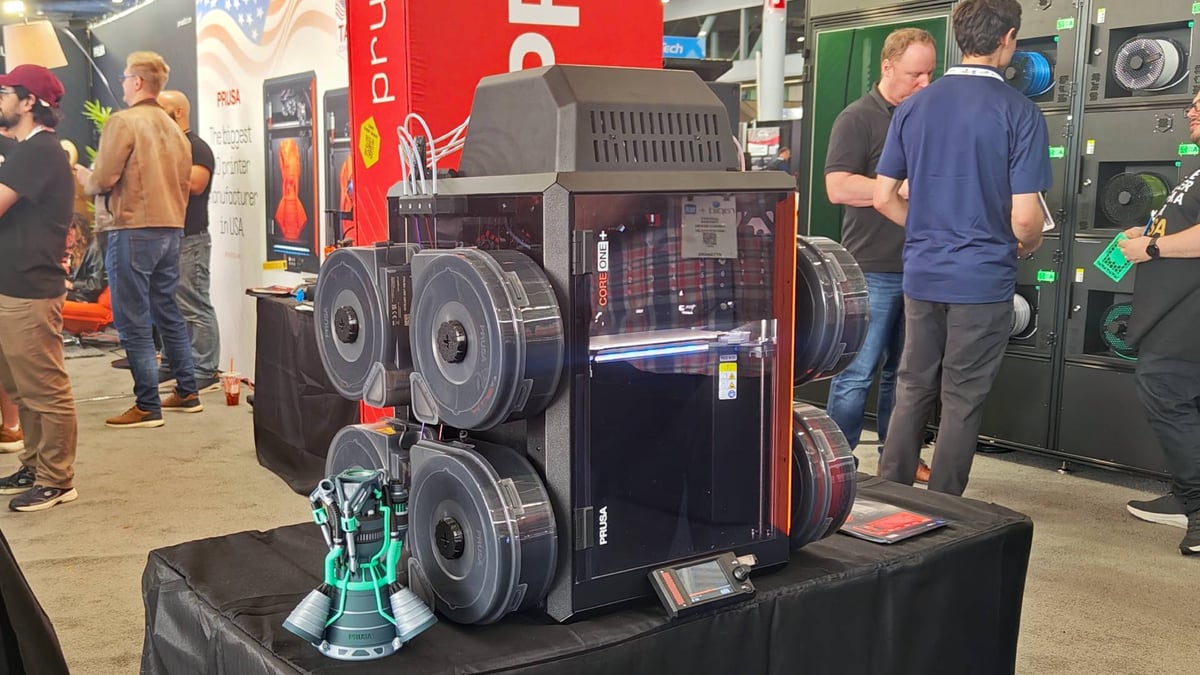
Prusa reminded us all that we’re still waiting on the release of the INDX upgrade for its Core One+. Demo units, flanked by the company’s new USS drybox system, were merrily printing away throughout the show. When it does release, expect fast nozzle changing for up to eight filament printing with close-to-zero purging promised. No new details were shared for the release, which is slated for Q2. We suspect it’ll be later in Q2, not sooner.
New Resin 3D Printers & Materials
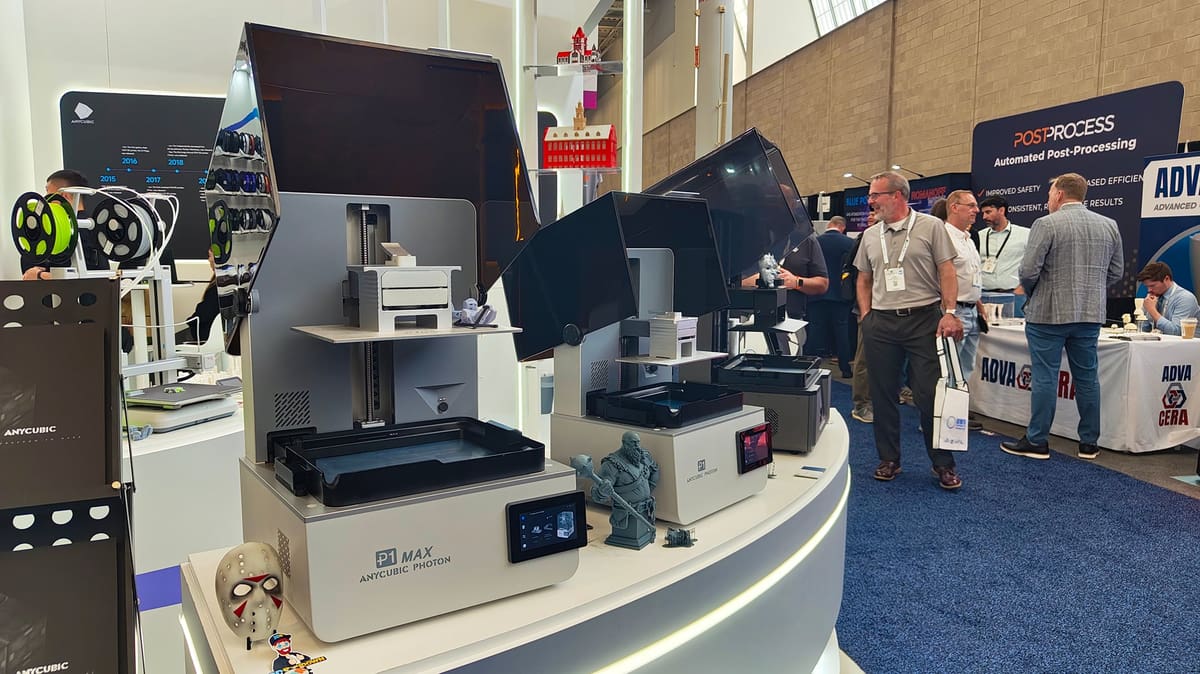
The new resin machines from Rapid + TCT this year show a category that is clearly aiming up. Instead of a pack of similar-looking launches, these printers each seem to have their own lane: the Elegoo Jupiter 2 goes bigger for users who want more build space, the Creality Halot X1 Max adds more automation and production-minded features, and the HeyGears Reflex RS Max keeps pushing resin printing toward a more polished, professional workflow.
The bigger takeaway is that resin printing is no longer just about sharper details and faster exposure times; it’s about making the whole process easier, more reliable, and better suited to specific kinds of users. What stands out most is how different these machines feel from one another, which makes the market less about head-to-head competition and more about where resin printing is heading next.
Elegoo Jupiter 2
Elegoo’s Jupiter 2 is finally here, a year to the week since its trade fair debut at Rapid TCT 2025. For $949, you get a 302 × 162 × 300 mm build volume and the modern trappings of intelligent resin 3D printing, albeit without the tilt vat or other speed-giving technologies we see on pricier systems. Shipping starts in June.
Creality Halot X1 Max
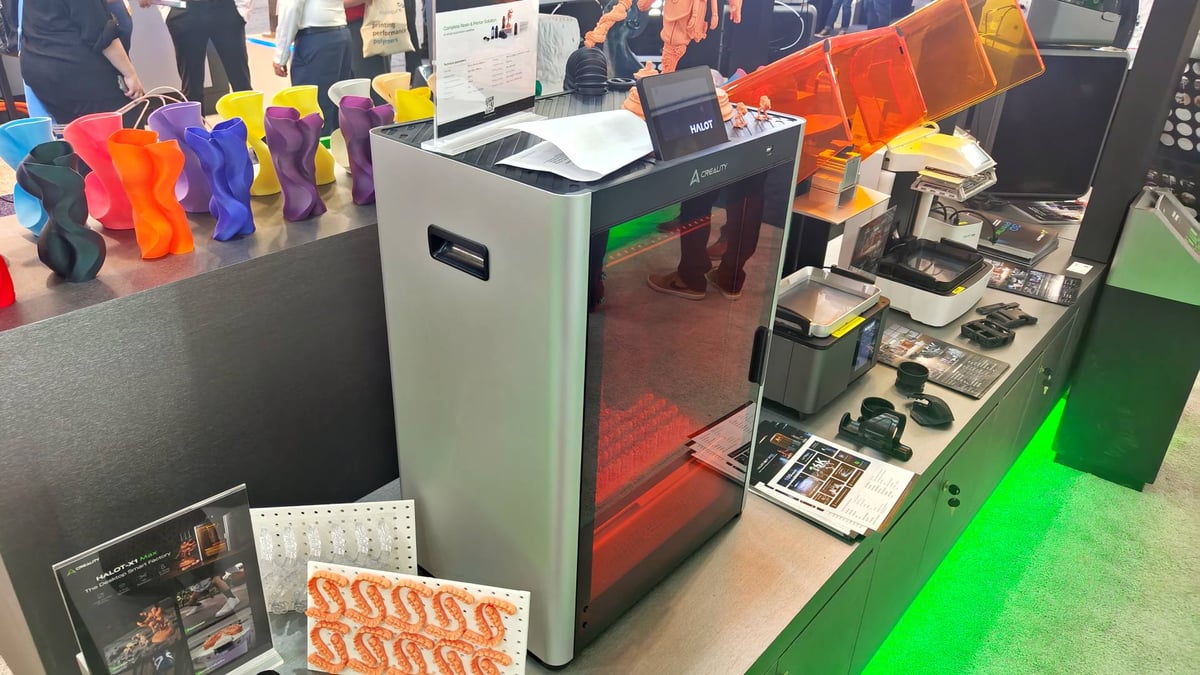
The Elegoo Jupiter 2 wasn’t the only large format resin printer to get attention this week. Creality brought a printer they describe as “the desktop smart factory”. It’s called the Halot X1 Max, but is basically an all new printer rather than a simple grow up of the original Halot X1. Details are thin still, but we know it’ll pack a 16K LCD for masking into its large build volume, and something called “AI temp control” will presumably maintaining the resin temperature throughout printing.
HeyGears Reflex 2 Max
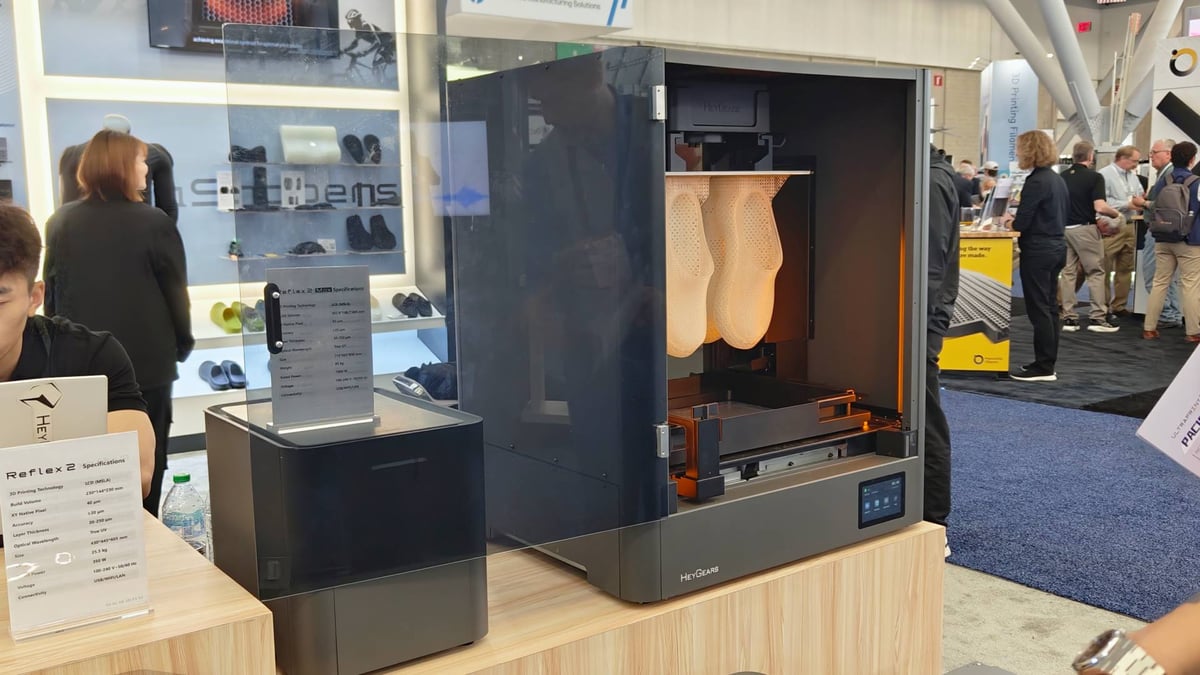
Another large format desktop resin debut at Rapid belonged to HeyGears, whose Reflex 2 Max printer (together with Wash Max and Cure Max) rounds out the Reflex 2 series with a cavernous ~350 x ~200 x ~400 mm build volume. Intelligent resin control, and the expected HeyGears firmware and software smarts positions the printer as a high-detail workhorse for exacting, large volume jobs.
The Reflex 2 Max is HeyGears’ largest desktop printer to date.
Stratasys J850 Core
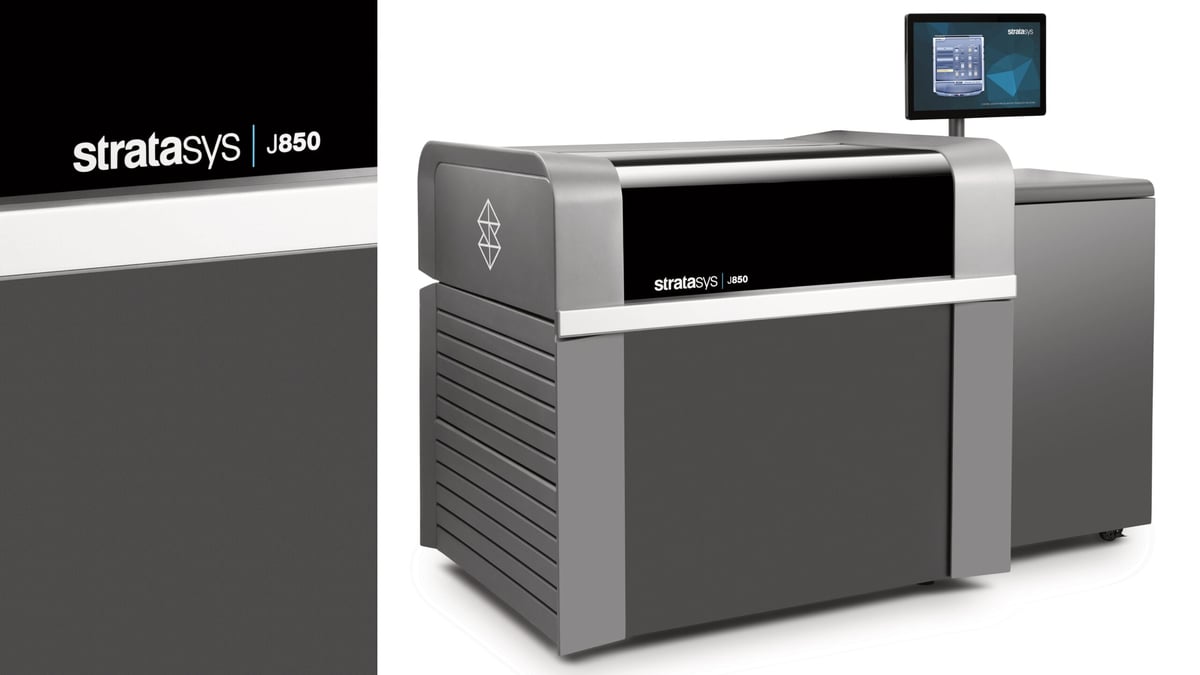
Technically a resin 3D printer, the new the Stratasys J850 Core is a streamlined PolyJet system designed for engineering teams that prioritize functional prototyping over aesthetic presentation, the company says, which essentially means it’s not color. By stripping away full-color capabilities, Stratasys says it can lower the price (as of yet undisclosed) but maintain the high-speed performance and reliability expected of the J850 series with many of the same materials.
While it reduces material channels to three and simplifies the build modes compared to the J850 Pro, it retains the identical 14-micron resolution, accuracy, and large build tray. This makes it an ideal solution for fast-moving teams that need to validate parts daily and scale their operations without the added cost and complexity of high-end material mixing.
New Powder Bed Fusion 3D Printers (Polymer & Metal)
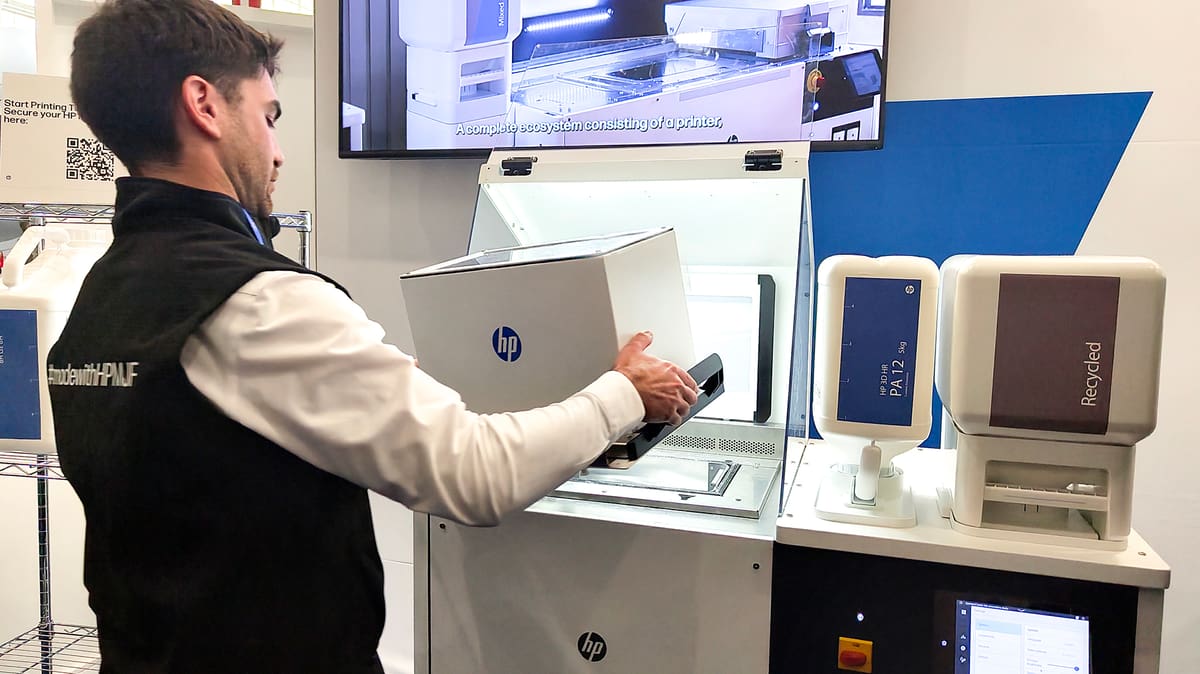
Although they serve very different markets, both the HP MJF 1200 and the Union Tech Muees430 Pro share a common goal: lowering the barrier to entry for industrial-grade production.
By focusing on more compact footprints, automated workflows, and “approachable” entry points, these systems signal a shift where professional polymer and metal 3D printing are no longer reserved for high-budget factories.
HP MJF 1200
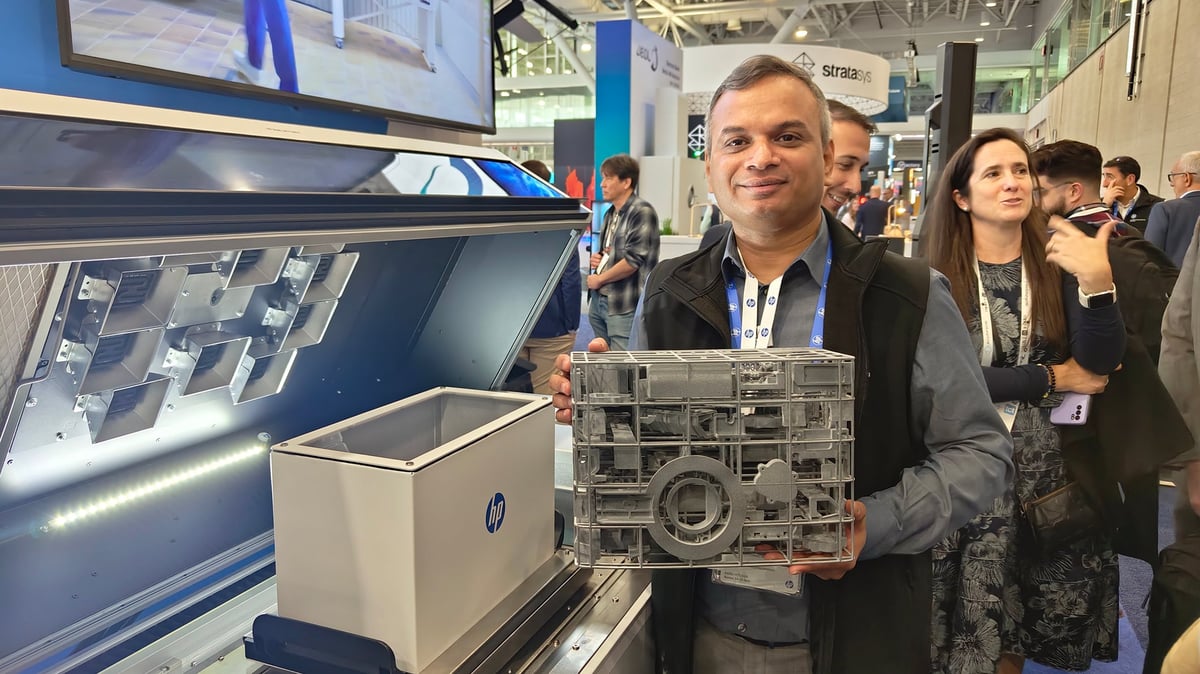
At Rapid + TCT in Boston, HP introduced the MJF 1200 as a more approachable entry point to its Multi Jet Fusion lineup, pairing the compact new printer with the HP 3D Printing Service Powered by Craftcloud so users can order professional MJF parts even without owning a machine. Designed to be smaller, faster, and easier to use, the MJF 1200 features a 12-liter build volume—much smaller than the 41-liter build units used across most existing MJF systems—and adds new automated steps for material mixing, build prep, and part unpacking to cut down on manual work.
HP says the MJF 1200 delivers the same core technology used across its broader additive manufacturing portfolio, making it capable of producing strong, functional polymer parts for real-world use, not just prototyping. Supported by Materialise’s Magics Print for HP software, the system is intended as a scalable starting point for companies moving into industrial 3D printing. As HP’s global head of product and strategy Arvind Rangarajan put it, the goal is to help customers move from “exploring 3D” into “real 3D printing,” with part quality that is “indistinguishable” from what comes off HP’s larger industrial printers.
UnionTech Muees430 Pro
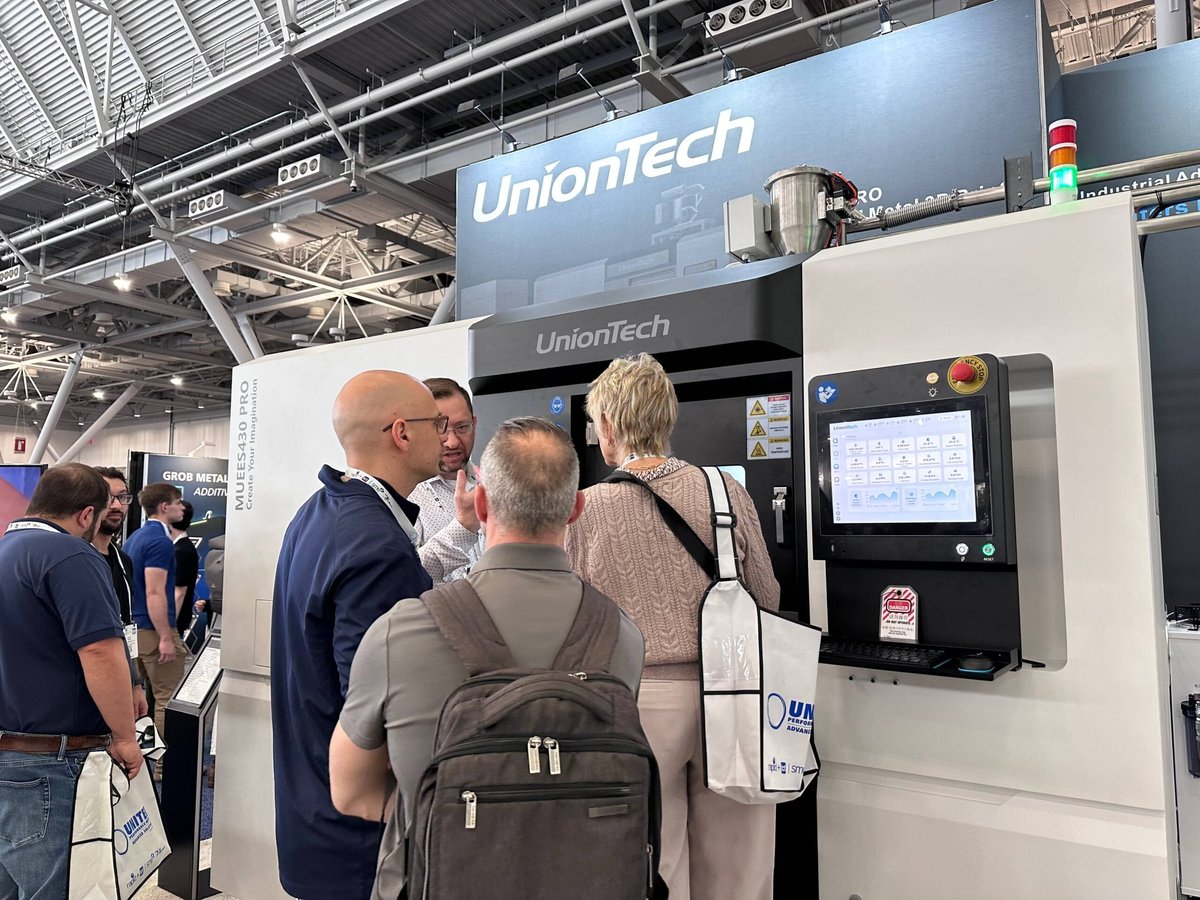
Unveiled at Rapid + TCT 2026, the Muees430 Pro was introduced as UnionTech’s latest push into industrial metal additive manufacturing, with the launch centered on one clear message: more output, more durability, and a stronger fit for batch production. Rather than framing it as an experimental or niche system, UnionTech presented the machine as a serious production platform built for manufacturers looking to scale metal LPBF.
The Muees430 Pro stands out for its four-laser configuration, a claimed 20% efficiency increase, and a stated 40,000-hour service life. Those features gave the launch a practical, production-minded tone, positioning the machine less as a showcase piece and more as a system designed to keep pace with demanding industrial workflows.
Look for more new printer details here on All3DP as they become commercially available.
_____________________________
Never Miss Any News:

License: The text of "We Found 7 Game-Changing 3D Printers at Rapid + TCT 2026 & the Tech Trends That Actually Matter" by All3DP Pro is licensed under a Creative Commons Attribution 4.0 International License.