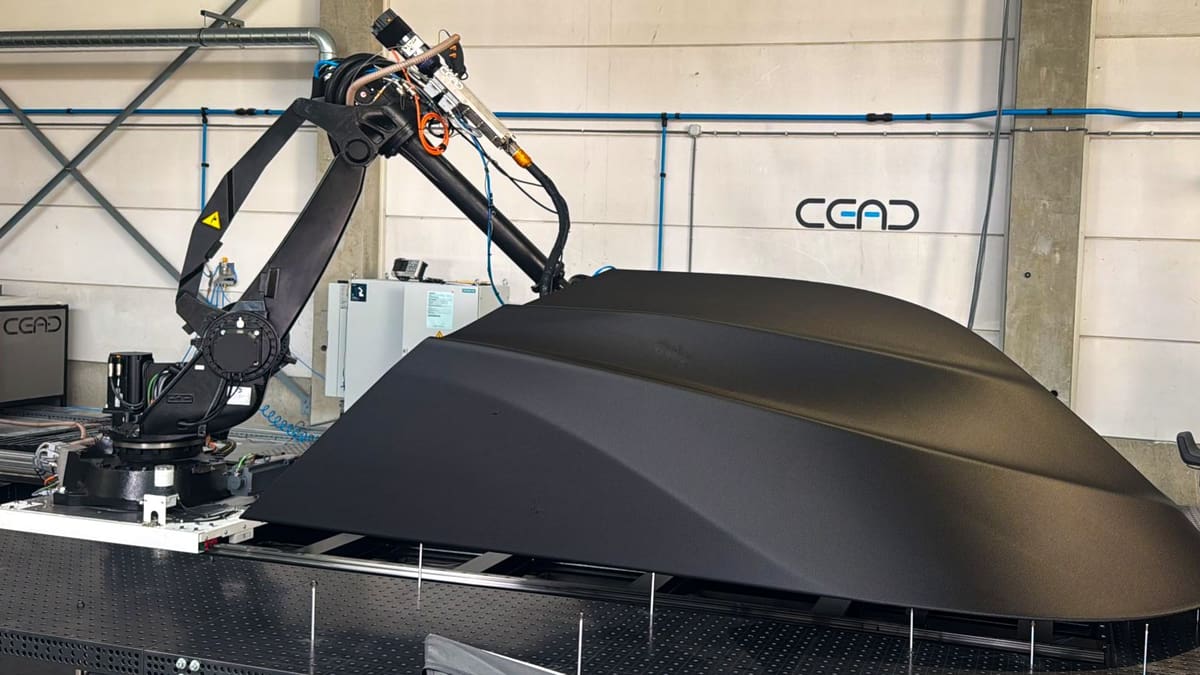
From Houses to Rockets: Why Robotic Arm 3D Printing Is Now Nearly Everywhere

Robotic arm 3D printing – aka robotic additive manufacturing – is gaining ground as a flexible, efficient way to 3D print larger, faster, and cheaper.
From multistory houses and full-size boat hulls to rocket components and marine propellers, robot 3D printing – also called robotic arm 3D printing or robotic additive manufacturing in on the rise. It’s virtually limitless when it comes to materials (polymers, metals, concrete, etc.) and it can make large and complex parts that traditional 3D printers cannot.
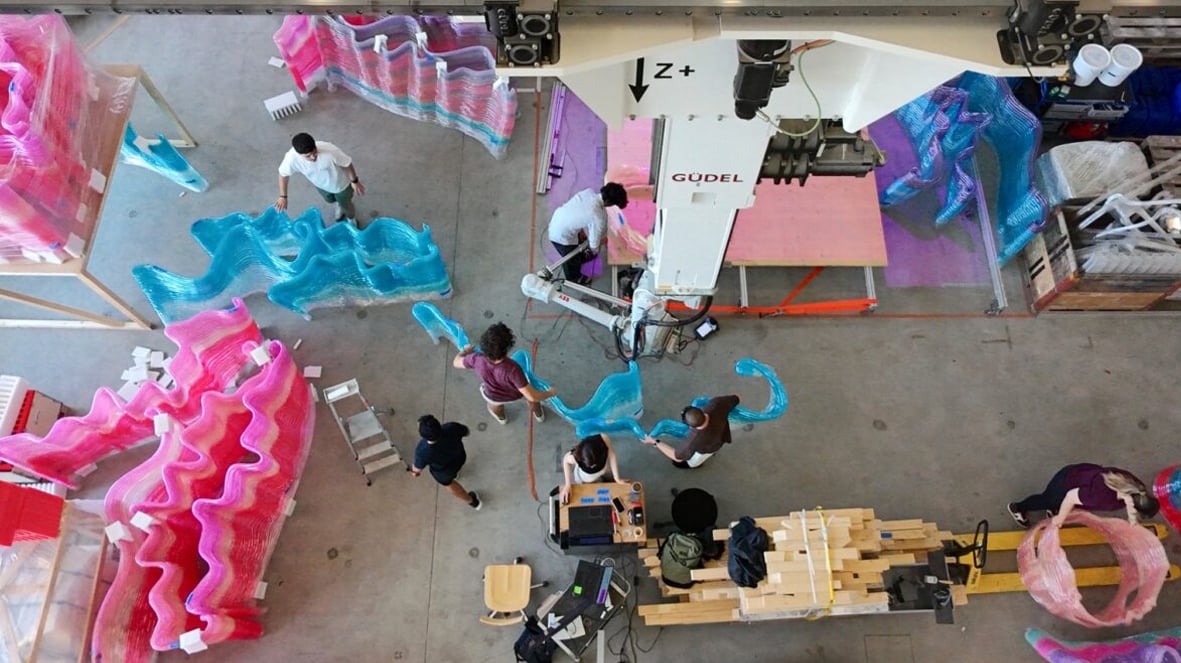
The use of robotic-arm 3D printing is gaining attention both in terms of technology maturity and industrial adoption. In the Wohlers Report 2025, which tracks and analyzes the state of the additive manufacturing industry, “the deployment of mobile additive manufacturing robots is transforming production landscapes, aligning with Industry 4.0 smart factories. Over the next five years, the AM industry will see substantial growth across multiple robotic technologies.”
With its high movement range, the robotic arm is increasingly used for large projects, such as mold-making, large-scale prototypes, artistic sculptures, architectural elements, furniture, and even rockets. It opens up a whole new world of design freedom in 3D printing. The arm can print from virtually any angle, enabling extremely complex, curved geometries. It also provides much larger print sizes than regular printers – up to 30 meters or more!

Arms Have Advantages over Gantries
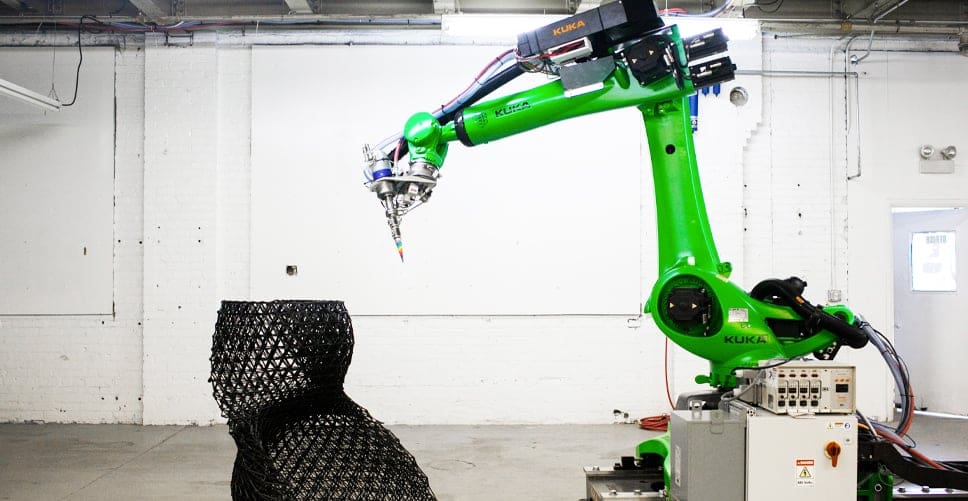
Printed parts from robotic arm 3D printers generally don’t require supports, which further increases the degree of design freedom and saves money on material costs. This does require the structures to be self-supporting, which would typically rule out overhanging designs. However, many manufacturers have solved this problem by allowing the building platform to be reoriented, making it possible to create overhangs by aligning the extrusion layer with the underlying geometry to use it as support.
Another unique feature of robotic arm printers is that they don’t require the slicing software to create the layers as needed with fixed-axis printers. Thanks to the multi-axis toolpaths, these machines are programmed with specialized 3D printing software (see below) that’s similar to traditional robotic arm programming software, but with a layer of additive-manufacturing–specific logic added on top.
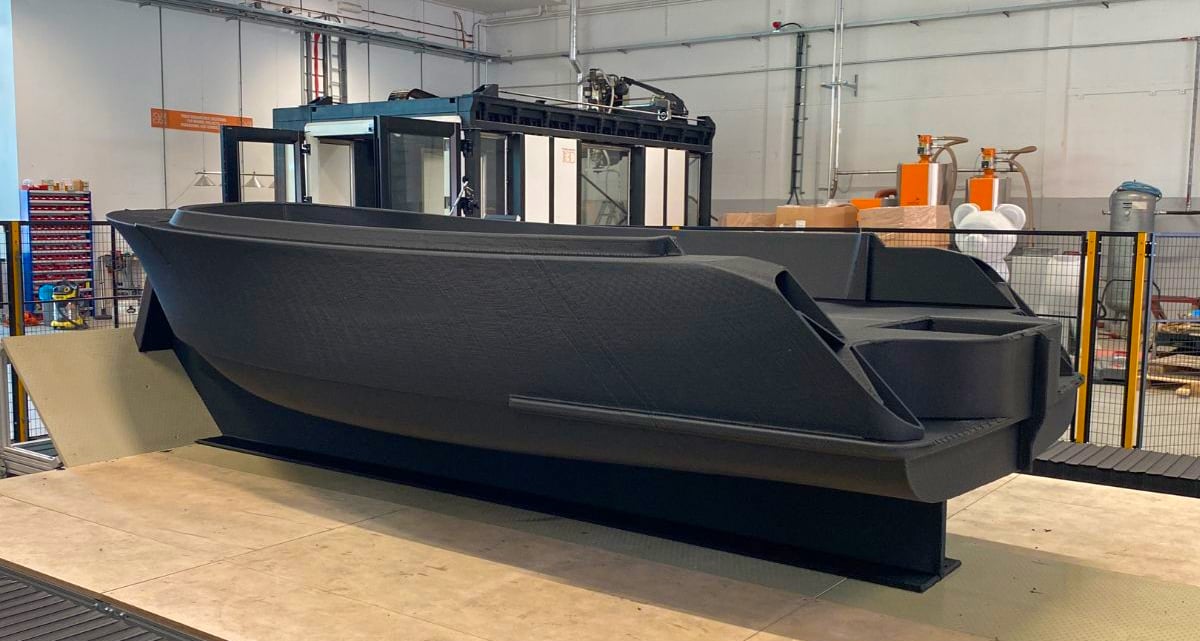
Another distinguishing feature of robotic arm 3D printers is that they are primarily “build-your-own,” although the number of turnkey platforms is growing. It’s most common for companies to purchase a robotic arm, an extruding unit, software, and other parts separately. Although this can be a drawback, for industrial manufacturing where many companies already own robotic arms, the ability to outfit them with new equipment for new uses makes the technology more accessible and familiar.
Cheaper, Sustainable Materials
Robotic arm 3D printers do not use giant rolls of filament. Instead, they typically use polymer material in pellet or chip form; metals in wire or powder form; and clay or concrete-type materials from a special vat.
How Robotic Arms Become 3D Printers
Robotic Arms for Polymers
The extruder mechanism draws the pellets from a central hopper and heats them to create the exact amount of viscosity needed for extrusion based on the type of plastic. Plastic pellets are used in various industries, including injection molding, so they’re typically vastly cheaper than the plastic filament used in conventional extruder 3D printers. The pellet form also opens up opportunities to mix materials and create custom blends, plus use recycled plastic that’s been shredded. Printing with pellets and shreds is also faster than printing with filament since it’s usually found on larger machines with longer heat zones that enable higher material throughput.
Robotic Arms for Metal
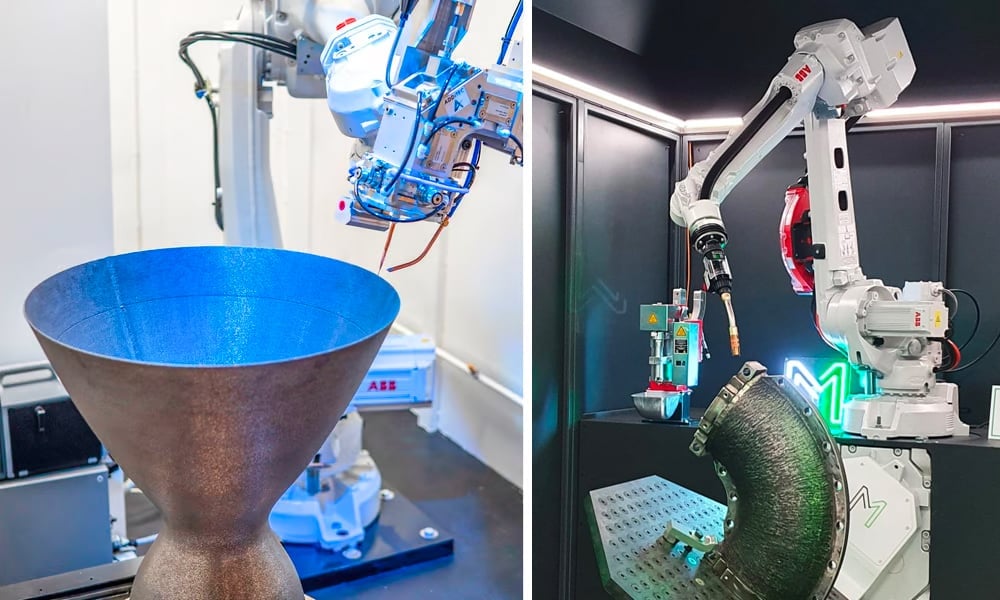
Robotic arm 3D printers are not limited to plastics, of course. However, 3D printing with metal and robotic arms typically falls under the wire arc additive manufacturing (WAAM) technology category or the directed energy deposition category, which we cover in separate guides, so we won’t go in-depth here.
Robotic Arms for Concrete
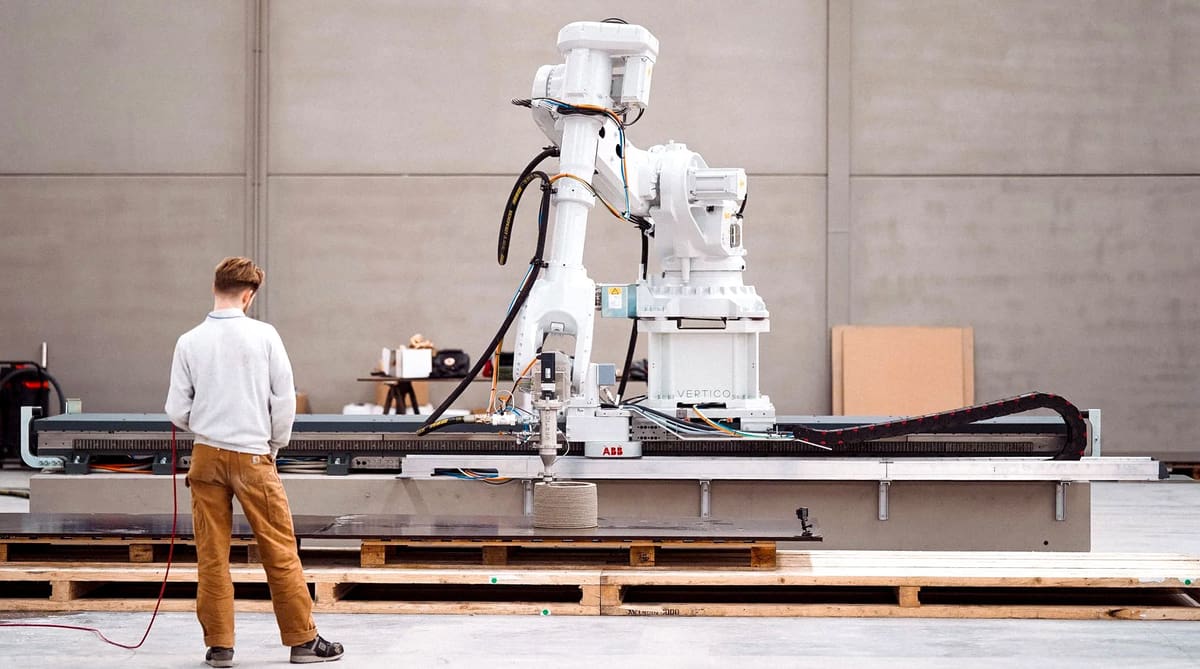
Robotic arm 3D printers are also increasingly used with concrete-like materials for projects in construction and architecture. Companies, such as Vertico and Twente AM, offer a variety of robotic arm and concrete extruder configurations for 3D printing walls, benches, planters, and light construction projects. We cover more concrete 3D printers at the end of this article, “3D Concrete Printing – The Ultimate Guide.”
Now that we’ve briefly examined the basics of robotic 3D printing, let’s get into the polymer-focused machines themselves and the applications that illustrate how they’re used today.
Manufacturers of Robot 3D Printers
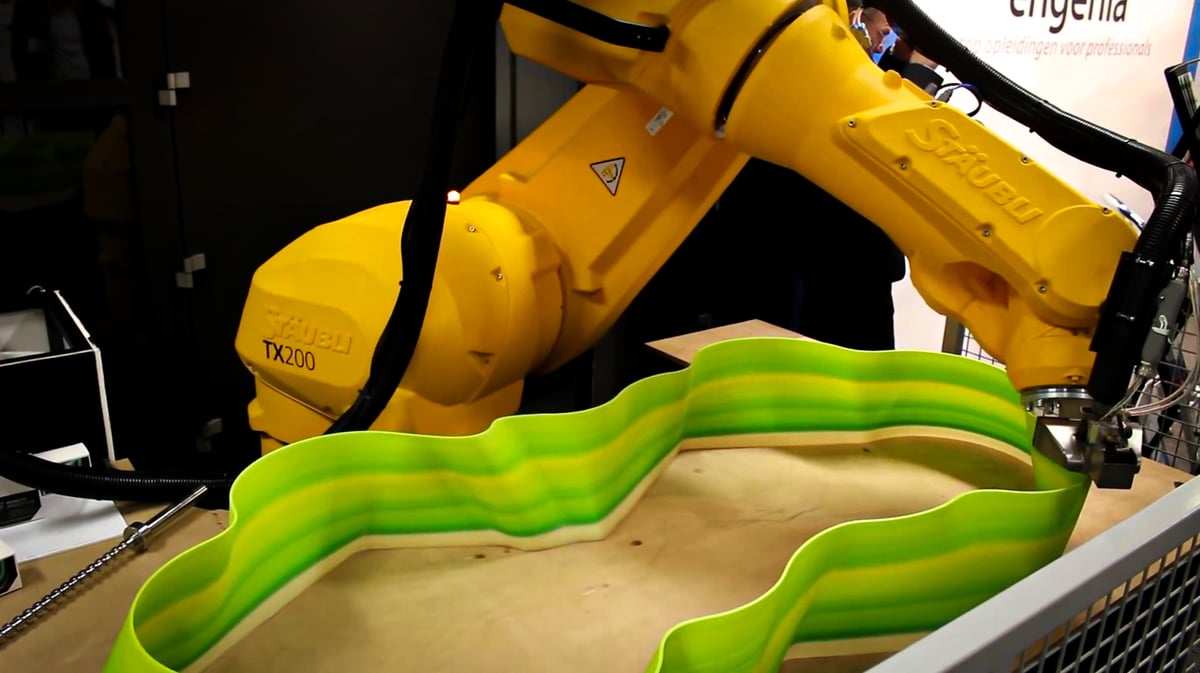
As we mentioned, currently, robot-assisted 3D printing is a bit of a mix-and-match situation where you may buy a robotic arm from one manufacturer (KUKA, ABB, Stäubli, etc.) and an extruder end-of-arm tool from another. Some companies offer packages, often called cells, that can be customized with different configurations of arms, extruders, and supporting accessories to fit your specific printing needs.
This is why you’ll find far more companies offering robotic arm 3D printing as a service using their proprietary printer than companies selling robotic arm printers. Yet, this is has changed as more companies see the benefits of robotic arm additive manufacturing and want the technology in-house.
CEAD
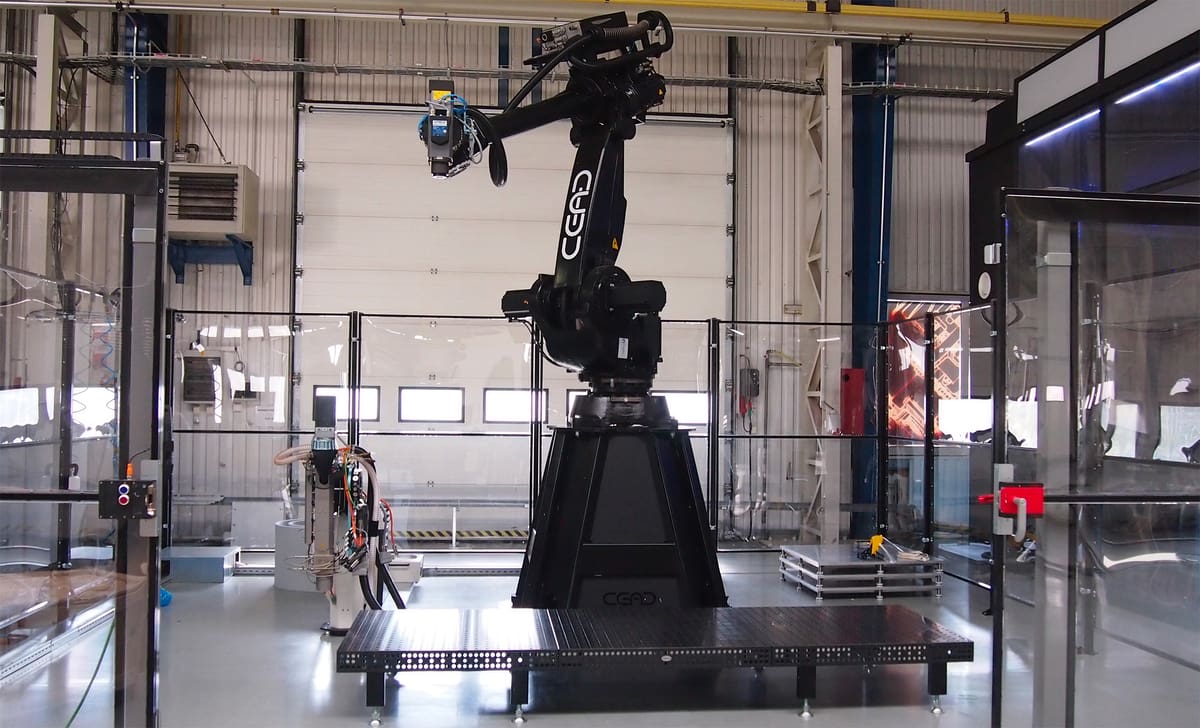
Dutch 3D printing technology supplier CEAD has developed the AM Flexbot, a flexible robotic solution for large-scale additive manufacturing. The modular system is highly customizable, allowing it to be modified to suit various applications and include functions such as CNC milling. In March 2024, CEAD announced a collaboration with robotics software start-up Adaxis. This strategic partnership integrate AdaOne software for large format 3D printing with CEAD’s Flexbot solutions.
Unlike the ABB, the CEAD AM Flexbot comes with an extruder that can handle engineering-grade, high-temperature plastics, such as PET and ABS-carbon fiber. (You can also purchase any of CEAD’s extruders separately, as we cover in the extruder section below.)
Using Siemens’ Sinumerik 840D controller to manipulate the Comau robotic arm across 31 axes, the machine can deliver highly accurate results with a printing table of 1.2 x 1.8 meters. It doesn’t need a separate robot controller, unlike some other solutions.
The Flexbot can be expanded with optional modules that add functions such as a rotary table, a heated working table, and a milling add-on. The latter enables operators to achieve various levels of surface finish for mold-making and tooling applications.
According to the company, CEAD’s Flexbot is compatible with any slicing software, yet recently launched the AdaOne for Flexbot integration. Combined with the arm’s operational flexibility, it is easy to incorporate into varying manufacturing processes.
The Technical University of Munich (TUM) teamed with CEAD to print a mold for a demonstrator composite flaperon for large passenger aircraft. The Flexbot allowed TUM to use their proprietary G-code to control the robot, helping them print molds faster and reduce warping in the final print.
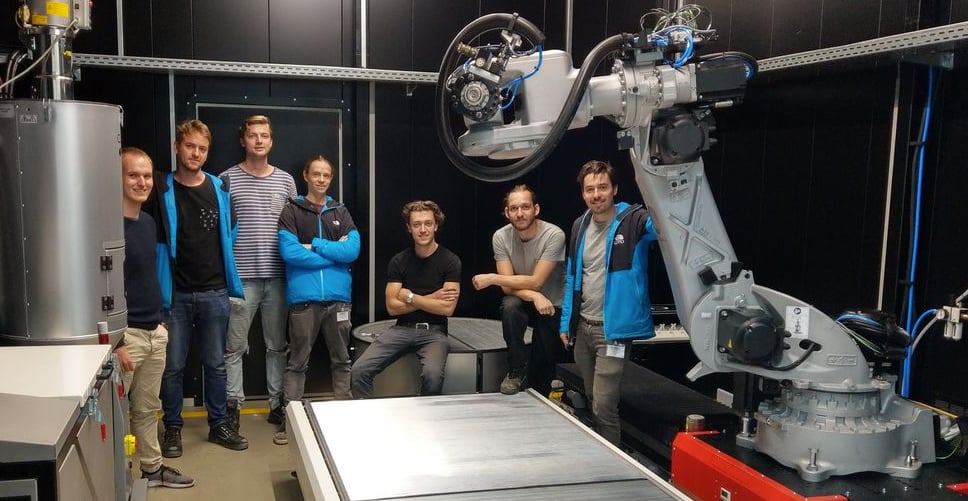
Caracol
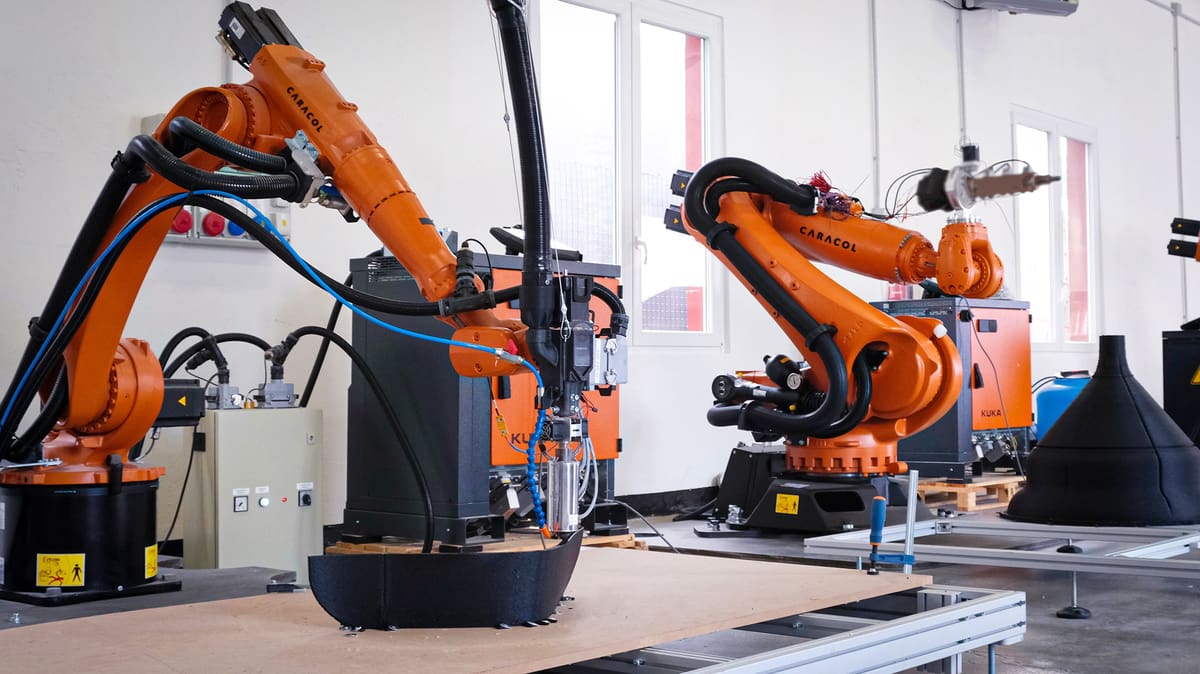
Italy-based Caracol, which operates four facilities and a new headquarters in Texas, developed both the hardware and software powering its robotic additive manufacturing service. Originally a service provider, the company now offers its integrated hardware and software solution, Heron AM, as a purchasable system—sold alongside machine training and customized to user requirements.
Caracol uses its proprietary Scalprum 13800 system (parts of which are patented) combined with KUKA six-axis robotic arms to manufacture large-scale prototypes and finished products, as well as tools, jigs, molds and end-use parts. The company says this six-axis technology has no limits in scale or complexity and significantly reduces production time and material costs. Caracol works primarily in industrial manufacturing today, including the aerospace and automotive sectors.
The company can print in a variety of high-performance and recycled materials including PEEK, nylon (PA12) reinforced with glass or carbon fibre, PPS, TPU, and recycled polymers such as rPLA and rPET.
In advance of recent growth, Caracol introduced its metal large-format additive manufacturing platform, Vipra AM, launched in November 2024. This robotic Direct Energy Deposition system is offered in “XQ” (Extreme Quality) and “XP” (Extreme Productivity) configurations for different metal types and industrial use-cases.
In October 2025 Caracol raised a US $40 million Series B funding round to accelerate its global expansion, bolster its software, automation and AI capabilities, and scale operations across Europe, the U.S., the Middle East and Asia-Pacific.
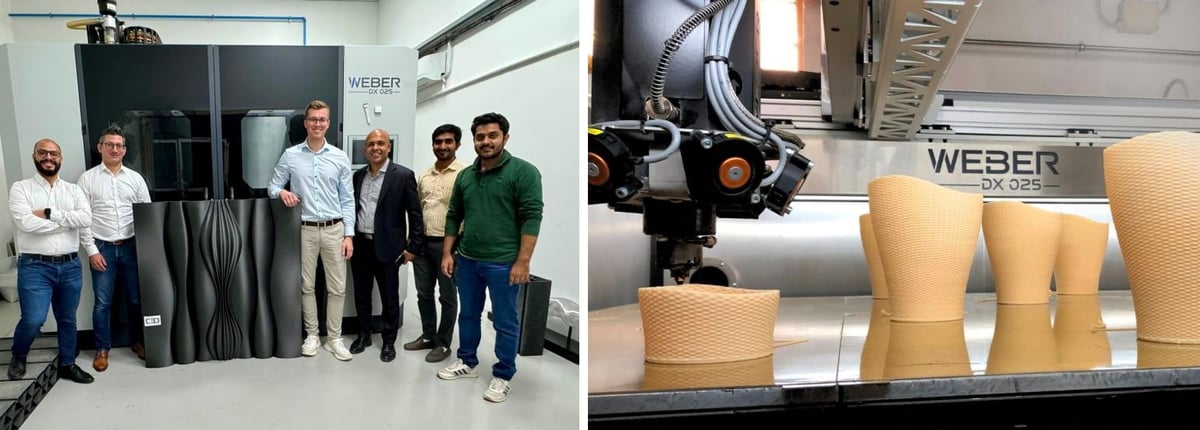
The firm also completed a strategic acquisition of additive-robotic IP and technology from Hans Weber (Weber Additive) in Germany, reinforcing its European technology and supply base.
KraussMaffei
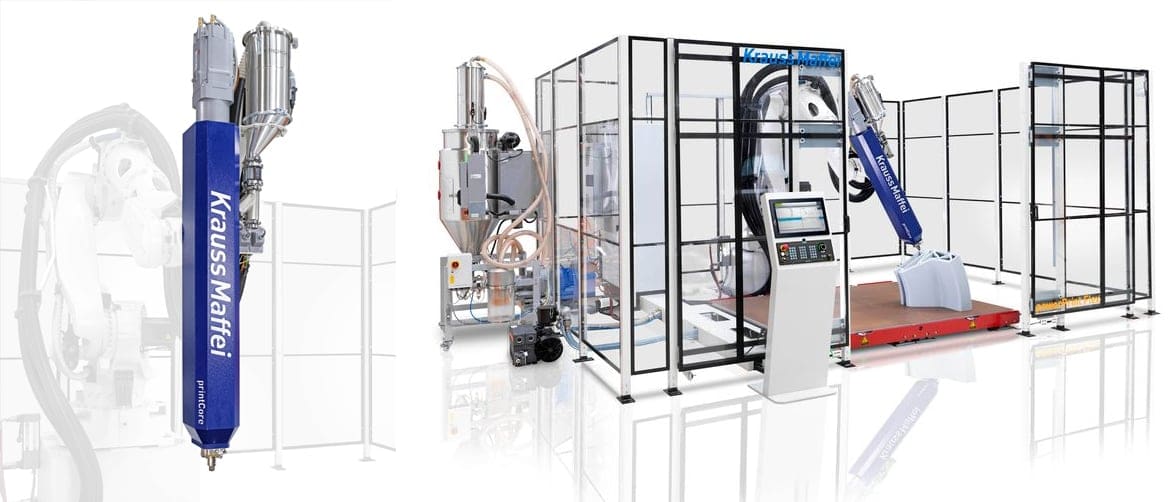
The powerPrint Flex by KraussMaffei was just introduced in Nov. 2025. It’s a modular, robot-based large-format additive manufacturing system designed to bring industrial-level flexibility to thermoplastic part production. At its heart it combines a six-axis industrial robot cell with a high-throughput extruder (the PrintCore) capable of processing up to 70 kg/h of melt and reaching temperatures up to 400 °C, enabling the use of medium- and high-performance polymers including fibre-reinforced materials.
The build platform of the system measures around 2,500 × 2,000 mm in its standard configuration and incorporates a heated vacuum clamping table with 16 individually controlled zones and a maximum bed temperature of up to 180 °C. The overall architecture is fully modular, allowing the system to scale from a standalone cell to an integrated production line and to incorporate additional automation axes, rotary tables or post-processing modules.
Polymer Extruder Heads For Your Robotic Arm
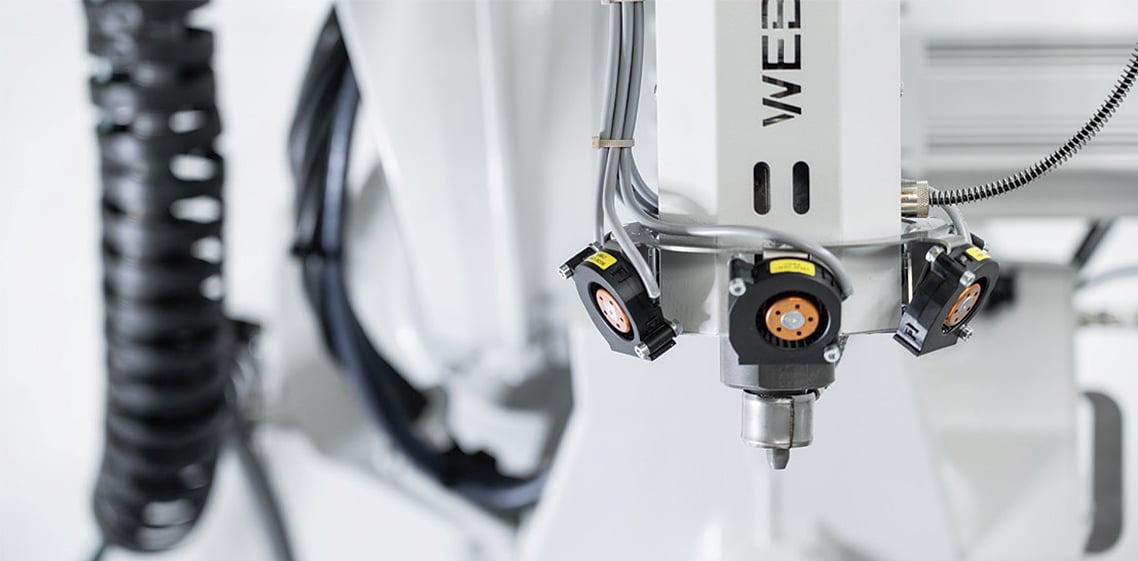
If you’re up for engineering your own robotic arm 3D printer — or you’d like to retrofit a robotic arm or CNC machine that you already own so you can repurpose your equipment for additive manufacturing — you’ll need a pellet extruder. We cover the top options below.
You’ll also need other accessories that many extruder manufacturers also offer, such as a unit that conveys the material from the hopper to the print head, a feedstock agitator, and a cooling fan. You may also want to consider a heated build surface.
CEAD
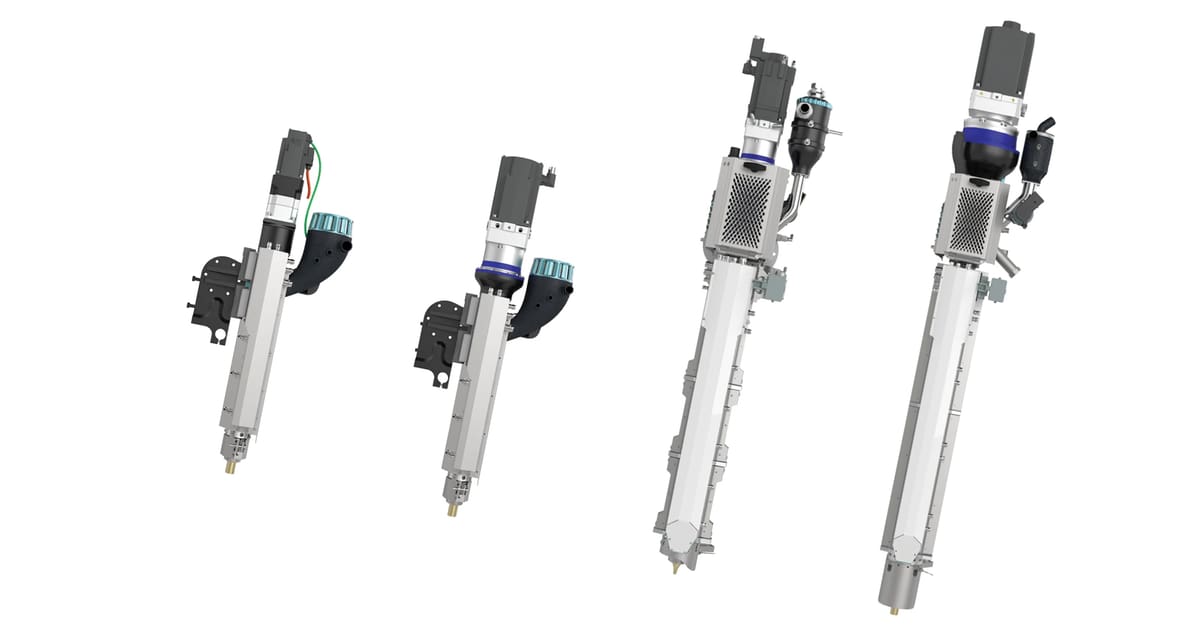
CEAD offers its polymer pellet robot extruders as complete standalone systems, accompanied with a base unit that controls temperature, extrusion speed, and automatic material transport, which ensures safe operations. The extruders are regularly integrated with robot arms and gantry-based solutions.
The extruders are designed to process fiber-filled thermoplastic pellets and can process virtually all short-fiber-reinforced thermoplastic composites, making them widely applicable to many industries. The company also offers a pellet dryer and a proprietary print bed.
The extruders in four sizes (E25, S25, E40, and E50) have max output rates from 12 kilos per hour up to 84 kilos per hour.
Dyze Design
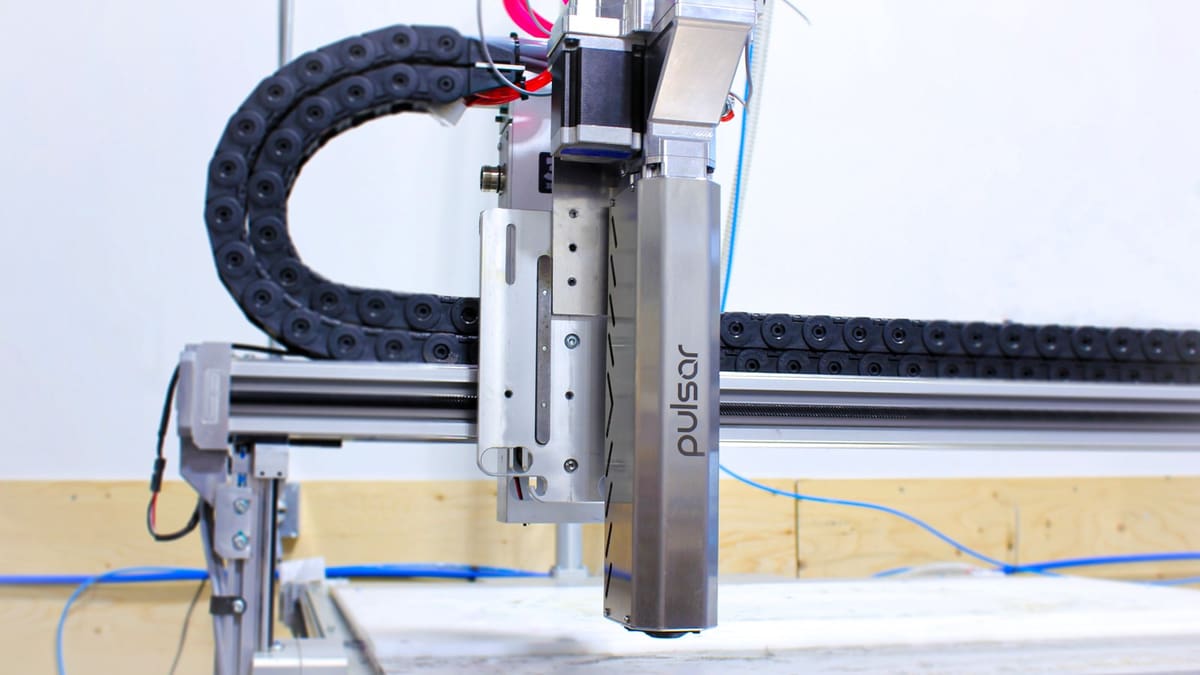
Dyze Design makes a wide range of extruders and hot ends, many of which are the standard equipment on a wide range of branded 3D printers. For robotic arm 3D printing, Dyze offers the Pulsar Pellet Extruder ($10,850) that can be installed on any large-scale 3D printer or robotic arm, transforming it into a pellet printer. New at Dyze is the Pulsar Atom Extruder, available for pre-order for about $4,000, that the company says reaches 450°C with a material output of 800 grams per hour.
The Pulsar Pellet features a high 500 mm3/s throughput, making it one of the fastest pellet extruders available. It has three heat zones, designed to keep the melted plastic transported by its customized extrusion screw at a constant temperature. The Pulsar supports multiple nozzle sizes from 1 mm to 5 mm and can come with an optional automatic feeding system that also detects the pellet level in the hopper. While the extruder doesn’t have retraction, its anti-oozing mechanism should maintain high print quality, the company says.
The Pulsar Pellet can heat up to 500°C, and as such, supports all available types of standard, engineering, and reinforced thermoplastics, whether recycled or virgin.
Massive Dimension
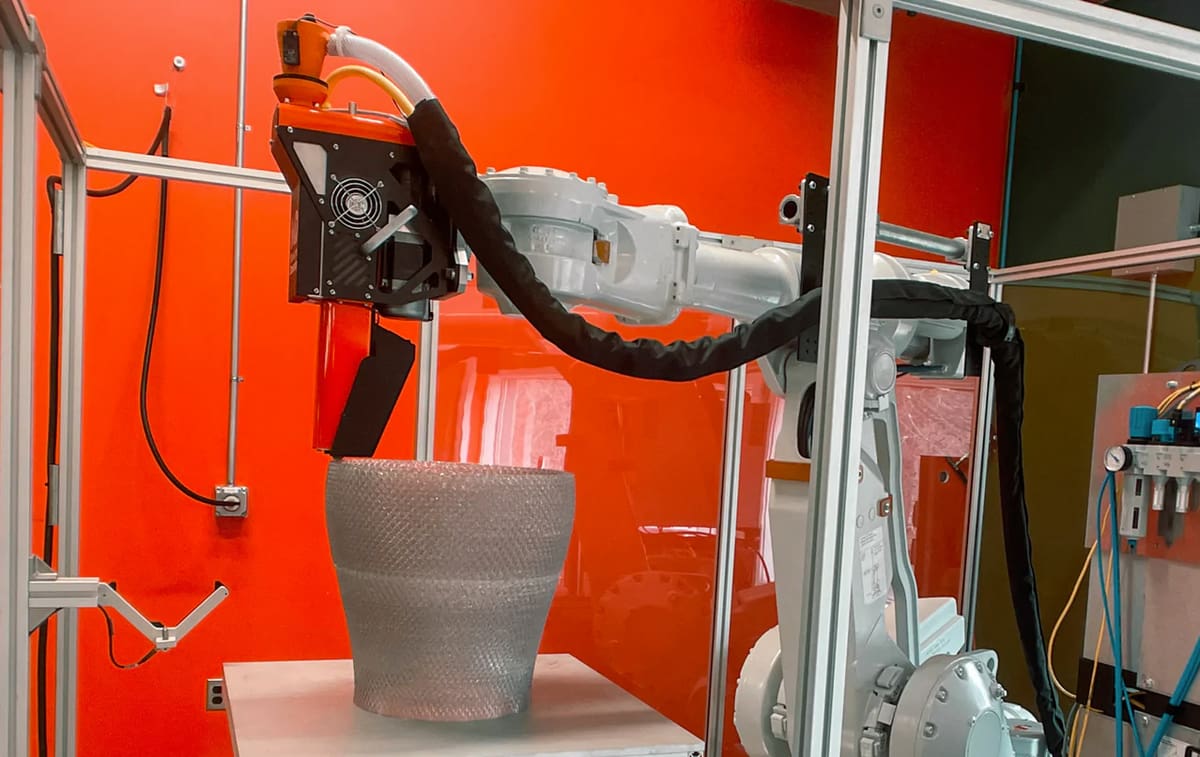
US-based Massive Dimension was created with sustainability in mind. The company aims to promote using recycled and pellet materials through robotic arm 3D printing.
Massive Dimension’s product line encompasses all components needed to convert an industrial robotic arm into a large format additive manufacturing platform. The company has worked in thermoplastic extrusion technology for over a decade through its sister company, Filabot, the filament extrusion machine maker.
The Massive Dimension MDPH2 pellet head extruder ($4,945) is a lightweight and economical option for those looking to break into the frontier of large-format additive manufacturing. The MDPE10 extruder ($14,848) outputs 10 lbs per hour, five times more material than the MDPH2, which allows for shorter print times and thicker walls in a single pass. The largest MDPE10 Industrial extruder ($17,973) is designed for high-volume production, extrusion of highly filled polymers, and abrasive additives.
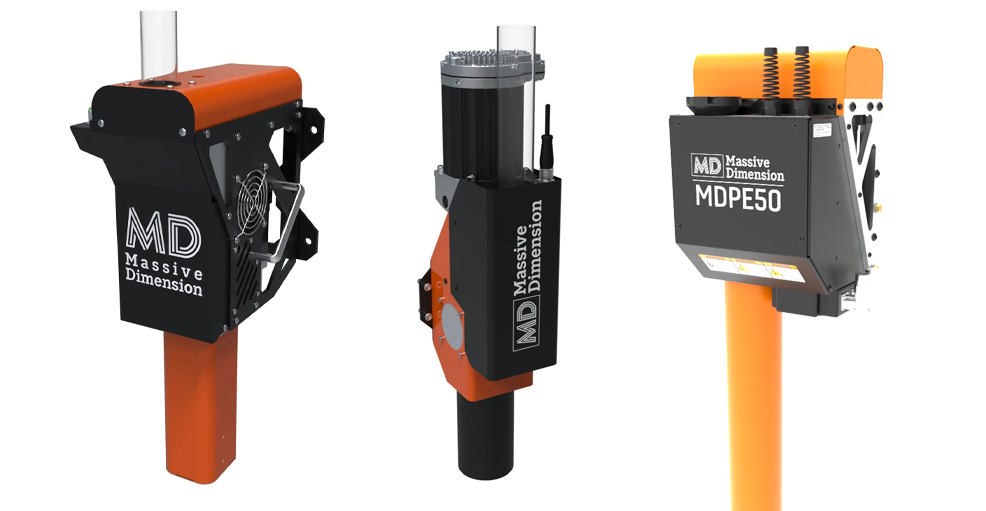
In addition to three extruders that can be fashioned onto robotic arms, Massive Dimension offers turnkey, customizable robotic printing cells for large-format additive manufacturing applications featuring arms from ABB. You can also purchase training services from Massive Dimension and ABB to get you acquainted with your printer, ensuring your operators are well-equipped to begin producing parts without significant downtime or undue print failures. These training services include an overview course on all aspects of the printing process, including slicer software, polymer extrusion, rapid programming, and extruder maintenance.
Rev3rd
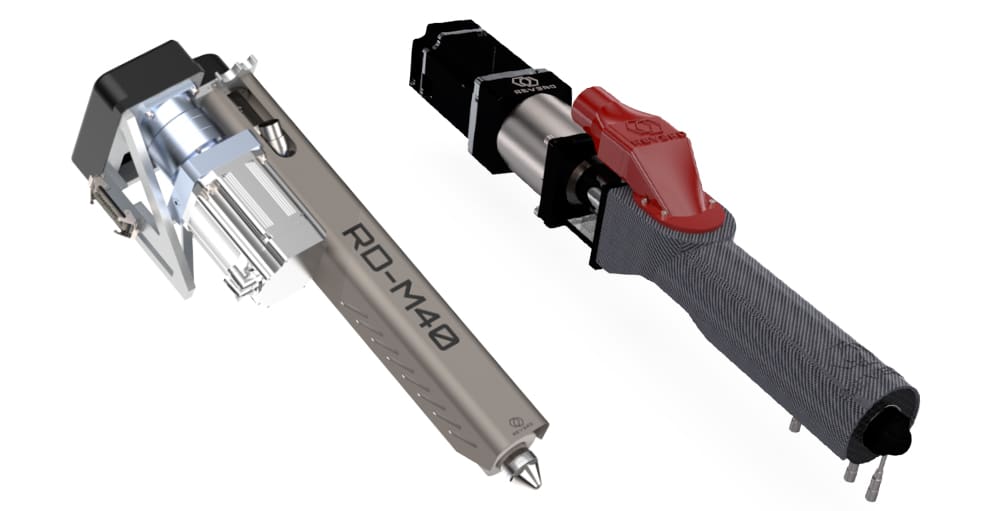
Rev3rd makes pellet extruders and offers pellet-enabled large-format 3D printers and pellet printing as a service.
The company’s extruders feature a quadruple heat zone design that helps keep the polymer at a constant temperature. The feeding section receives cold pellets and generates more heat to melt them. Then, the compression zone stabilizes the polymer at a precise temperature ensuring the plastification process (all the solid pellets turn into a molten status). Finally, the metering heater ensures an even flow. The water-cooling loop keeps the whole system (motor, screw shank, reducer, and feeding zone) at a constant temperature.
The three extruders, RD-M40, RD-M25, and RD-M10, are robot and CNC machine ready and offer various output volumes per hour (40kg, 25kg, and 9.5kg). Each option comes with an optional venturi feeding system that detects the level of the pellets and auto-charges the extruder. Pellets can be delivered from a bulk source or directly from a dryer.
Caracol/Weber Additive
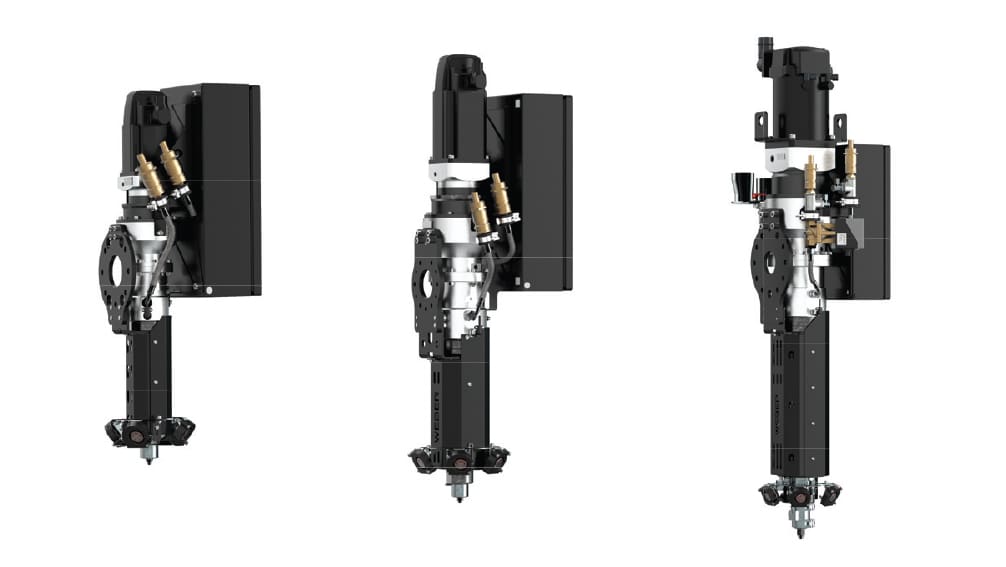
Weber Additive, known for its robotic and extruder technology, can outfit any modular 6-axis industrial robot (a KUKA or Stäubli) with an extruder (AE 16, AE 20, AE 30), and an enclosure called a robotic cell as a package called the DXR Series. If you just want an extruder, that’s for sale, too, upon request.
The Weber extruders can reach 450 °C and feature tempered feeding zones, water cooling, and interchangeable nozzles. They are lightweight, optimized for variable output, and have a powerful servo motor and compact material feeder. The right configuration and size of the pellet extruder depends on many factors, the company says, such as the desired extrusion speed, layer and wall thickness, and material.
Weber Additive’s portfolio includes systems for direct extrusion with a gantry system (DX-Series), robotic production cells (DXR-Series), and parts production for customers on demand.
KraussMaffei
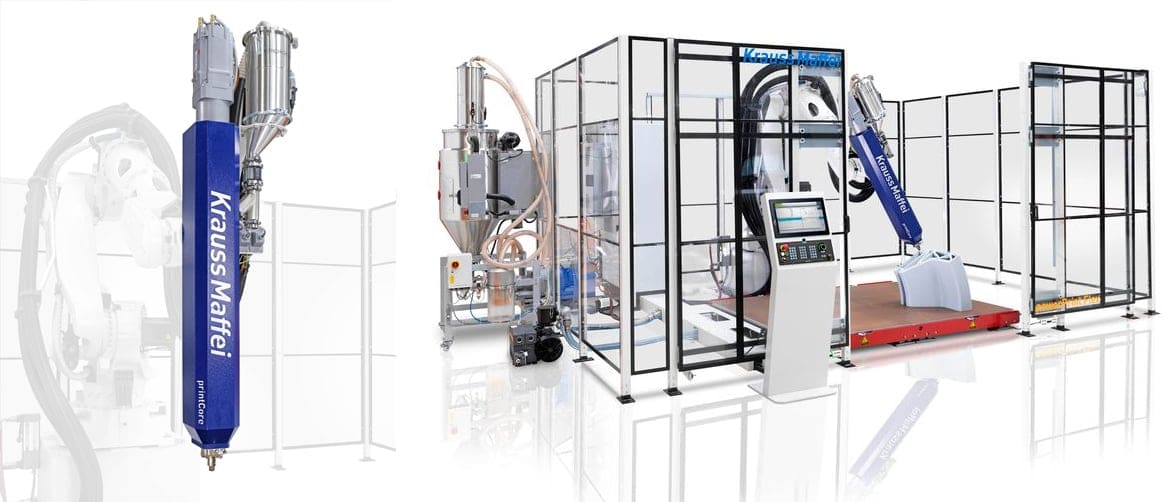
The PrintCore extruder head from KraussMaffei is a high-performance component specifically engineered for industrial additive manufacturing. It is built to handle not only standard thermoplastics but also demanding high-temperature materials and fibre-reinforced polymers.
Capable of melt temperatures up to 450 °C and output rates in the region of 30 to 70 kg/h depending on configuration, the printCore is designed to integrate with industrial robots or gantry systems, enabling high throughput and stable production of large-format parts. Its architecture supports performance motion control via a servo motor, giving precision and dynamic response required for reliable deposition in large-scale 3D printing environments.
Software for Industrial Robot Programming
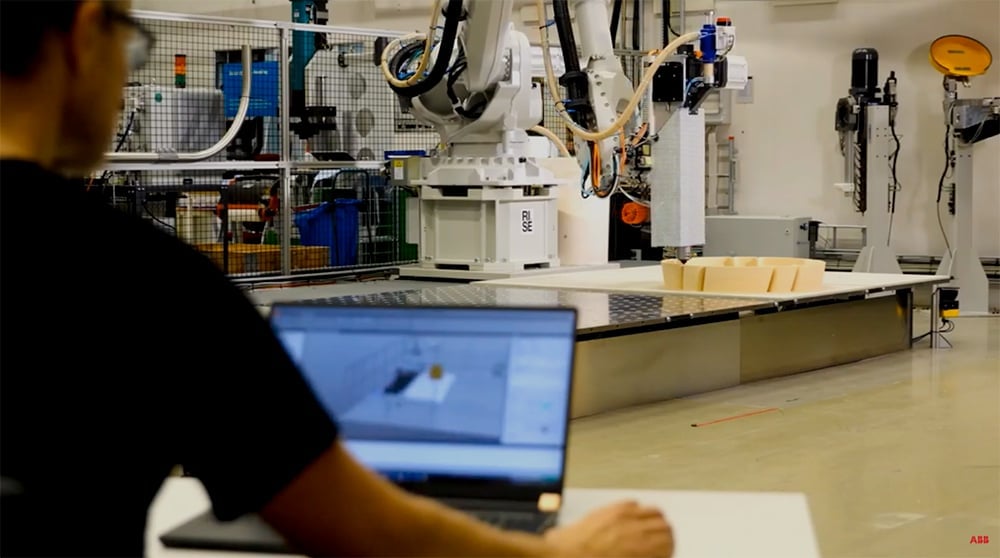
Although some of the robot 3D printers above make it a selling point that they can be used with any slicing software, the fact stands that many machines on the market will not be compatible with typical slicers. Here we cover software solutions that help turn a 3D part file into robot programming.
Robotmaster
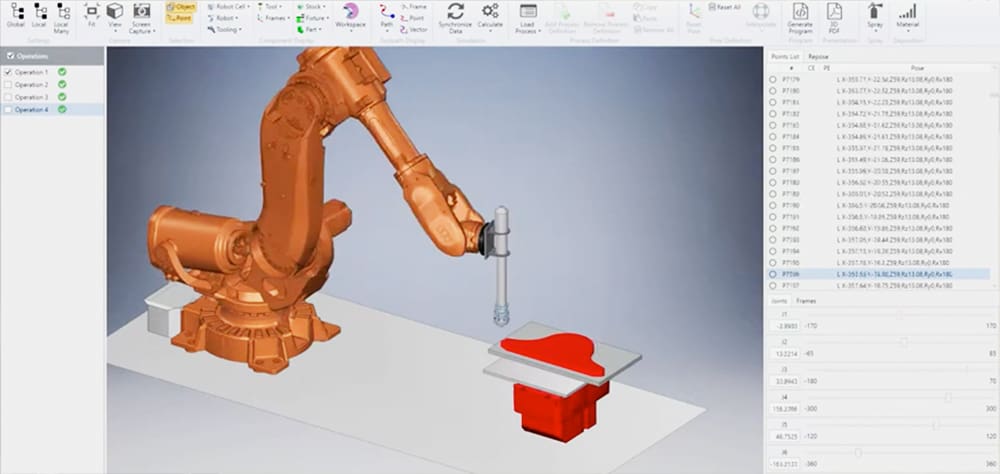
Robotmaster produces CAD/CAM software that helps robot operators integrate offline programming, simulation, and code generation for additive manufacturing. The program features powerful visualization of any issues and errors, making it easier to produce successful prints on the first attempt. The company says that automated programming for robotic additive manufacturing applications can be generated from CAD models and subsequently modified with minimal effort to adjust for all process-based parameters.
Robotmaster’s click-and-drag interface makes it simple to reorient and rework robot arm pathing for optimal print results. It also features single-click contour identification, allowing operators to configure optimized robot programs without learning complex simulation skills.
All in all, Robotmaster automates many of the most challenging tasks in robot programming. The manufacturer says these features enable faster print times and higher part quality.
ABB RobotStudio
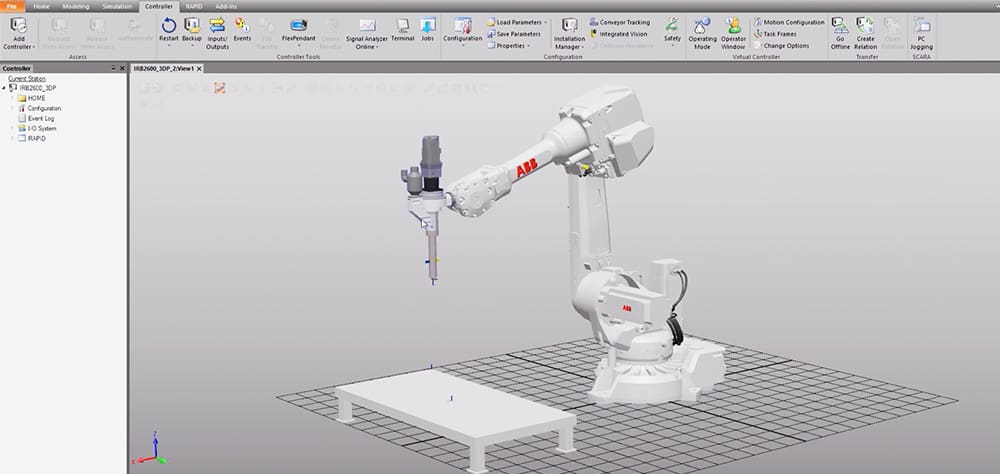
We already mentioned ABB’s RobotStudio earlier. This simulation and programming software allows operators to program the company’s robots for additive manufacturing in less than an hour.
The firm says that belonging to ABB’S PowerPac portfolio, RobotStudio’s 3D printing feature introduced in 2020 removes the need to manually program robot arms, allowing for faster prototyping. The software can translate any standard slicer software design into ABB’s simulation environment and RAPID robot code without the need for manual programming.
RobotStudio features G-code filtering, which removes unnecessary G-code points for smoother robot movement. Including an ABB-compatible extruder screw on the printer allows the program to control extrusion for precise printing.
Ai Build
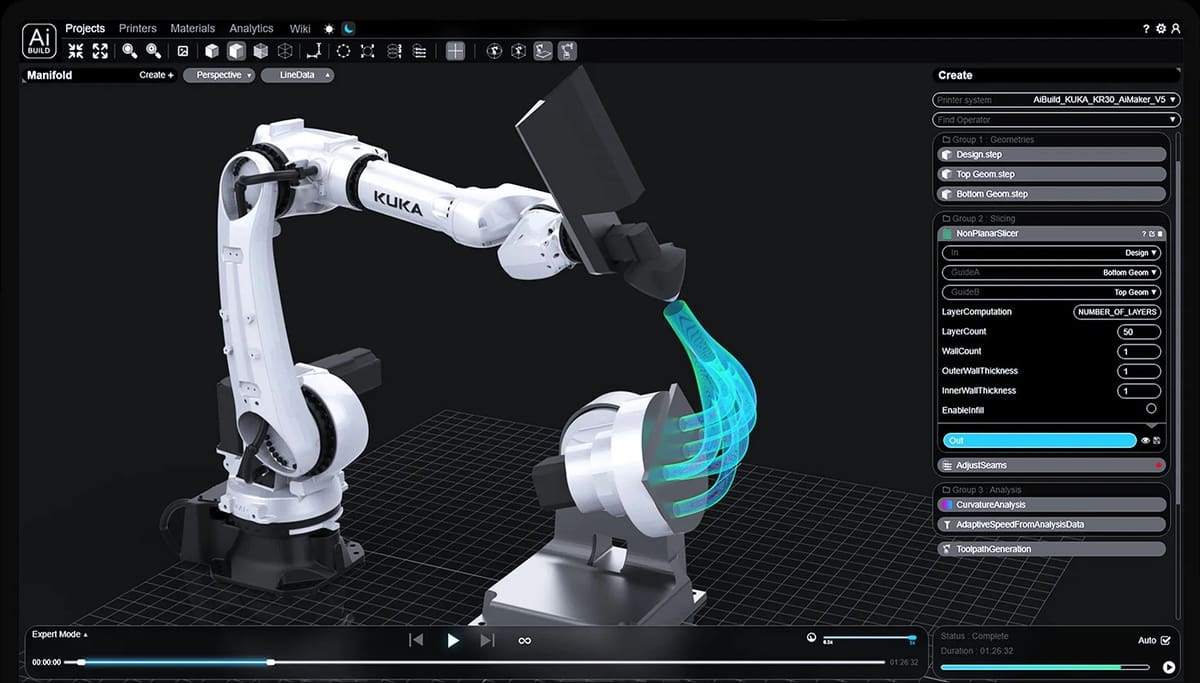
British Ai Build’s AiSync software provides automated toolpath generation, process control, and monitoring workflows for extruder-based industrial 3D printers. The program is capable of controlling multiple printers on one platform with minimal setup.
AiSync produces multi-axis toolpaths that – unlike those created with regular slicing software – are not restricted to layers. The software features a predefined geometrical operator library that makes it easier to customize and optimize toolpaths.
The manufacturer says the software automatically compensates for issues such as warping and layer detachment. Automatic failure detection and predictive analysis functions help operators optimize their printing processes further.
Ai Build currently focuses on software solutions, but the company has also done limited custom printing. AiSync has seen use in multiple applications, including energy, aerospace, automotive, and construction.
Adaxis
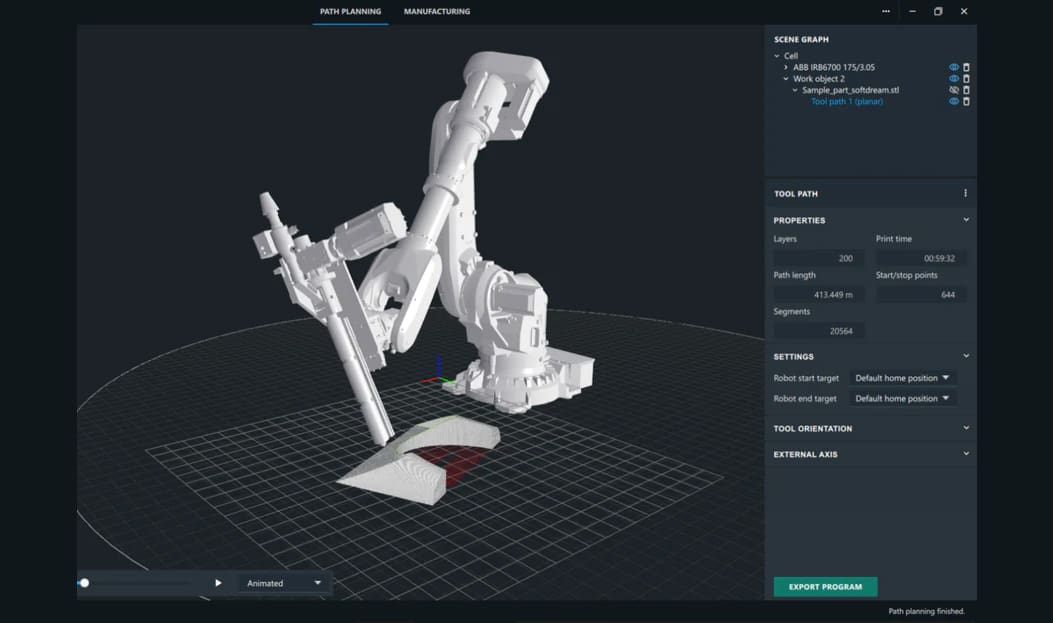
Adaxis is a French-Swedish robotics software start-up with a mission to enable a flexible and sustainable manufacturing industry by making advanced manufacturing processes accessible to every company. They say their software will turn any robot into a flexible 3D printer.
The company’s AdaOne is a robust software for robotic additive manufacturing of metals, plastics, composites, and concrete. The software platform covers every aspect needed to go from idea to finished part, including robot simulation, multi-axis path planning, the all-important collision detection, and robot program generation.
AdaOne is compatible with a wide range of industrial robots and positioners, including ABB, KUKA, Yaskawa, and FANUC, and can be adapted to handle custom kinematic systems up to 14 axes.
Octopuz OLRP
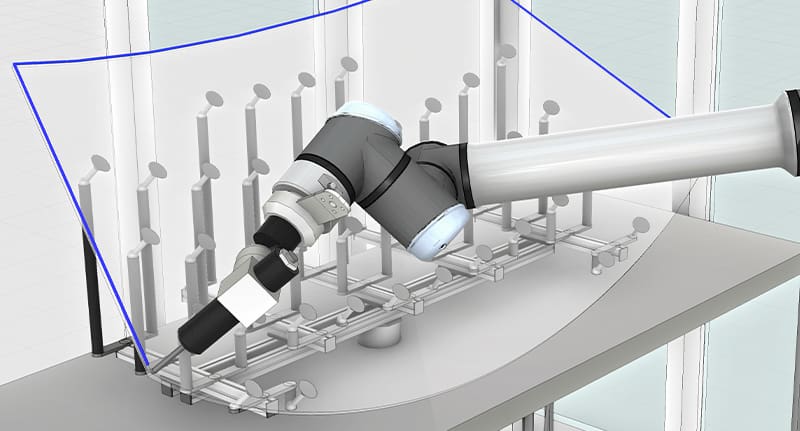
Octopuz, headquartered in Ontario, Canada, released a major 3.0 update to its Offline Robot Programming (OLRP) software in mid-2020. The company added the new PathPlanner tool suite for enhanced path programming.
The Octopuz OLRP for additive manufacturing makes it possible to configure multiple angle settings for high robot movement reliability and accuracy. The new PathPlanner tools let operators create, modify, and transform paths to further enhance arm movement efficiency.
The program is also capable of analyzing material thickness and quality through advanced simulation features. The OLRP supports CAM integration and slicer G-code importing.
Octopuz’s software solutions support robot arms from several different manufacturers. For example, it has been used with KUKA’s robot arms, featured in the previous section.
RoboDK
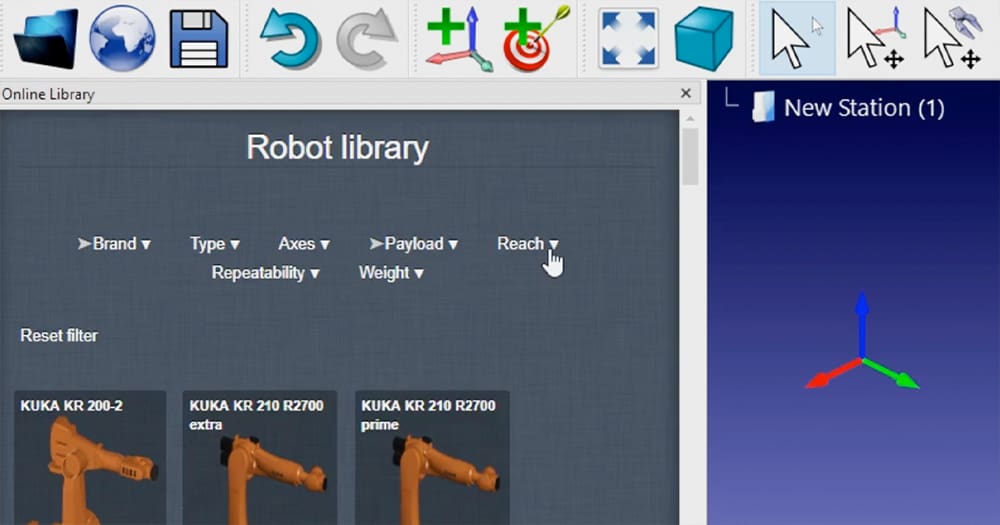
RoboDK is another Canadian software solutions provider. Its offline robot programming software highlights its compatibility with various options – it supports over 500 industrial robots from 50 manufacturers, including ABB and KUKA.
The program allows users to define their tool by simply uploading its 3D model through a simple drag-and-drop interface. This lets operators quickly define their 3D printing head for their robot arm of choice.
The manufacturer says an intuitive, automated CAD/CAM integration interface can quickly create error-free tool paths that avoid collisions, singularities, and axis limits. Generating the final robot path in RoboDK requires no programming experience. The automated two-click process works with more than 70 post-processors that guarantee support for an astonishing variety of robots.
Operators looking for a one-size-fits-all software solution should give RoboDK a look. The company constantly adds support for new robots based on user and manufacturer recommendations, so the odds of it not working with your robot arm are fairly low.
Robotic 3D Printing Service Providers
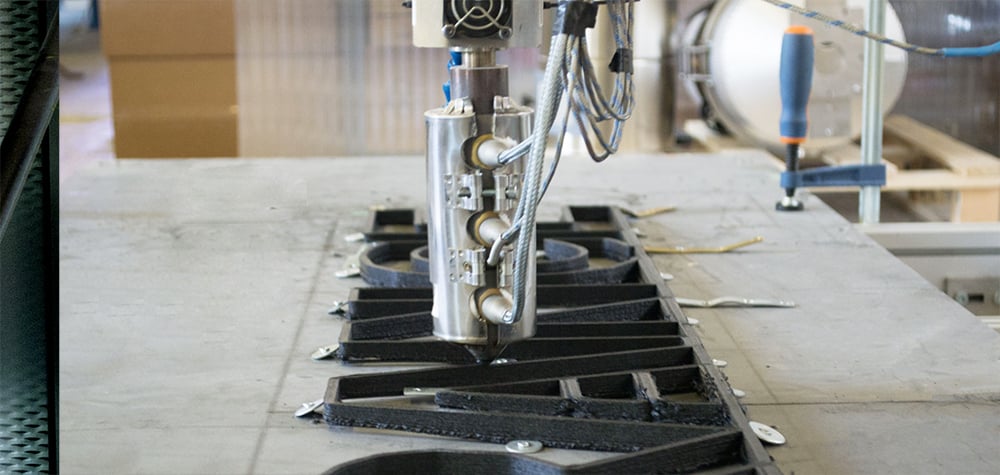
As is usually the story with industrial 3D printing, purchasing your own machine is an expensive proposition – doubly so with advanced industrial robots. Especially for smaller creators, it can be a better idea to hire a third-party service provider to print your part for you.
The companies listed below all have robotic arm 3D printer solutions available. This is by no means an exhaustive list, but these service providers will get your part printed no matter your application, from architecture to furniture. Also, check out our guide to large-scale 3D printing services for more large 3D printing options that aren’t necessarily robotic arm.
Nagami Design
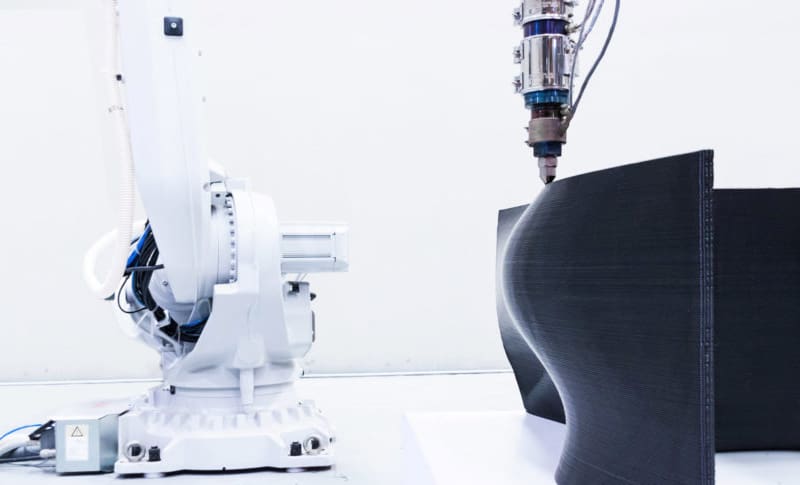
Nagami Design in Spain brings 3D printing and robotic manufacturing to large-scale products and objects with various customization possibilities. Research and innovation are at the core of their products, developed in collaboration with internationally renowned designers who challenge the technology to create groundbreaking products.
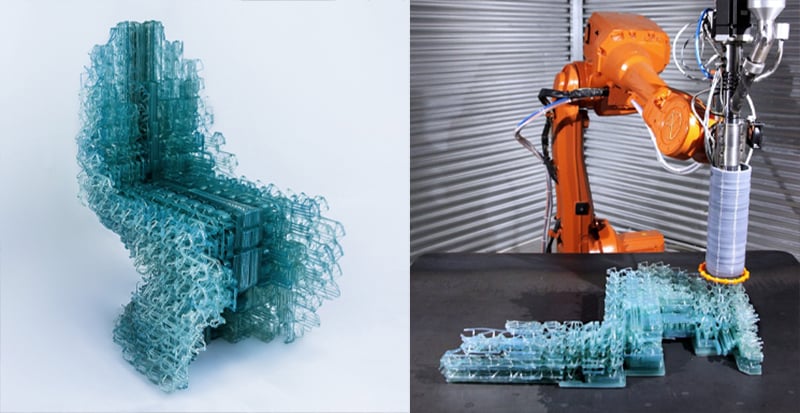
Together with UCL Design Computation Lab, Nagami created the Voxel-Chair v1.0 from a 2.4km continuous line of plastic, which was melted and solidified mid-air, creating a new level of intricacy. The Voxel Chair is the first prototype designed using a new design software developed explicitly for robotic 3D printing. The software is based on research led by Manuel Jimenez Garcia and Gilles Retsin at the Bartlett School of Architecture, Design Computation Lab.
Branch Technology
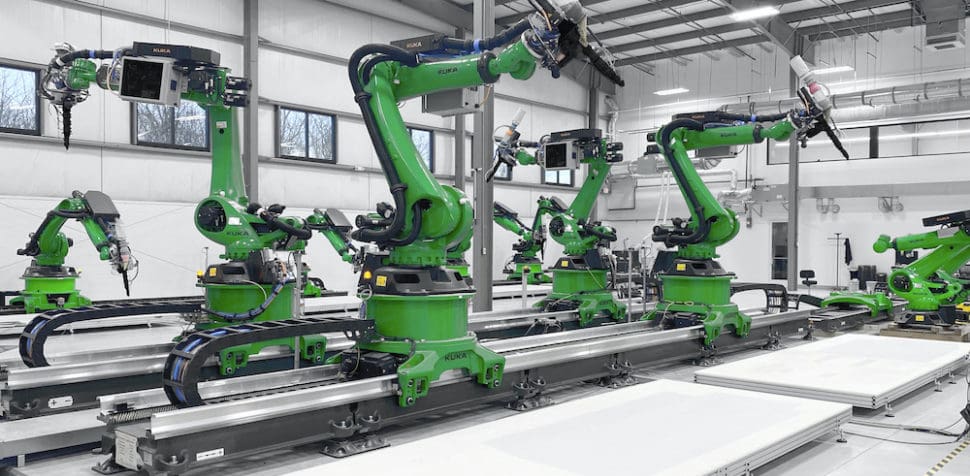
We already mentioned Branch Technology in our entry on KUKA for their collaboration with a botanical garden. But you, too, can hire these innovative design and manufacturing experts for your architectural projects.
Branch Technology’s C-Fab (Cellular Fabrication) technology creates a 3D printed freeform polymer matrix filled with a composite material that is finished with a façade panel and connections. The method uses 20 times less material than traditional layered printing, offering a higher strength-to-weight ratio.
In 2019, Branch teamed up with the University of West Florida to create an art installation for its campus. The final creation was a pavilion 3D printed with Branch’s C-Fab method, which allowed the pavilion to be durable and lightweight while enabling a high degree of design freedom for its parabolic shapes.
Aectual
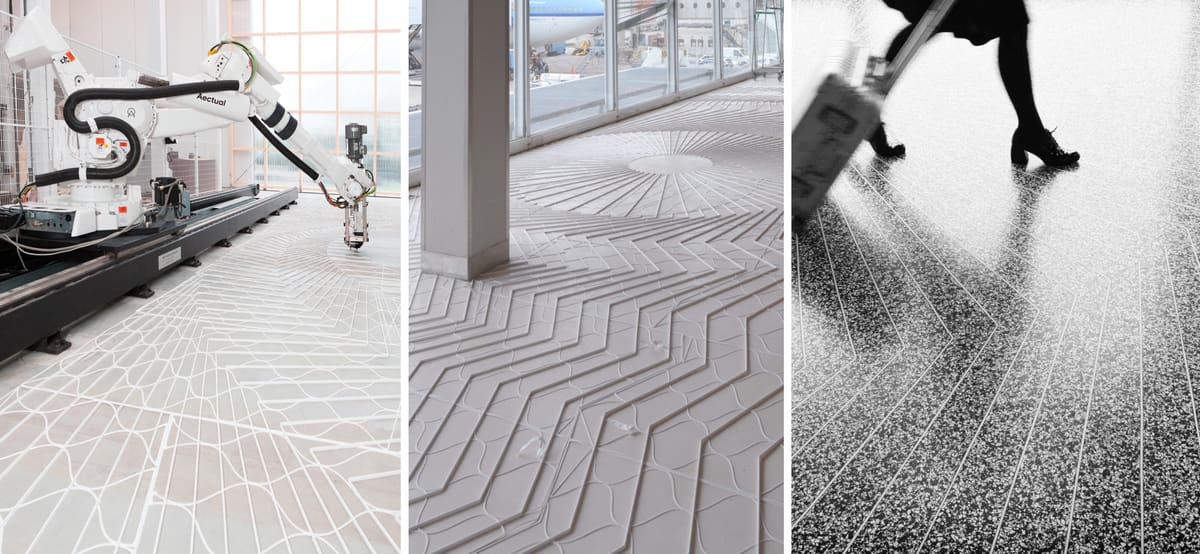
Dutch design company Aectual creates interior and exterior furniture and architectural elements. The company has actually developed its own XL 3D printing system, utilizing an ABB robot arm and IRC5 controller, a custom industrial extruder, and Siemens PLCs. The 3D printer package is also available to purchase for selected partners.
Aectual can print in a variety of materials, from concrete to bioplastics, terrazzo, and recycled waste plastics, like Tetra Pak packaging. Launched in 2022, Tetra Pak is committed to fitting all of its offices with 3D printed furniture made by Aectual and from their recycled containers. It offers large-volume prints, with a 500 sq ft printing area at its Amsterdam facility.
In January 2021, Aectual launched its Aectual Community, which allows members to get their furniture designs custom printed. In 2019, the company worked with acclaimed Spanish architect Patricia Urquoila, printing her flooring designs for that year’s BMW Welt exhibition in Munich.
Haddy
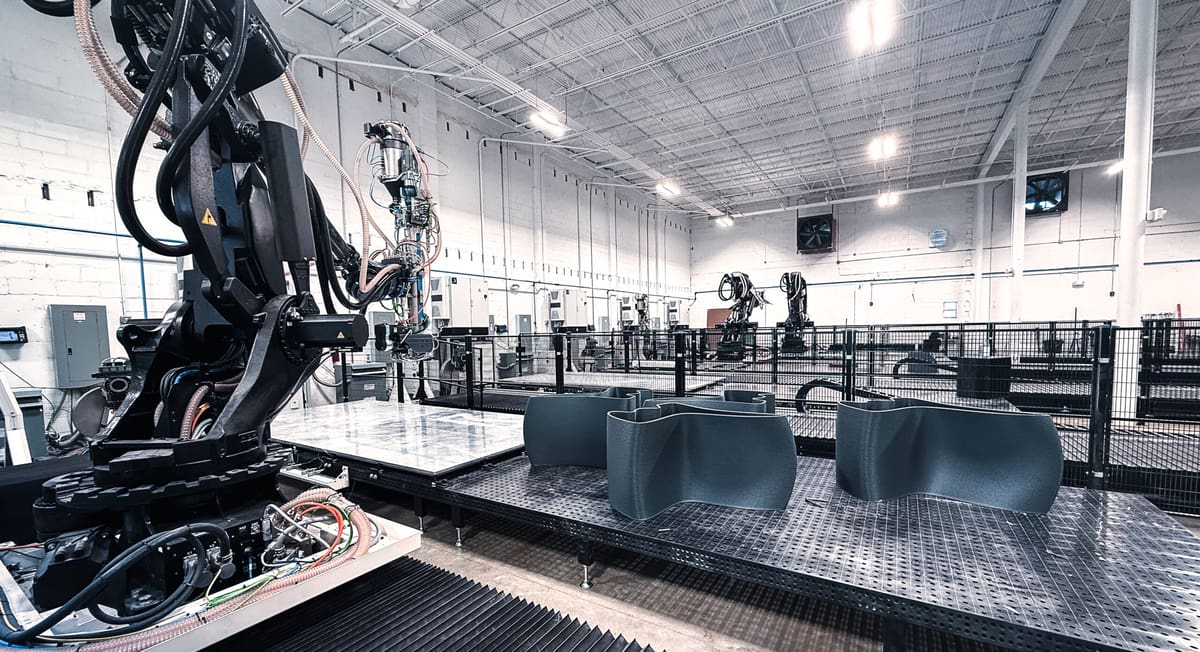
Haddy, a U.S.-based sustainable design and manufacturing company, opened its new large-format 3D printing microfactory in Florida in 2025. The facility featured CEAD Flexbot robotic 3D printing systems with integrated CNC post-processing capabilities. The facility is one of the largest of its kind globally.
Currently Haddy focused primarily on furniture with products that are sustainable.
Lead image source: Bow by Zaha Hadid Architects for Nagami Process ©Nagami
License: The text of "From Houses to Rockets: Why Robotic Arm 3D Printing Is Now Nearly Everywhere" by All3DP Pro is licensed under a Creative Commons Attribution 4.0 International License.