Where Is the Pentagon’s Growing AM Investment Going? Find Out at America Makes’ Fall TRX Show

Rocket engines, Future Vertical Lift, aerospace-grade alloys, supplier qualification, and AM production scale-up dominate the October program — reflecting a sharp rise in DoD-backed additive manufacturing funding.
If you want a snapshot of where U.S. defense additive manufacturing is heading, the agenda for the next America Makes Technical Review & Exchange (TRX) is a pretty good place to look.
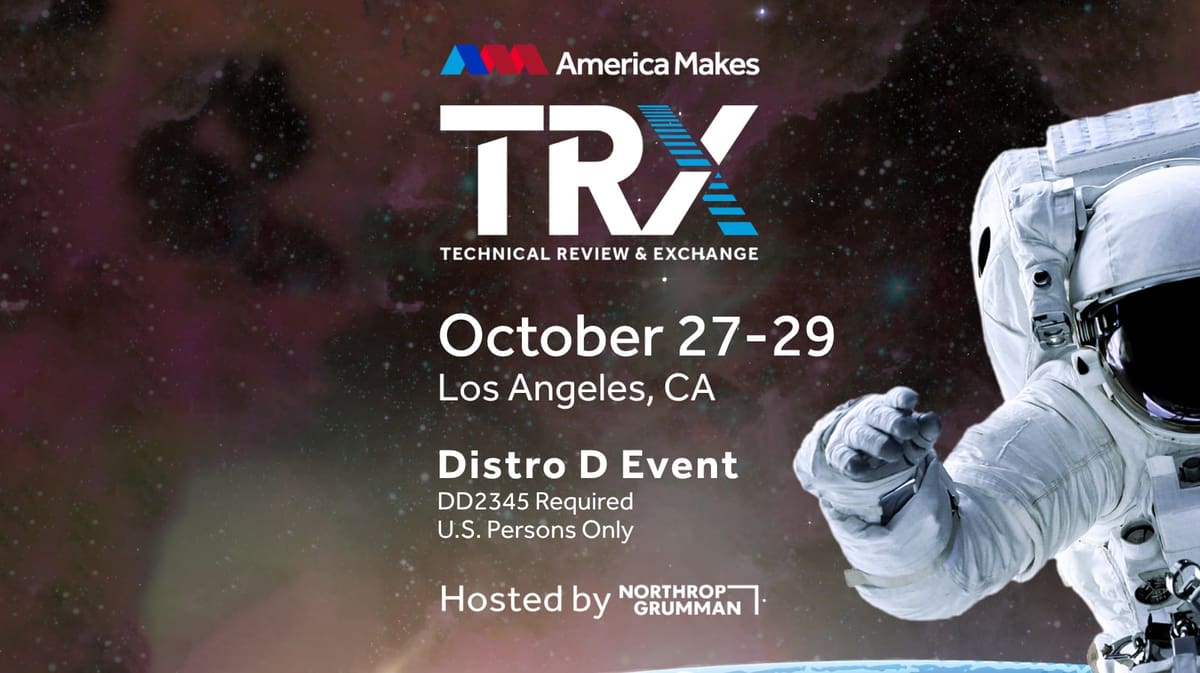
America Makes will hold its Fall TRX from Oct. 27–29 at Northrop Grumman’s Presentation Center in Redondo Beach, California. Unlike a conventional 3D printing conference filled with product launches and sales pitches, TRX is essentially a progress report on government-backed AM R&D: engineers and project teams present what they’ve learned, what’s working, and what still stands between a promising technology and production.
And this year, aerospace and defense are hard to miss.
Scheduled presentations include AM for Future Vertical Lift, 3D printed rocket-engine components from Ursa Major, thermal-management structures for high-temperature vehicles, rocket-motor coatings from Anduril, high-temperature nickel superalloys, Divergent’s work on an airworthiness framework, and Castheon’s C-103 work for high-temperature and space applications. Boeing, Lockheed Martin, Honeywell, Elementum 3D, Nikon AM Energy, EOS, Wichita State University’s NIAR, and others are also slated to report on materials, qualification, interoperability, powder reuse, and manufacturing processes.
That defense-heavy agenda arrives alongside a significant increase in the amount of federal money being routed through America Makes project calls.

As All3DP reported in June, America Makes released 14 competitive project calls totaling more than $72.5 million between April 2025 and April 2026. That funding is largely supplied by organizations including the Department of Defense’s Manufacturing Technology program, the Air Force Research Laboratory, and other defense industrial-base programs, with America Makes and its manager, NCDMM, acting as the public-private mechanism for putting it to work.
The direction is clearly upward. Looking just at headline-valued new calls published by America Makes, announced opportunities totaled roughly $8.7 million in 2024 and about $15 million in 2025. By the end of April 2026, four major announcements alone contained at least $58.6 million in specifically stated project budgets, before counting the full potential of the separate 2026 Organic Industrial Base Modernization Challenge. These figures are best treated as an indication of funding pace rather than audited annual spending — project-call money may be awarded later and some programs span multiple years — but the jump in scale is hard to miss.
More important than the dollar figure may be what the money is targeting.
Recent calls are increasingly about making AM dependable enough to use, repeatedly, on real hardware: qualifying suppliers, reducing inspection and testing bottlenecks, establishing material allowables, proving machine-to-machine equivalency, strengthening refractory-alloy supply chains, modernizing depots and arsenals, and replacing traditionally manufactured alloys with validated AM alternatives. One 2026 program alone, MIAMI, carries a $12.4 million budget to demonstrate that additively manufactured metals can reliably substitute for conventional alloys in defense weapon-system components; the accompanying INSITE call puts another $13.2 million behind integrated in-situ monitoring and post-build inspection.
That represents an important maturation of the government’s AM strategy. The Pentagon has long identified additive manufacturing as a way to improve supply-chain agility, sustain legacy equipment, and produce parts closer to the point of need. What the latest America Makes calls suggest is a move beyond proving that AM can make advanced parts toward establishing the qualification data, inspection systems, suppliers, and repeatable processes required to make them at meaningful scale.
TRX Fall puts much of that transition on one stage.
There is one catch for anyone hoping to drop in: despite being open to America Makes members and non-members, this isn’t a typical open-door trade show. Non-government attendees must have a valid DD Form 2345 certification, and all attendees must meet the event’s U.S.-person requirements and bring photo ID.
License: The text of "Where Is the Pentagon’s Growing AM Investment Going? Find Out at America Makes’ Fall TRX Show" by All3DP Pro is licensed under a Creative Commons Attribution 4.0 International License.