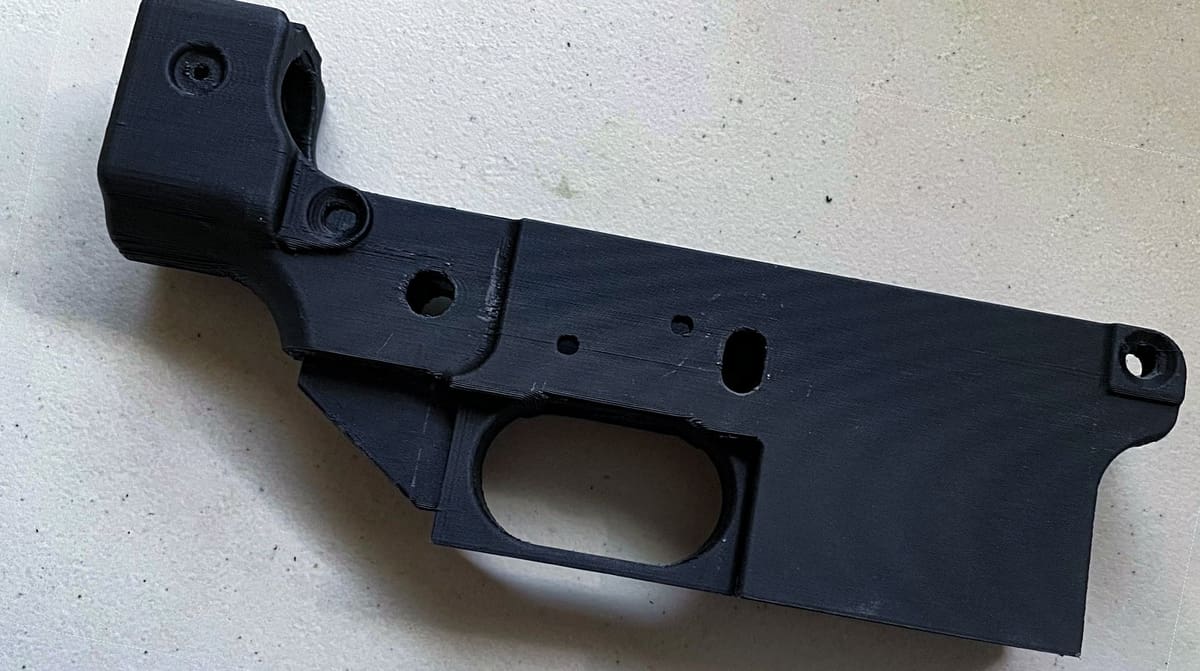
What This Week’s Texas Ruling Means for New York’s 3D Printer Gun Blocking Law

A recent federal decision striking down ATF regulations on unfinished firearm components raises new constitutional questions for states attempting to technologically block the 3D printing of guns at home.
No, a Texas judge did not just make all 3D printed guns legal. The ruling is considerably narrower than some reports suggest.
What U.S. District Judge Reed O’Connor (TX) said in his ruling on Monday was that two parts of the federal government’s 2022 framework for deciding when certain unfinished firearm frames, receivers, and parts kits are treated as firearms are unconstitutional and cannot be enforced against the plaintiffs in Defense Distributed et al. v. Todd Blanche.
The decision has potential implications for the DIY and 3D printed gun community, as well as states looking to more actively regulate parts that 3D printers can print.
When Is a Part more than a Part?
Judge O’Connor ruled that two provisions of the ATF’s 2022 “Frame or Receiver” —27 C.F.R. § 478.11 and § 478.12(c)—are unconstitutional and cannot be enforced against — and this is important — only the plaintiffs in this case. Those provisions expanded when certain weapon parts can be treated as firearms under the Gun Control Act, which can trigger things like sale through a federally licensed dealer (FFL), a background check, serialization, and dealer recordkeeping.
The court ruled for the plaintiffs on two constitutional grounds:
- Second Amendment: The regulations impermissibly burden the right to make or repair firearms for personal use.
- Fifth Amendment Due Process: The regulations are unconstitutionally vague, because terms such as “readily” convertible and “clearly identifiable” do not give people sufficient notice about when an unfinished piece becomes a federally regulated firearm.
As New York moves to implement a new 3D printer blocking law and California considers similar requirements, printer manufacturers may increasingly be asked to encode into software legal distinctions that remain unsettled in court. It highlights the technical difficulty of asking software embedded in a printer to enforce legal categories that courts themselves are still arguing over.
The Texas ruling does not directly strike at New York’s new 3D printer law or similar proposals, but it raises two potential constitutional questions for them: whether states may technologically prevent an individual from manufacturing firearms at home under the Second Amendment, and whether a software algorithm can be required to make a legal distinction resembling one that O’Connor found insufficiently defined in ATF’s own rule.
The practical relief is narrow: federal officials are barred from enforcing the two provisions against Defense Distributed, the Second Amendment Foundation (SAF), and SAF’s current and future members with respect to Defense Distributed’s M1911 80% frames and G80 build kit, unfinished receiver, and grip module. Even so, the judgment adds a new constitutional challenge to regulations that rely on indeterminate thresholds for deciding when unfinished material becomes a regulated firearm component.
What the Ruling Doesn’t Do
Still, no nationwide injunction against the ATF “Frame or Receiver” rule was issued. The decision does not strike down state firearm laws or other federal restrictions, and it does not establish that gun-parts kits can never be legally classified as firearms. State and local laws governing unfinished receivers, gun kits, and privately made firearms are not invalidated by this decision.
The ruling comes after the Supreme Court held last year that federal law reaches at least some unfinished frames, receivers, and weapon-parts kits. The Supreme Court did not decide the constitutional questions addressed here.
You May Also Like:



License: The text of "What This Week’s Texas Ruling Means for New York’s 3D Printer Gun Blocking Law" by All3DP is licensed under a Creative Commons Attribution 4.0 International License.