What Is a UV Printer, and Why Is Bambu Lab Making One?

UV printing has spent decades in sign shops, print businesses, and factories. Now the technology is shrinking toward the desktop, and Bambu Lab’s arrival could accelerate its transformation from specialist equipment into another tool for makers.
First 3D printers, then laser engraving, and now UV printing: Bambu Lab’s ambitions are clearly stretching across the maker workshop.
Bambu Lab confirmed to All3DP that it is developing a consumer-grade UV printer project.
“When we founded Bambu Lab, our vision extended far beyond developing a single type of machine: we aimed to build a personal manufacturing hub,” Bambu Lab’s Head of PR & Communications Nadia Yaakoubi said in a statement. “This vision has remained unchanged ever since we launched the X1C. What has become clearer and more refined is our insight into this underserved market. This is the line of thinking that underpins our recent expansion into laser and UV product lines.”
But Why UV printing?
For anyone coming from 3D printing, the UV category can seem surprisingly obscure. UV printers rarely appear in electronics stores or ordinary home offices. Yet they are well established in commercial printing, where companies including Mimaki, Roland DG, Epson, Canon, Fujifilm, Mutoh, Agfa, and swissQprint have been selling UV systems for years.
What’s changing is the scale.
The technology that once belonged primarily to print shops and factories is becoming small enough, inexpensive enough, and increasingly automated enough to interest creators, Etsy-scale businesses, makerspaces, and serious hobbyists. Bambu Lab may be arriving at precisely the moment when UV printing is ready for its consumer 3D printing moment.
So, What Is a UV Printer?
We’ve covered several of these machines here at All3DP, including the breakout EufyMaker E1 that raised $45 million on Kickstarter last year from more than 17,000 backers.
The simplest description of a UV printer is that it’s an inkjet printer that prints directly onto an object or material and cures the ink with ultraviolet light.
UV printing akin to resin 3D printing turned sideways and flattened. In a resin 3D printer, UV light cures layers of photopolymer resin to build a three-dimensional object, but in a UV printer, microscopic droplets of UV-curable ink are jetted onto the surface of an existing object and cured in place. The result is a thin, durable layer of color rather than a freestanding part, although repeated passes can build up material up to a few millimeters. UV printers can put designs on surfaces, like T-Shirts, and make thin objects like coasters.
A typical flatbed UV printer, depending on its capabilities, can print a design on acrylic, wood, glass, metal, ceramic, leather, coated fabric, plastic, foam board, signage material, or an already-manufactured object such as a phone case.
Accessories further expand the possibilities of UV printers. Rotary fixtures allow printing around bottles and tumblers. There’s also a direct-to-film printing option so designs can be transferred onto another object, making it possible to decorate shapes that cannot simply be laid beneath a flatbed printhead.
The result is a technology sitting somewhere between an ordinary inkjet printer, 3D printer, a vinyl cutter, and a laser engraver. That overlap is exactly why it could make sense for Bambu Lab.
UV Printing Is Established. Consumer UV Printing Isn’t, Yet
At the commercial end of the market, the UV printing technology is thoroughly established. What has historically separated professional machines from the new breed of desktop ones is not simply their size, it’s their price, workflow, maintenance burden, and intended customer.
Yet, even the industry’s attempts at “entry level” have traditionally meant entry level for a print business. For example, when Epson introduced its first desktop UV flatbed, the SureColor V1070, in 2024, its launch price was $8,495. Epson specifically positioned it as a lower-cost option for small businesses, e-commerce sellers, maker markets, and at-home businesses. Roland DG’s compact BD-8 arrived the same year, likewise targeting home businesses, small offices, retail locations, and first-time UV users.
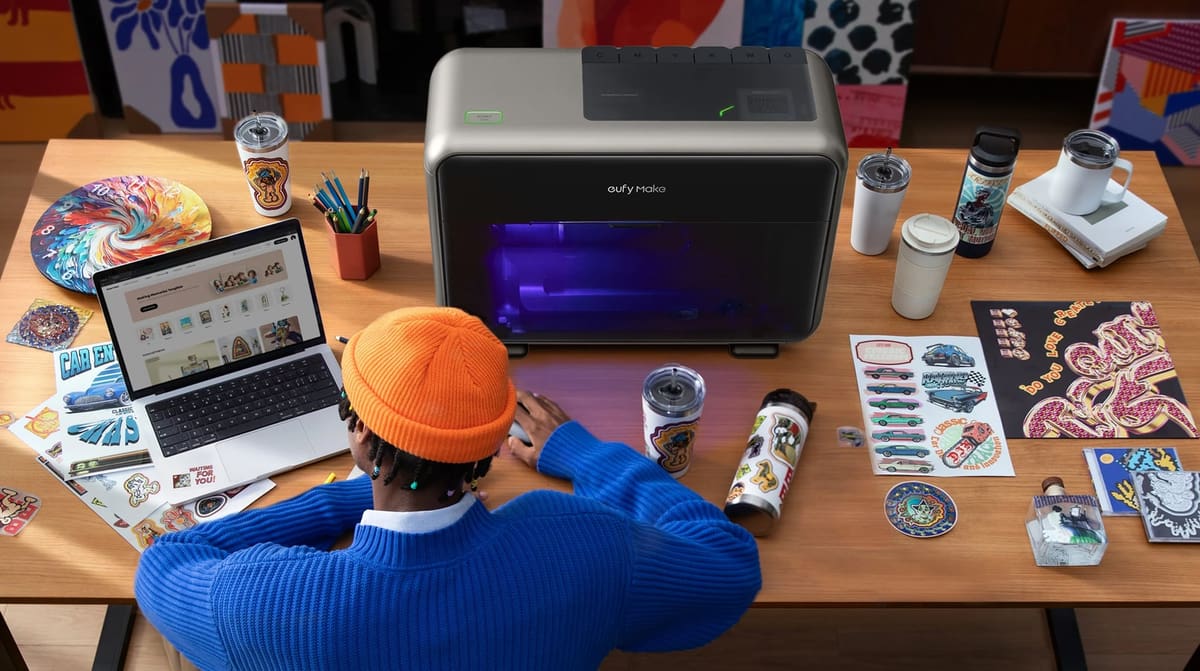
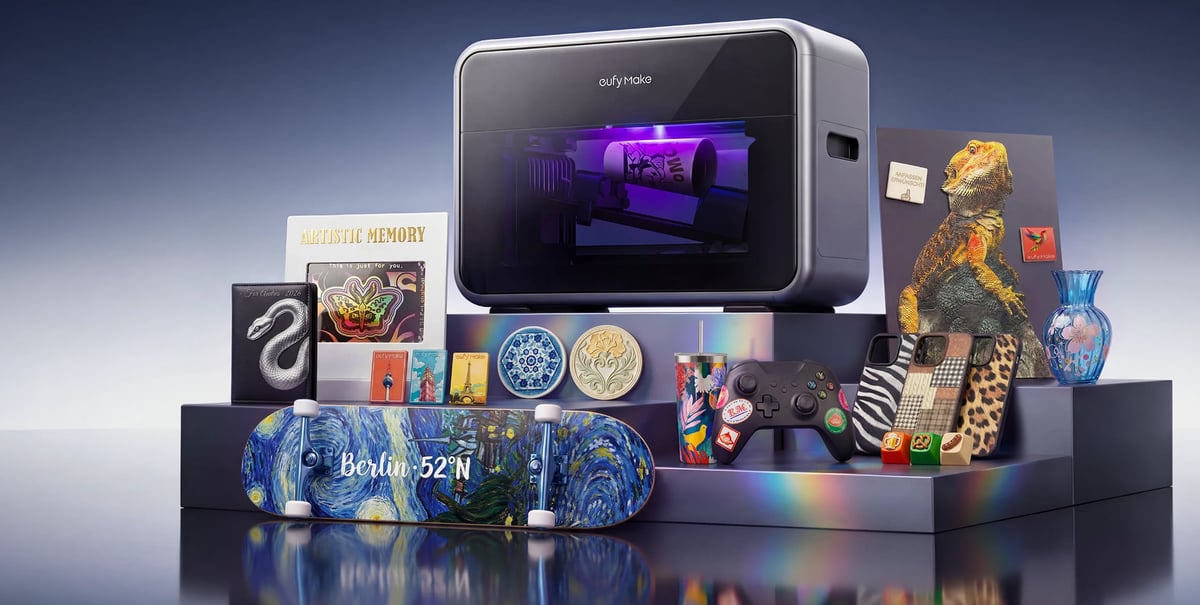
Then came EufyMake starting at $2,359. Its E1 pushed the concept dramatically closer to consumer-hardware territory and introduced a desktop enclosure, automated positioning, self-cleaning features, optional rotary printing, UV DTF equipment, and a consumer-style software and template ecosystem.
The Desktop UV Printer Brands to Know
Bambu Lab isn’t entering an empty market. Over the past couple of years, a new group of UV printers has emerged specifically for makers, creators, home businesses, and small workshops, with one, the Morpho just launching last week. Significantly, several of the companies behind these are already familiar names in desktop 3D printing and laser cutting.
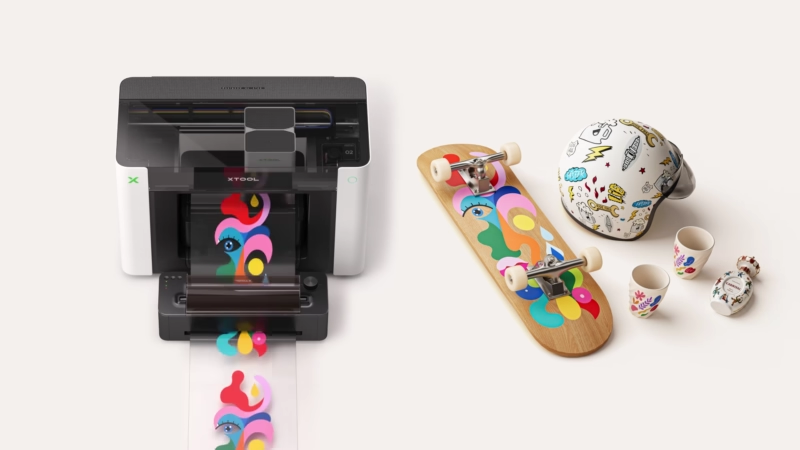
xTool, already well known for its desktop laser cutters, launched it’s first UV printer in July, the O1 Omni Printer. Depending on configuration, the O1 combines direct UV printing with UV DTF, and direct-to-garment printing. Its UV system can print on acrylic, wood, glass, and metal, while accessories expand it to cylindrical objects and transfer-film workflows. Starting at $1,899 in the U.S., the O1 is currently on preorder, making xTool one of the newest maker-hardware brands to commit to the category.
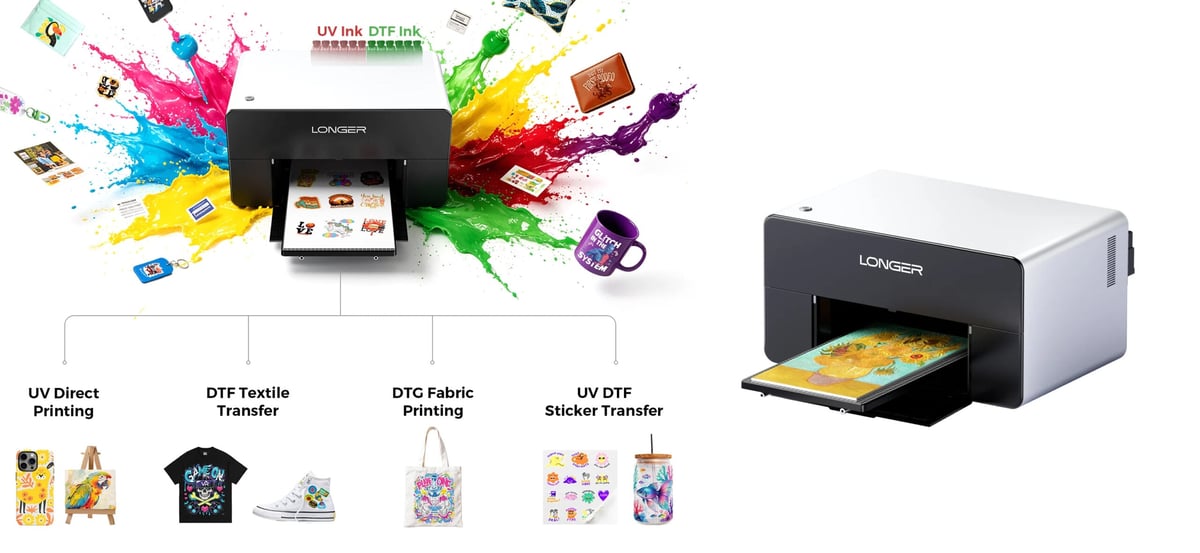
Longer, another company with roots in affordable 3D printers and laser cutters, has taken a similar route with its ePrint. The desktop machine uses two printheads and 12 ink channels and combines conventional UV printing with UV DTF, DTF, and DTG workflows. Its flatbed accommodates objects up to 310 × 420 mm, and Longer has deliberately positioned it as equipment for customization businesses rather than traditional print shops. The ePrint is currently listed at $2,499 in the U.S., with initial shipments scheduled from late August 2026.
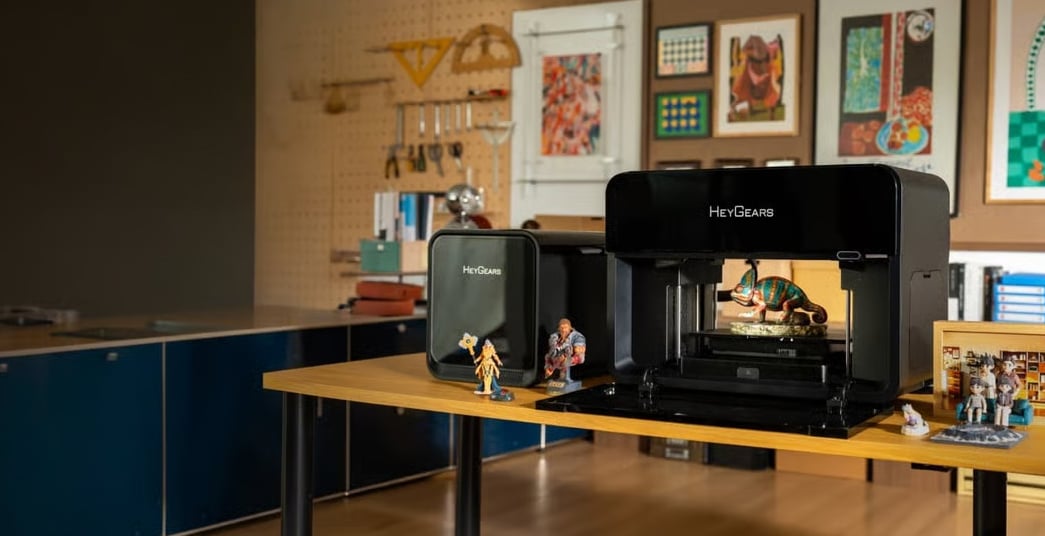
HeyGears is taking perhaps the most unusual approach with its G1 series, which sits directly at the intersection of UV printing and 3D printing. It still has a few weeks left in its Kickstarter campaign having raised more than $12M. In normal UV mode, the machine has a 420 × 330 mm flatbed and an eight-channel ink system capable of conventional graphics and raised textures. The higher-end G1X goes further, using material jetting and dedicated photopolymer resins to create full-color 3D objects with soluble support material. That makes it less a straightforward UV flatbed than a hybrid between a UV printer and a full-color material-jetting 3D printer, and particularly relevant to an audience already familiar with additive manufacturing.
EufyMake is currently one of the clearest examples of UV printing being repackaged as a consumer maker tool. Its E1 has a 330 × 420 mm flatbed and can print CMYK, white, and varnish, including raised textures up to 5 mm. Optional modules add rotary printing and UV DTF transfers. Automated positioning and a self-cleaning ink system are intended to remove some of the setup and maintenance traditionally associated with UV printers. The E1 currently starts at around €2,400 in Europe, putting it much closer to premium maker hardware than conventional commercial printing equipment.
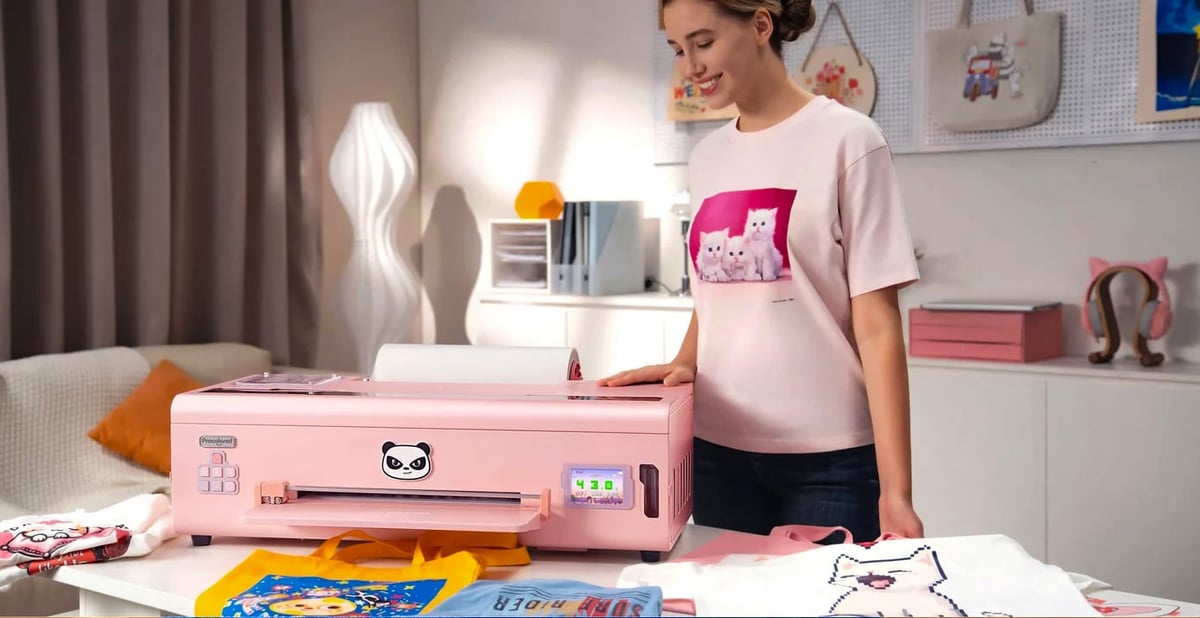
Procolored has been selling relatively compact UV printers for longer than most of these newer maker brands but it hasn’t brought its prices down, with its lineup of A5, A4, A3, and larger machines in the $2k to $5k range. The V6 Panda is its latest A4 desktop model that prints directly onto objects such as phone cases, acrylic, leather, signs, and small promotional products and supports objects up to 110 mm high. Procolored’s machines illustrate that comparatively small and affordable UV printers existed before the current wave, although their workflow and presentation have traditionally been closer to small-business printing equipment than polished consumer appliances.
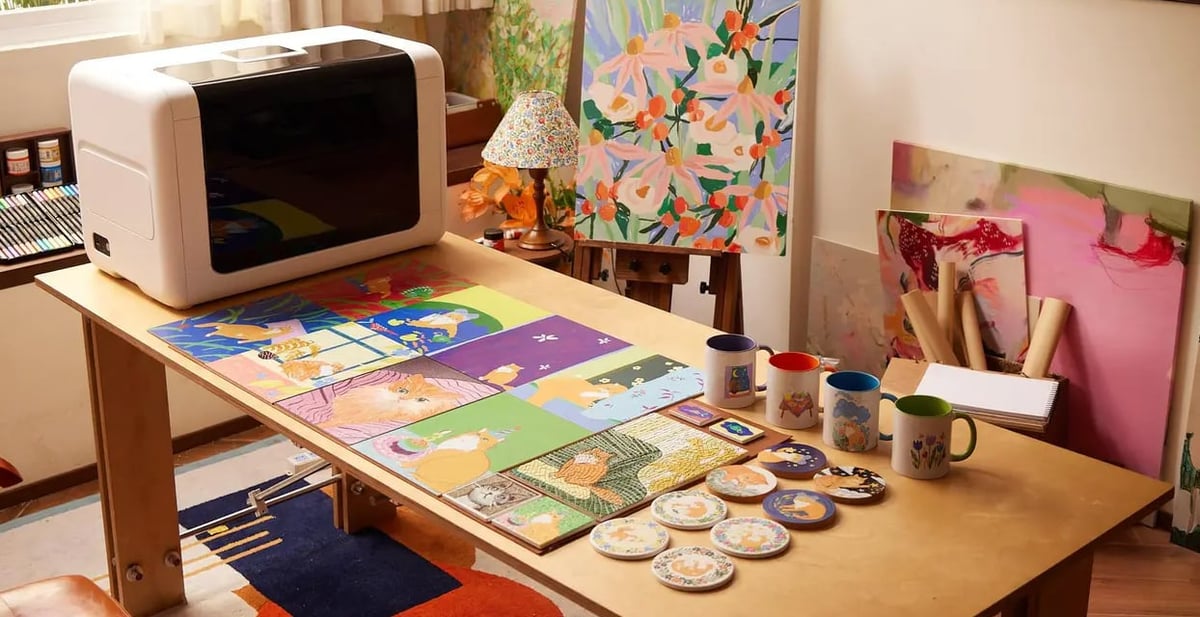
Morpho is another newcomer targeting consumer and small-business UV printing with its Morpho Desktop UV Printer, currently offered through Kickstarter. The enclosed machine uses cameras, structured-light scanning, and automatic height detection to position objects, while its refillable ink system supports CMYK, white, and varnish. Morpho also emphasizes low-maintenance operation with white-ink circulation, nozzle compensation, and automated cleaning features. The Pro model uses an Epson i3200 eight-channel printhead and can build raised textures up to a claimed 60 mm. Kickstarter pricing starts at $1,799 for the standard model and $2,999 for the Pro.
The arrival of Bambu Lab adds another major maker-hardware company to a category that is suddenly attracting a surprising number of them. EufyMake, xTool, Longer, HeyGears, and now Bambu Lab have all reached roughly the same conclusion: UV printing may be ready to become part of the desktop fabrication toolkit.
Why Bambu Lab?
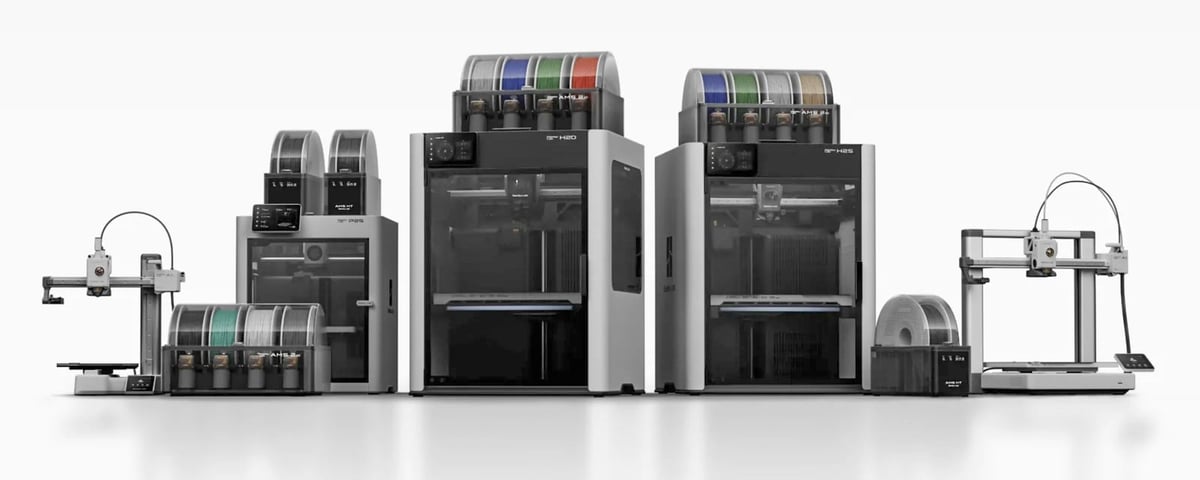
Bambu’s significance isn’t that it has invented another method of putting color onto objects. Its significance is that the company has already demonstrated an ability to take technically demanding fabrication equipment and make it feel unusually appliance-like.
According to market-intelligence firm Context, Bambu Lab captured 37% of global entry-level 3D printer shipments in 2025, taking the lead in the sub-$2,500 category. In Q1 2026 it remained the global market-share leader. Context has also described a broader “Bambu effect” in which capable entry-level machines have pulled users away from significantly more expensive professional FDM printers.
That’s the precedent UV-printer manufacturers should probably be paying attention to.
Bambu did not make fused-filament fabrication new. It made speed, automation, multi-material printing, calibration, software integration, and polished hardware available in combinations that forced much of the established consumer 3D printer market to respond.
UV printing currently has several of the same friction points that desktop 3D printing had and in some respects still has.
Ink needs careful handling. Printheads can clog. White pigment can settle and needs circulation. Different materials have different adhesion characteristics, sometimes requiring primer. The distance between the printhead and object matters. And maintenance has historically assumed a more technically experienced operator.
Even Bambu’s recruitment tells this story.
According to 21st Century Business Herald and 36Kr, Bambu is assembling a team across more than ten areas of development, including printhead driving electronics, jetting-waveform control, ink-path engineering, materials validation, and software integration. Initial positions reportedly included UV printing specialists, FPGA engineers, inkjet-control engineers, and mechanical engineers working on ink-delivery systems.
In other words, the problem Bambu appears to be tackling isn’t merely “make a UV printer cheaper.”
A Natural Partner for 3D Printers and Lasers?
There is another reason UV printing belongs in the maker world: it solves a problem other digital-fabrication tools largely don’t.
A 3D printer makes the object, a laser cutter shapes or engraves it, CNC machine machines it, but none of those tools is particularly good at putting a full-color, photographic-quality graphic directly onto the finished surface.
EufyMake says this gap was one of the motivations behind development of the E1: its team saw makers using 3D printers, laser cutters, and woodworking tools without an accessible way of adding professional color and graphics to their creations. Together, makers can print objects then load them into their UV printer and apply a full color graphics to them.
That logic applies even more strongly to Bambu Lab, whose customers already manufacture objects at home.
If Bambu can compress the cost of a capable UV printer while automating setup and maintenance, it could steal existing professional UV customers, like it did with some manufacturers who 3D print, and it could produce customers who previously would never have considered owning a UV printer at all.
For now, though, almost everything about Bambu Lab’s UV printer remains unknown. There is no announced print area, ink configuration, printhead, price, or release date. We don’t know whether the company will build a conventional flatbed, emphasize cylindrical printing, support UV DTF transfers, chase thick relief printing, or try to combine several of those functions.
Whatever happens, the next machine sitting beside a 3D printer and laser cutter in a home workshop may not make the object at all. It may simply give it color.
License: The text of "What Is a UV Printer, and Why Is Bambu Lab Making One?" by All3DP is licensed under a Creative Commons Attribution 4.0 International License.