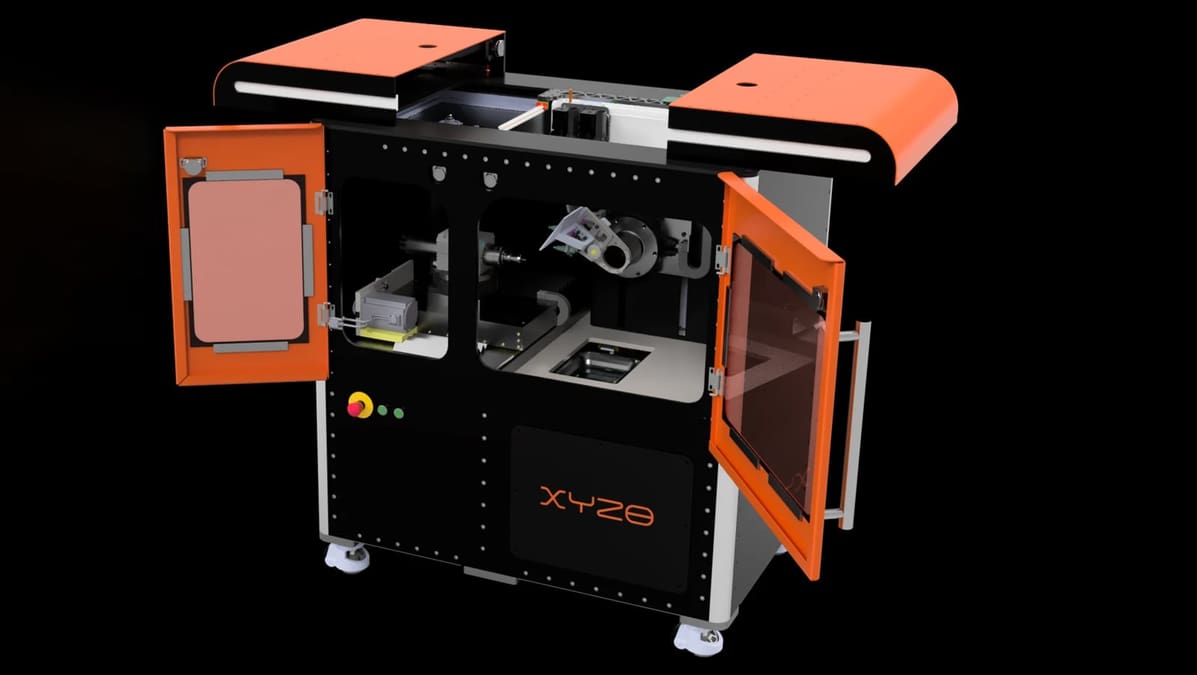
What Do You Get When You Cross FDM, DLP, CNC, and a Pellet Extruder? The New Modular Printer from XYZO

UK startup XYZO has revealed an ambitious modular manufacturing platform that wants to print, machine, cure, clean, and inspect parts without them ever leaving the machine.
What happens if you take an FDM 3D printer, add a DLP resin printer, throw in a pellet extruder and a five-axis CNC mill, then bolt on washing, curing, and inspection equipment? You get something resembling the first commercial offering from start-up XYZO. The company’s new Modular Microfactory is an intriguing idea, but for now, there are considerably more promises than purchasing details.
The company formally launched its automated hybrid manufacturing platform this week, although it had a booth at the TCT 3Sixty expo in Birmingham last June without the machine present. Rather than another printer competing over speeds, temperatures, or build volumes, XYZO is attempting something considerably more ambitious: combining several manufacturing processes into one automated production system.
The basic idea makes a lot of sense. A 3D printer rarely produces a genuinely finished component. Resin parts need washing and curing. Printed parts may need holes drilled, surfaces machined, threads cut, or dimensions brought into tolerance. Then someone has to inspect the final part.
XYZO wants the machine to handle all of those jobs as an automated production line built around additive manufacturing.
Instead of trying to make one additive process do everything, XYZO is effectively admitting that different processes are good at different things. Print the geometry, machine the bits that actually need machining, automatically perform the necessary post-processing, and inspect the result before calling it finished.
One Machine, Many Machines
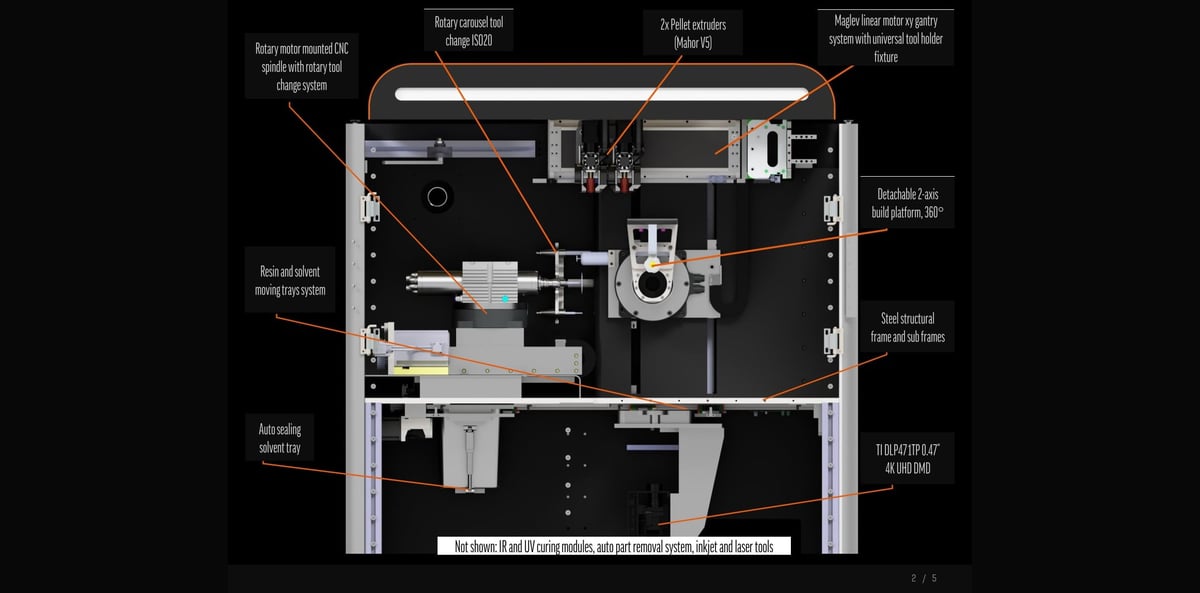
The company describes a common modular chassis that can accommodate different processes, rather than one fixed printer configuration. It currently promotes FDM for engineering thermoplastics, DLP for detailed resin parts, pellet extrusion for higher-throughput polymer deposition, five-axis micro-milling for precision surfaces and features, and drop-on-demand systems for applications including multi-material and biofabrication.
The obvious question is who actually needs a resin printer, filament printer, pellet extruder and CNC mill living under the same roof. XYZO’s answer isn’t necessarily “everyone.” The platform is modular, and the company sees configuring it around specific production jobs, particularly medical devices, microfluidics, printed electronics, defense, and other low-volume work where conventional tooling is difficult to justify.
It’s not difficult to see the appeal for low-volume manufacturing. A system that can print a near-net-shape component, machine critical features, clean it, and inspect it automatically could potentially remove a lot of labor from workflows that are currently anything but automatic. But there is a large gap between could and does.
Keep the Salt Shaker Handy
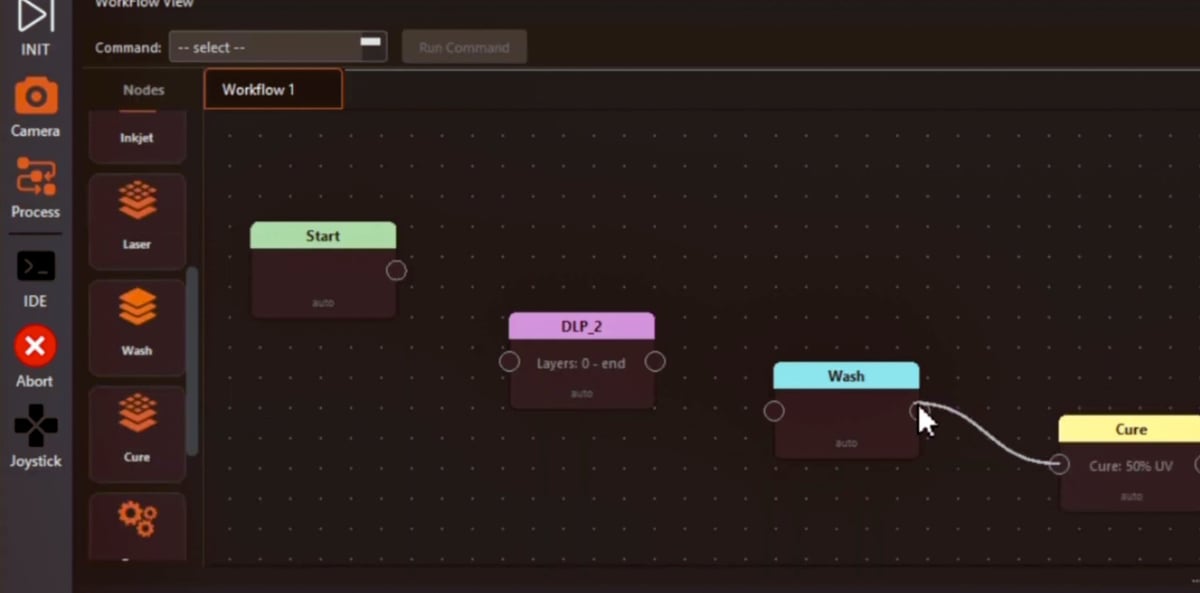
XYZO’s website makes some exceptionally confident claims, including “100% lights-out automation,” zero manual handling between processes, and the ability to produce more than 500 repeatable parts in a run. It also states that its closed-loop system can identify and correct defects before they become scrap and goes as far as saying that “repeatability is NOT an issue.”
There is still no public price or conventional ordering page, and while XYZO has now published a fairly detailed technical specification sheet, we haven’t seen independent performance testing, customer production case studies, or a firm delivery schedule that would let us judge the system as a mature commercial machine. But, we’re still intrigued.
XYZO itself is somewhat more cautious when speaking about where the technology stands.
CEO Kegan McColgan-Bannon told TCT Magazine that there is still “enormous scope to develop the platform.” The company is currently working with customers to develop application-specific workflows, evaluate parts and processes, and potentially progress toward pilot projects and system deployments.
That sounds less like a machine ready to arrive on a factory floor tomorrow and more like a technology platform entering the awkward but interesting stage between development project and commercial product. In fact, XYZO is unusually open about the fact that development isn’t finished. Its own technical brochure lists the core workflow engine and slicers as fully developed, while remote execution and parts of the interface remain in testing. AI-assisted workflow generation and autonomous parameter optimization are still roadmap items.
And that’s fine. In fact, we’d rather see XYZO demonstrate that the difficult parts work than rush another half-finished machine onto the market.
Coordinating an FDM printer is one problem. Coordinating an FDM printer, resin process, pellet extrusion system, five-axis milling operation, post-processing equipment, inspection hardware, and the software required to move parts reliably between all of them is an entirely different challenge.
Doing it once is interesting. Doing it unattended, repeatedly, economically, and accurately enough for production is the part that will matter.
One to Watch?
XYZO is a small newcomer, but its central argument is a good one: improving the printer itself doesn’t necessarily solve the manufacturing workflow surrounding it.
The company currently presents itself not only as a machine developer but also as a contract manufacturer and engineering partner, offering companies the opportunity to submit parts for evaluation while it develops the platform and application-specific systems. That may ultimately be the sensible route to market. Instead of trying to create one enormous do-everything printer, XYZO can determine which combinations of processes actually solve real manufacturing problems.
XYZO isn’t something we’d put on a factory shopping list just yet. But it’s definitely one we’ll be keeping an eye on.
You May Also Like:
License: The text of "What Do You Get When You Cross FDM, DLP, CNC, and a Pellet Extruder? The New Modular Printer from XYZO" by All3DP Pro is licensed under a Creative Commons Attribution 4.0 International License.