Why Only 14% of UK Businesses Have Adopted 3D Printing & Ideas to Boost the Numbers

Although the UK currently lags behind the EU and USA in 3D printing adoption among SMEs, a new study found ways the government could spur more interest.
Small and mid-sized businesses in the UK either aren’t aware of 3D printing as a business solution or don’t think it applies to their business, a new study by the UK’s Department for Science, Innovation & Technology found.
“Non-adopters [of 3D printing] cite a lack of awareness about the availability of resources and perceived benefits, while those considering adoption face financial constraints, skills shortages, and technical challenges,” the report stated.
For the SMEs aiming to adopt the technology, several barriers were mentioned, including the cost of the initial investment, skilled worker shortages, and regulatory compliance issues, along with scalability and sustainability concerns.
Compared to the U.S. 3D printing (3DP) remains the least-adopted advanced digital tech in the UK
The report found that roughly 14% of UK firms are using 3D printing, below EU (24%) and the US (~20% in 2024).
How to Raise Adoption
If more SMEs had top-management support for their 3D printing initiatives, adoption would be stronger, the report found. Other aspects that would boost overall adoption would be technical and financial resources that companies could tap.
The report also found that SMEs would turn to 3D printing as a solution if there were more capable 3D printing services and if there were more competitive forces in their specific industries to adopt the technology. If SMEs had more community and university initiatives that lowered the risk of adopting 3D printing and built a talent pool, that would also help, the study found.
As a microcosm of 3D printing in the UK, the study focused on the Greater Manchester area. This north-west region of the UK has higher than average adoption of 3D printing (17%) compared to the country as a whole (11%). This success was due in part to programs, such as Made Smarter (piloted in the North-West), that offered roadmapping, grants, and training. It resulted in 379 projects since 2019 and created more than 1,700 jobs.
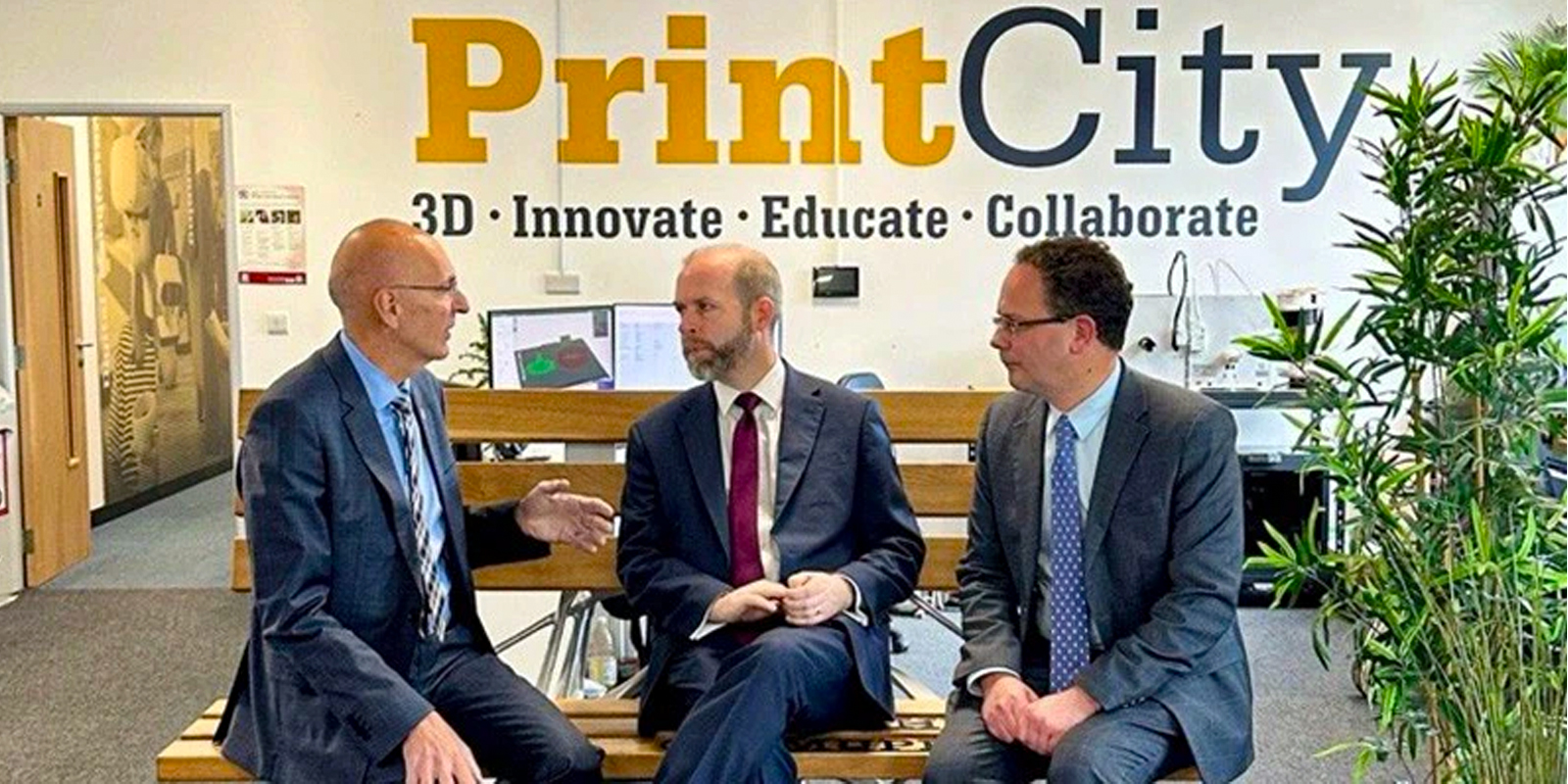
Another major driver of adoption in the North West is PrintCity, an innovative hub for additive and digital manufacturing based at Manchester Metropolitan University. Launched in 2018, PrintCity provides industrial support for business adoption of additive manufacturing. By the end of 2025, PrintCity will have invested close to £3 million in 3D printing and 3D scanning equipment and will have close to 100 machines that can be used by local businesses. It has assisted over 200 local businesses since 2020 in effectively accessing technology and determining the appropriate processes for product development.
Overall, the UK’s report found that the roadmap to increased 3D printing adoption included a place-based approach that builds on regional strengths, a human-centric skills focus, support at each stage of the adoption journey with targeted interventions, and more promotion of successful use cases (prototyping, customization, rapid tooling, resilient supply chains) to boost awareness.
License: The text of "Why Only 14% of UK Businesses Have Adopted 3D Printing & Ideas to Boost the Numbers" by All3DP Pro is licensed under a Creative Commons Attribution 4.0 International License.