
Two Printheads, One Part: The FDM Tech Promising 10X Faster Speeds

A new Kickstarter project aims to shatter 3D printing speed limits by coordinating two printheads on a single object. We dive into the clever software making it possible—and why that massive speed claim comes with a catch.
Desktop 3D printing speed has hit a wall, but a new dual-printhead system from start-up Anabolic Mechanics that just launched on Kickstarter wants to tear it down. By using twin independent print heads to collaborate on the same part at the same time using proprietary slicing software, the new DualCore aims to boost print times 10 fold without sacrificing surface detail.
The DualCore can achieve print speeds up to 1,850 mm/s, the company claims, by replacing sequential single-head execution with coordinated “twin-engine printing”. The system automatically determines when dual printing is required in order to reduce cycle times while maintaining surface quality. But the speed doesn’t just come from coordinating printheads. There’s software that adjusts the layer heights depending on whether the layer is infill or outer surface detail.
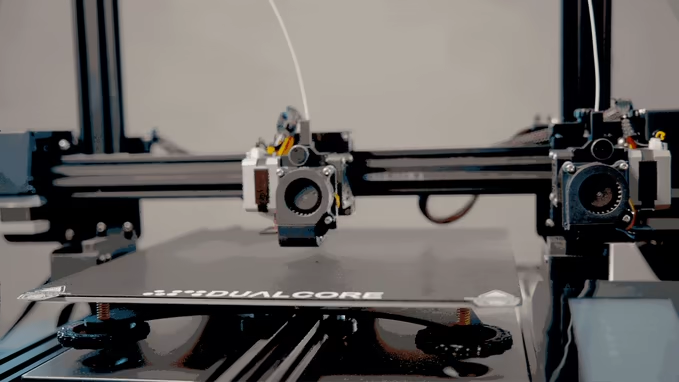
There are quite a few fresh and interesting innovations in the DualCore, but let’s take a second to unpack the speed claim of 1,850 mm/s.
Anabolic Mechanics’ kickstarter presents some equation used to back up the speed, but the claim is a bit slippery. They are not really proving that the printer literally prints at 1,850 mm/s in the way most people would understand print speed. What they are doing is taking a faster, thicker kind of interior printing, converting that into an “equivalent” speed compared with a more normal print setting, then assuming two print heads can share that work almost perfectly.
The big issue is that this only works under very favorable conditions ignoring factors like acceleration, cornering, vibration, extrusion pressure dynamics, melt capacity, and cooling to name a few. It assumes the printer is making a large part, that most of the job is easy interior fill, and that both print heads can stay busy without getting in each other’s way. It also gets some of its speed boost by printing the inside of the object in a rougher, less detailed way while keeping the outside detailed. That can be a smart design choice, but it is not the same as saying “this printer just prints everything at 1,850 mm/s.” A fairer claim would be that it can reach something like an 1850 mm/s “equivalent speed” in ideal cases.
In a collaborative mode, the second head is often locked out of 30% – 50% of the part’s geometry to maintain a safety buffer. This means the 10x speed claim only applies to massive, wide parts where the heads have room to breathe. On a standard 300 mm bed, the heads are essentially elbowing each other constantly.
On small parts, Anabolic makes a more realistic and industry-standard speed claim of 485 mm/s.
How Categorical Layer Heights Drive Speed
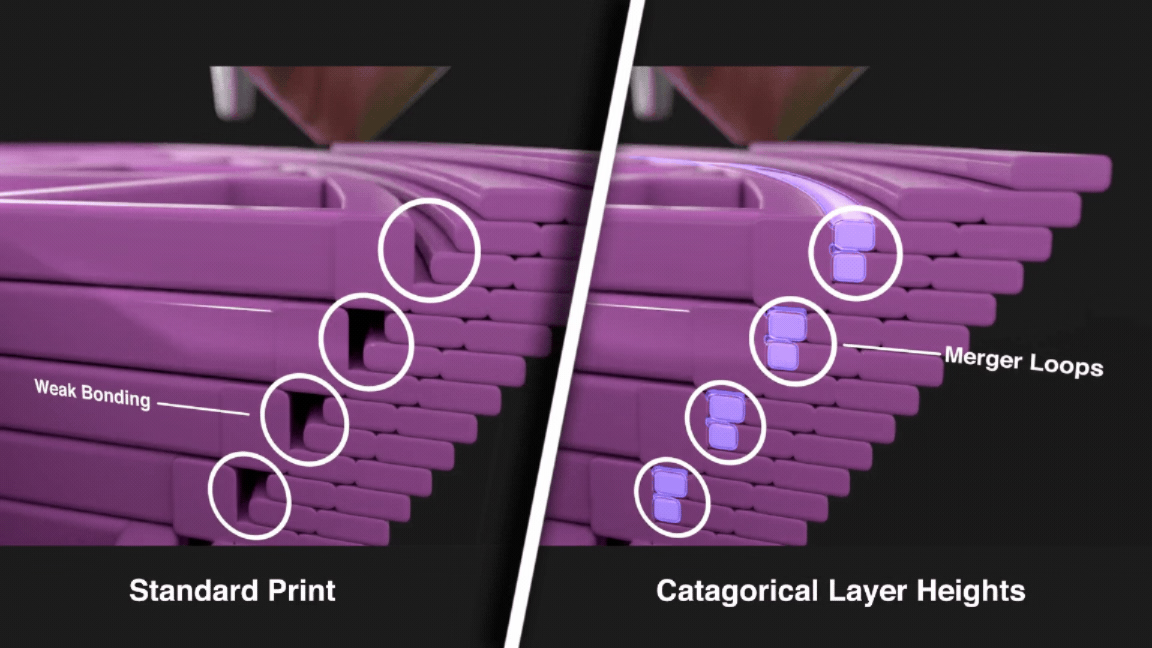
The slicing software here is the most interesting feature in how it manages two different layer heights on the same layer. To maintain structural bonding, the slicer adds “transition merger loops” where these fine-layer and thick-layer regions meet.
What makes this different from normal dynamic layer height is that it is not just reacting to shape. “It is intelligently assigning layer heights by print category,” the company says. “In other words, the slicer knows that a visible outer wall and hidden internal infill do not need to be treated the same way.”
The software also uses “Overflow Anchor Seeding” to create internal cavities that are filled in a continuous overflow process, forming solid internal anchor points intended to increase part durability. “Instead of leaving strength up to weak layer-by-layer bonding alone, this forms solid internal anchor points that help tie the print together from the inside,” according to Anabolic. Once the anchors are formed, the print closes over them with top fill. The result is a stronger internal structure with no visible impact on the outer surface, so you gain strength without sacrificing the final look of the part. Typically, you’d just pick a stronger material, but if you’re looking for a way to make a stronger PLA print, for example, this sounds promising.
If you are printing 100 copies of the same large, single-material mechanical bracket, the DualCore’s ability to churn out the interior while refining the exterior simultaneously has the potential to save you hundreds of hours. For a hobbyist, might you be better off with a tool-changer for variety or a single-head high-speed printer for raw acceleration?
Company founder and lead engineer Sargon Tony Hajjar developed this slicer software while at MIT in 2024. To facilitate the concurrent operation of two extruders in a single print job, Hajjar and his team developed new strategies for path generation, infill optimization, workload separation, and merging algorithms to balance aesthetics, strength, and speed.
If the software technology performs as claimed, it wouldn’t be a surprise if it’s quickly acquired by any number of established players in the FDM market who could apply it to more polished hardware. In fact, the hardware seems almost like an afterthought here. Conspicuously, the company doesn’t show the printer actually printing parts using both printheads. There’s some video where one printhead is printing, some video of both printheads moving around (but not printing anything), and digital rendering of how both printheads are intended to work together. Okay, okay, it’s a Kickstarter and still in R&D, but we’re intrigued. Show us more.

Currently, the Kickstarter campaign has earned just about half of its goal ($40K toward its $100K), with 23 days remaining.
A single AM DualCore unit is listed at $840 (super early bird special), which is 30% off the $1,200 expected retail.
If fully funded, the estimated delivery dates are scheduled for July 2026 and August 2026. The manufacturer offers a one-year warranty on the printer, excluding extruders and consumable parts, and states that shipping to the U.S. will be free of charge.
Tech Specs
Editor's Note – This article highlights a Kickstarter crowdfunding campaign. Kickstarter is not a shop; campaigns are under no legal obligation to deliver on crowdfunding promises, nor offer refunds on unfulfilled campaign rewards. For more insight, read our article 8 Things to Watch for When Backing a 3D Printing Kickstarter.
You May Also Like:



License: The text of "Two Printheads, One Part: The FDM Tech Promising 10X Faster Speeds" by All3DP is licensed under a Creative Commons Attribution 4.0 International License.