
Tooling-Free FDA Compliance: How Lynxter’s New SIL-004 Prints Food-Grade Silicone in Hours

This new additive material offers food-processing plants a rapid, cost-effective method to produce custom gaskets, seals, and production-line parts at fraction of the time of traditional manufacturing.
Lynxter, the French 3D printer and materials manufacturer is broadening its silicone system’s reach into the food industry with a new FDA food-contact silicone material.
The new SIL-004, which is only printable with Lynxter’s printers, targets a long-standing gap in additive manufacturing: directly printing functional, flexible silicone parts that can be used in regulated food-contact environments, like food processing, rather than printing a mold and then casting silicone into it.
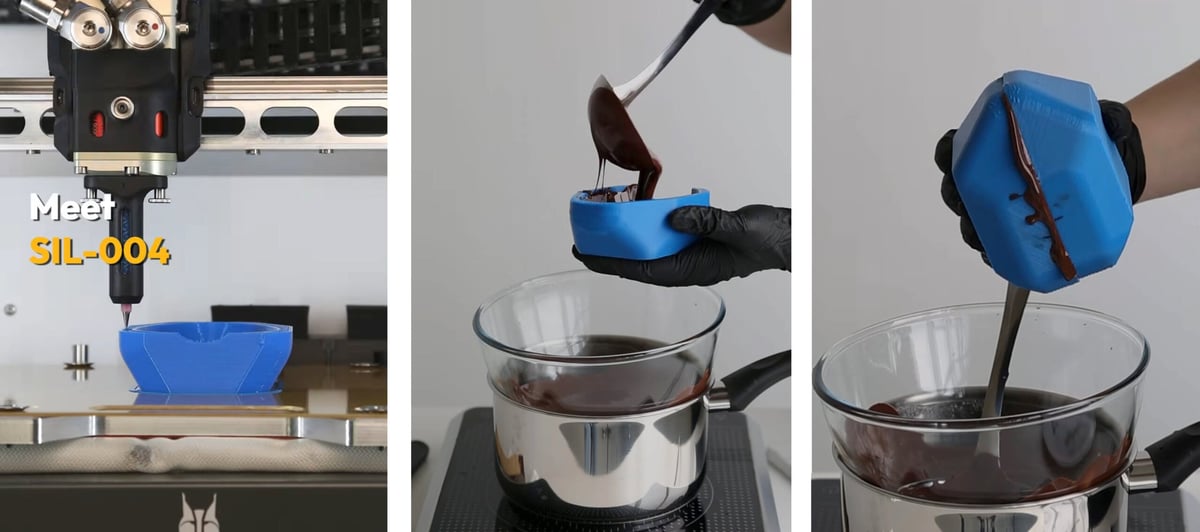
The practical implication is customization with compliance. A scraper for a chocolate line, a custom gasket for a legacy filling machine, or a prototype food-contact mold may have complex geometry and low production volume, so are costly to produce. With a printable food-grade silicone, those parts can potentially be made without dedicated tooling, which Lynxter says reduces production from several weeks by casting or molding to “within a few hours” for SIL-004 parts.
Much silicone 3D printing to date has been discussed in connection with medical, soft robotics, anatomical models, textiles, and other functional elastomer applications, but industrial food contact is a tougher market because material compliance and cleanability matter alongside mechanical performance, Lynxter says.
According to the company, the material is not only compliant with FDA CFR 21 177-2600, but free from BPA and PFAS, and intended for the rapid production of functional parts used in food-processing environments, such as custom seals, conveyor-line parts, scraping systems, food-grade molds, and hygienic design prototypes.

Lynxter describes SIL-004 as the “world’s first” 3D printable silicone compliant with the FDA food-contact standard. The material is compatible with the company’s S300X LIQ21/LIQ11 and S600D printers.
“Requests for food-grade silicone parts have surged with the widespread adoption of the S300X – LIQ21 | LIQ11, so we decided to tackle the challenge head-on,” says Lynxter CEO Thomas Batigne.
SIL-004 expands Lynxter’s elastomer materials lineup, which also includes SIL-001, a 50 Shore A silicone; SIL-002, a 70 Shore A high-hardness silicone; and PU-001, a 70 Shore A polyurethane. The new material is positioned for food, cosmetics, and other sectors where material-contact compliance is required.
SIL-004 has a 50 Shore A hardness, 203% elongation at break, 6.12 MPa tensile strength, and an operating temperature range of -50 °C to 250 °C. It is blue, uses a 1:5 mixing ratio, and is available in 5 g syringes and 850 g cartridges. Lynxter lists SUP-001 as the support material.
The company has not released any detailed post-processing requirements, surface-finish data, cleaning/sanitization test results, EU food-contact compliance, pricing, or a customer use case. Still, Lynxter’s SIL-004 pushes silicone 3D printing further into regulated production applications enabling food industry manufacturers to produce custom tooling, seals, parts, and molds faster and with less dependence on molds.
You May Also Like:



License: The text of "Tooling-Free FDA Compliance: How Lynxter’s New SIL-004 Prints Food-Grade Silicone in Hours" by All3DP Pro is licensed under a Creative Commons Attribution 4.0 International License.