This New Flashforge Dryer is the Ultimate Upgrade for Creator 5 Owners

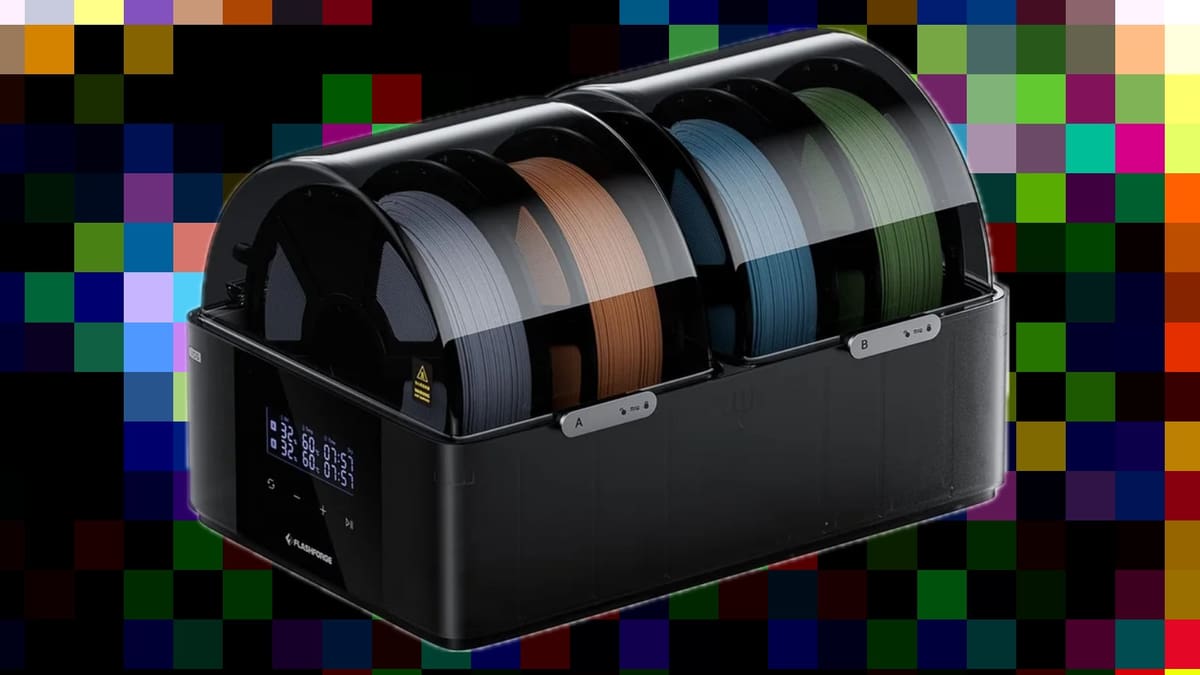
Flashforge's VDS dries up to four spools across two independently controlled chambers, with Creator 5 integration as its main selling point. Shipping starts Oct. 20.
Flashforge just released its VDS Smart Drying & Filament Management System ($259), a four-spool filament dryer built around two independently controlled chambers, 85 °C heating, and automatic humidity management.
That feature set is fairly typical for this increasingly crowded category, which makes it clear that Flashforge isn’t pitching the new dryer to everyone. This system is really aimed at owners of the company’s Creator 5 3D printers.
The most distinctive feature of the VDS (or Ventilated Drying System) is how closely it integrates with the Creator 5, but first let’s look at the dryer’s basic functions.
Each chamber can be set separately from 45 to 85 °C in 5 °C increments, with timers ranging from 1 to 48 hours in 30-minute steps. You can run one chamber on its own or start both together, making it possible to dry two different materials at different temperatures at the same time.
Flashforge says the system continuously monitors humidity inside each chamber and removes moisture when it rises above a set threshold. It uses reusable desiccant that regenerates during drying, while a front-mounted touch display shows live humidity, temperature and remaining time for both chambers. Dual overheat protection is also built in.
Built with the Creator 5 in Mind
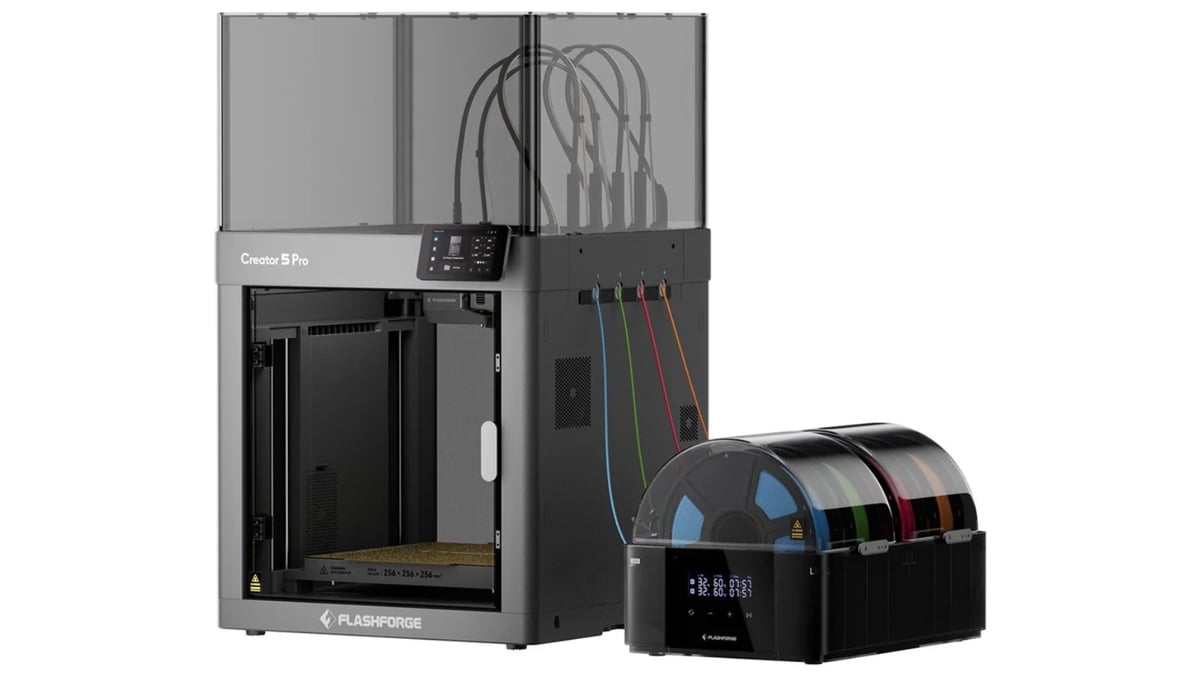
The VDS’s smarter functions come from how it manages moisture and communicates with the Creator 5 and most of this integration is exclusive to the Creator 5 series.
A 4-pin data cable connects the printer to the dryer, adding a VDS tab to the printer’s filament screen and moving most of the dryer’s controls onto the Creator 5 itself.
From there, you can start either chamber independently, run both at once with Dual Dry, choose a material preset or adjust the dehumidification settings without touching the VDS. The Creator 5 includes drying profiles for PLA at 50 °C for 8 hours, PETG at 65 °C for 8 hours, and ABS and similar materials at 80 °C for 12 hours. Selecting a filament loads its recommended settings automatically, while any changes you make are saved to that material’s profile. When a cycle finishes, the VDS chimes and the printer displays a notification.
The physical setup is designed around that pairing, too. The VDS sits to the right of the Creator 5 with its filament outlets facing the printer, allowing filament to feed directly from the dryer into the printer’s filament inlet. A lower outlet uses a PTFE tube for most materials, while a separate upper outlet is intended for TPU and carbon-fiber-filled filament, which Flashforge says helps reduce friction.
That means filament can stay in the drying chamber while the Creator 5 prints, but the VDS isn’t an automatic material changing system. It doesn’t load or switch spools for you; each filament still has to be fed through manually.
One VDS can communicate with only one Creator 5 at a time, and although Flashforge describes the dryer as compatible with all of its printers, its documentation says data communication is limited to the Creator 5 series.
With other printer brands, the VDS works as a standalone dryer. Automatic dehumidification still operates independently and can be switched on or off with a long press, but its target humidity range is fixed unless the dryer is connected to a Creator 5.
The VDS supports both 1.75 mm and 2.85 mm filament, with room for spools up to 202 mm in diameter and 70 mm wide. That is enough for up to four standard-size spools, although wider spools won’t fit.
How It Compares
The VDS enters a crowded four-spool dryer market, and on core drying specs it doesn’t stand far apart from cheaper rivals. Sovol’s SH03 and Creality’s SpacePi X4 both use two independently controlled chambers, both reach 85 °C, and both cover the same broad range of common engineering and consumer filaments.
On paper, the three are closely matched. All support PLA, PETG, ABS, TPU, PC and PA, while the VDS and SpacePi X4 both offer a 45 to 85 °C range and drying cycles of up to 48 hours. The SH03 also tops out at 85 °C and adds automatic dehumidification and 10 material presets.
The bigger differences are price and ecosystem integration. At regular pricing, the VDS costs about $60 more than the SpacePi X4 and $100 more than the SH03.
What that extra money buys is the Creator 5 integration. Neither rival is designed to put dryer controls on the printer’s own screen or tie its drying profiles into the printer’s filament interface. If you’re using the VDS as a standalone dryer, that advantage largely disappears.
Flashforge launched the VDS at a $199 pre-order price, against a regular price of $259. Its U.S. store currently lists the dryer as sold out in pre-order, with shipping scheduled to begin on October 20.
You May Also Like:



License: The text of "This New Flashforge Dryer is the Ultimate Upgrade for Creator 5 Owners" by All3DP is licensed under a Creative Commons Attribution 4.0 International License.