This Filament is Made of (Almost) Moon Dust

Basalt Moon Dust Filament is composed of synthetic moon dust, although to print with it you’ll have to contend with the gravity of its hefty price tag.
A new 3D printing filament has hit the market, and it’s almost out of this world.
Basalt Moon Dust Filament is made from “lunar regolith simulant” – a synthetic material that is 60-62% basalt and designed to mimic the composition of actual lunar regolith, or moon dust.
The filament is a collaboration between The Virtual Foundry and Astroport Space Technologies. There’s not much information available on the filament’s properties (much less practical applications), although The Virtual Foundry claims it can be sintered, resulting in a final product that is 100% basalt. The filament is also not prone to warping.
To achieve the best results, The Virtual Foundry recommends printing the filament with a 0.6 mm hardened steel nozzle, a nozzle temperature of 210°C, and a flow rate of 135%.
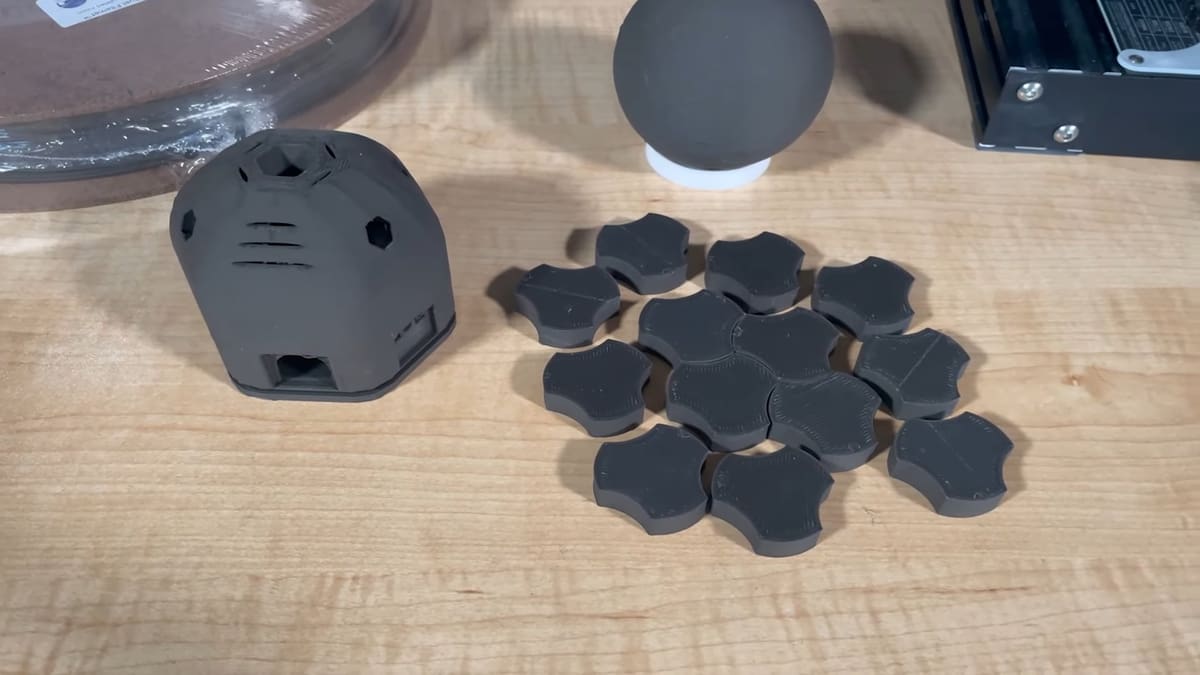
While Basalt Moon Dust Filament is probably not “poised to redefine the possibilities of additive manufacturing”, as its press release claims, it’s nevertheless a pretty good gimmick, as far as gimmicks go – if only for the realistic models of the Moon you’ll be able to create.
That said, you’ll have to contend with the hefty price tag. A 0.25 kg spool of 1.75 mm filament will set you back $225, with a 0.5 kg spool coming in at $400. A 1 kg bag of pellets, meanwhile, costs a whopping $779.
If you’re not put off by the eye-watering price, you can buy The Virtual Foundry’s Basalt Moon Dust Filament from its website. There, you can also find more information and free print files for a “Planetary Habitat Model” that could be worthy of your first moon-inspired creation.
You’ve read that; now read these:
License: The text of "This Filament is Made of (Almost) Moon Dust" by All3DP is licensed under a Creative Commons Attribution 4.0 International License.