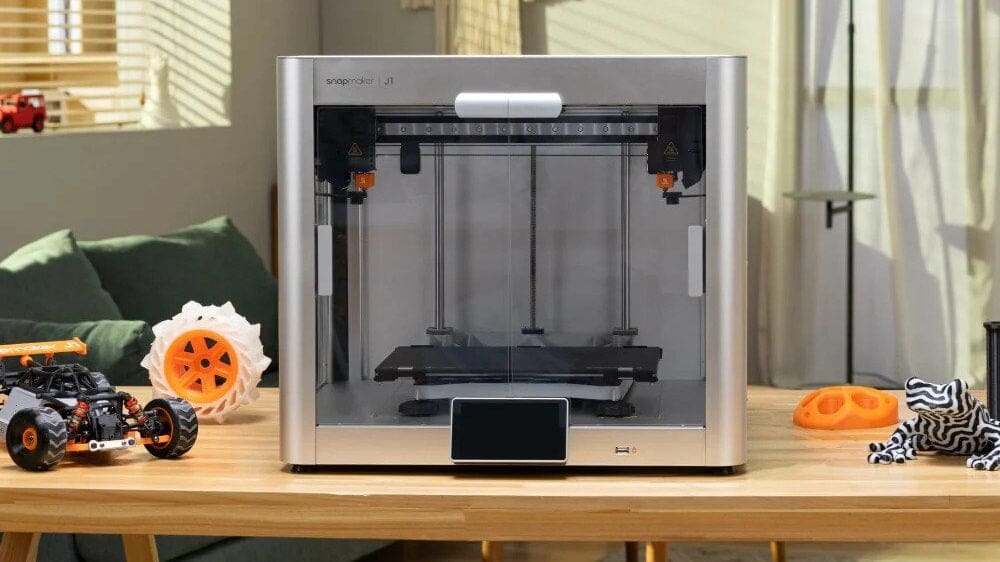
Snapmaker Releases J1 Controller Software As Open Source

The release follows a growing conversation about the state of open source in 3D printing and details some of the company's contributions.
Snapmaker has open-sourced its controller software for the Snapmaker J1 IDEX 3D printer. The announcement comes weeks after an open letter by Josef Průša, founder and CEO of Prusa Research, lamented the state of open source in 3D printing and condemned a lack of credit toward open-source contributors by those benefiting from the work. Although, it is unclear if the two things are directly related. Regardless, the J1’s firmware, which is based on Marlin, is “basically stable,” according to a recent Snapmaker blog post, and as such is ready to be shared with the 3D printing community.
In the release announcement, Snapmaker outlines three major updates it contributed to the base Marlin code. First and foremost is vibration compensation, which is achieved through the implementation of input shaping and “precise pulse control” – and results in the J1’s maximum motion speed being increased from 150 mm/s to 350 mm/s and maximum acceleration from 3,000 mm/s2 to 10,000 mm/s2, according to Snapmaker. A detailed rundown of the feature – as well as insight into Snapmaker’s decision to implement it – is included in the blog post linked at the end of this article.
Second is a new communication protocol that results in “more reliable and user-friendly” communication between the J1’s controller and touchscreen. Finally, an “innovative” IDEX calibration method leverages electrical conduction, allowing users to complete the calibration process in Assist Mode in 10 minutes, helping reduce errors and improve accuracy.
While Snapmaker’s move to open source is an exciting one, it is worth noting that All3DP had a poor experience with the J1 — especially given its hefty price tag. While we appreciated its all-metal design and solid IDEX build, we found it ultimately fell short, with poor print cooling and software that proved functional but generally lackluster and buggy.
For more information about Snapmaker’s open-source release, as well as the aforementioned deep-dive into the vibration compensation feature, check out Snapmaker’s blog post.
You’ve read that; now read these:
License: The text of "Snapmaker Releases J1 Controller Software As Open Source" by All3DP is licensed under a Creative Commons Attribution 4.0 International License.