Researchers Develop a New Method of 3D Printing Glass

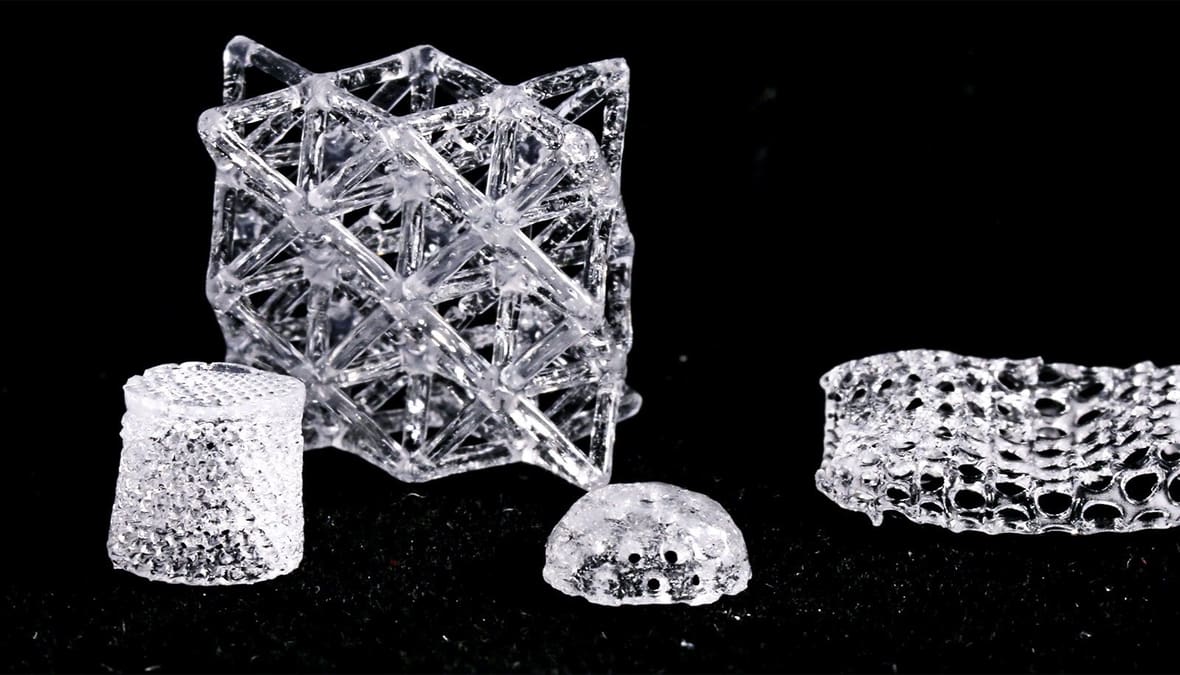
ETH Zurich researchers used a 3D printing process to produce complex glass objects.
Researchers from the Swiss Federal Institute of Technology used a 3D printing process based on stereolithography (SLA) to produce complex and highly porous glass objects.
The group of scientists developed a special resin that contains a polymer as well as organic molecules to which ceramic glass precursors are bonded. The resin can then be processed using UV-light. The plastic monomers are cured to form a labyrinth-like structure with interstices of ceramic-bearing molecules.
The 3D printed parts are then fired in a furnace, first at 600°C to burn off the polymer, followed by 1.000°C to turn the ceramic structure into glass. During the process, the objects shrink significantly but become transparent and hard like window glass.

However, the 3D printed objects are no bigger then a die, as large glass cannot be produced this way.
But, “that was not actually the goal of the project,” researcher Kunal Masina stated in a press release. The aim was rather to prove the feasibility of producing complex glass objects using a 3D printer.
Nevertheless, the researchers applied for a patent and are already negotiating with a major Swiss glassware dealer looking to use the technology in its company.
(Source: ETH Zurich)
License: The text of "Researchers Develop a New Method of 3D Printing Glass" by All3DP is licensed under a Creative Commons Attribution 4.0 International License.