Recycle Your Scrap & Powder into 1.5 kg of New Filament Per Hour with 3devo’s New X10

Turn everything from pellets to failed prints to leftover SLS powder into new 3D printing material with 3devo's latest extruder machine.
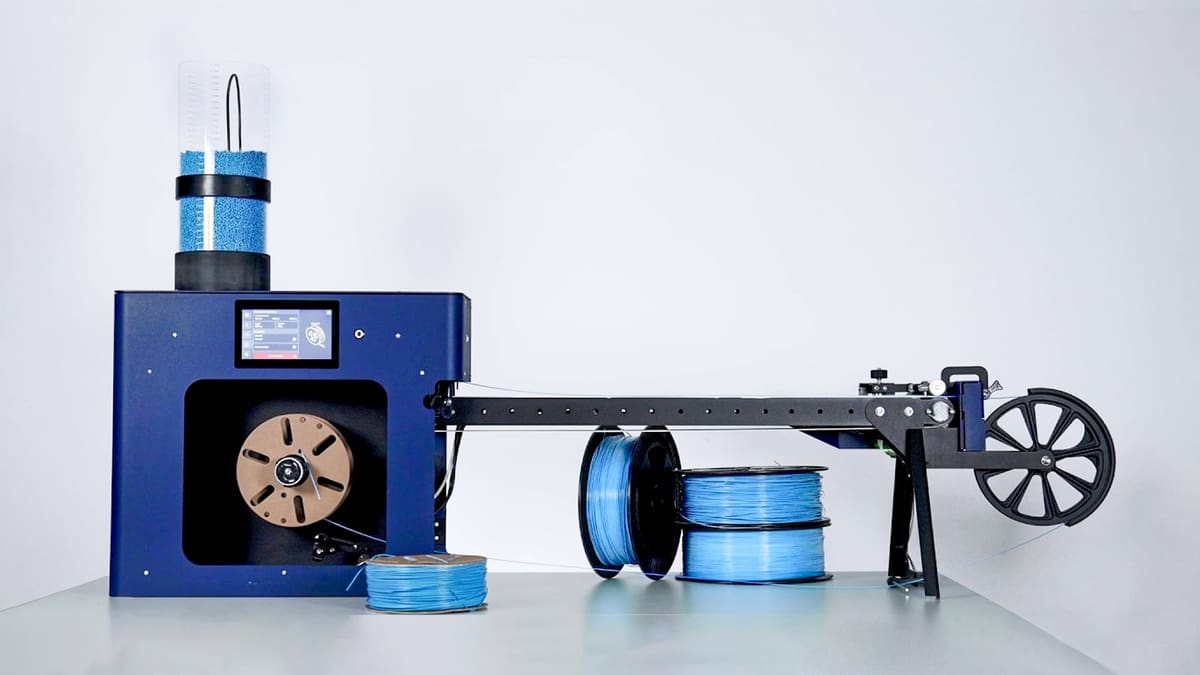
Turning failed prints, plastic scrap, and leftover material back into usable filament is getting a little more practical. With its new Filament Maker X10, Dutch extrusion equipment manufacturer 3devo is targeting print farms, small manufacturers, and in-house 3D printing operations with higher throughput and tighter control over filament diameter, which have been two of the biggest challenges when making your own recycled feedstock.
The X10 produces 3D printing filament from standard injection molding pellets, left-over SLS and MJF powders, and general shredded plastic waste.
3devo rates the X10 for throughput of up to 1.5 kg per hour with PLA and says it is designed to operate continuously, including 24/7 runs. Unlike a conventional filament extruder that requires an operator to adjust the process as filament dimensions change, the X10 uses a closed-loop control system to monitor filament and make corrections automatically.
The company says the X10 “is built for teams who want to decentralize their filament supply; producing their own material on demand, instead of relying on external supply.”
3devo has not disclosed pricing for the X10, but or comparison, its Filament Maker Two launched at around $18,000 in 2024 and is currently listed by European resellers for around the same price.
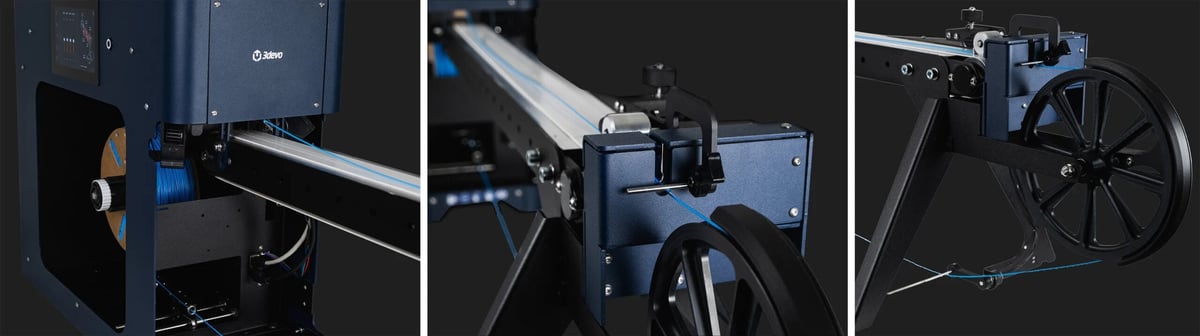
The X10 measures filament with a three-axis optical sensor positioned toward the end of its cooling path. According to 3devo, the sensor has a resolution of 10 microns and takes more than 25 measurements per second, with the resulting data fed back into the extrusion controls.
3devo claims an on-spool diameter tolerance of ±30 microns, although that figure is based specifically on recycled carbon-fiber-filled PA12 rather than all supported materials. The company also notes that its 1.5 kg/h maximum throughput is a PLA reference value and will vary with material and processing settings.
Filament travels 2.8 meters between the nozzle and spool, including a one-meter silicone conveyor. The longer path gives material more time to cool before it is measured and wound. 3devo says this cooling arrangement is one of the changes that allows the X10 to operate at higher throughput and handle lower-viscosity materials.
Four independently controlled heating zones reach up to 450 °C. The machine can wind spools of up to 3 kg and uses a 7.25-liter hopper with a vibration feeder intended to keep powders and irregular regrind flowing into the extruder. Remote monitoring and operation are available over Ethernet, with process data recorded for individual spools.
3devo lists materials ranging from PLA, PETG, and ABS to PA12, PEEK, PEI, and PEKK, along with filled compounds containing carbon fiber, glass fiber, ceramic, or metal powders. As with the performance figures, those are manufacturer-listed compatibilities rather than results independently tested by All3DP.
Recycling Powder Into Filament
One application 3devo is highlighting for the X10 is turning unused powder from SLS and MJF printing into filament.
The company says it has processed more than 2,000 kg of PA12 powder waste on its own production line while working with the X10. It does not provide independent test data for that figure on the product page, but says the machine was tested across 15 units over more than six months, including systems operated by six pilot customers.
The X10 joins the Filament Maker One and Filament Maker Two in 3devo’s current lineup. The company describes the Two as a system for research, recycling, and controlled filament production, while the X10 is explicitly presented as its option for continuous, unattended production.
You May Also Like:


License: The text of "Recycle Your Scrap & Powder into 1.5 kg of New Filament Per Hour with 3devo’s New X10" by All3DP Pro is licensed under a Creative Commons Attribution 4.0 International License.