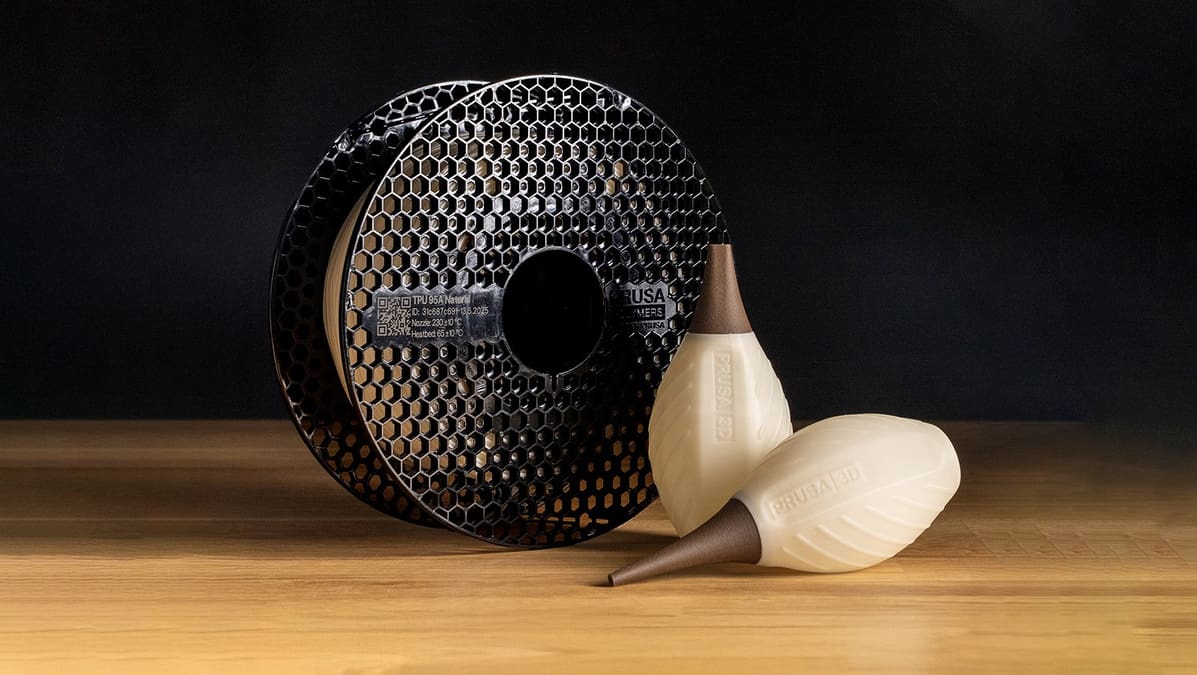
Prusa Debuts TPU Filament Designed to Fix the Hassles of Printing with Flexibles

Soft and bendable objects have never been easier to 3D print with a TPU manufactured for consistency, repeatability, and industrial-grade performance, says Prusa Research.
Flexible filaments like TPU can be challenging to print with. Stringing, inconsistent extrusion, and nozzle jams are just some of the common issues that 3D printer and material manufacturer Prusa Research says it has fixed with its “breakthrough” new filament, Prusament TPU 95A.
Prusa claims it has cracked the code for reliable and consistent TPU printing. By introducing a unique post-manufacturing relaxation process at its Prague-based manufacturing facility, the filament is able to settle into a slightly different diameter than it was right out of the extruder. The “polymer reshapes to a more energy-efficient state,” Prusa said in its latest blog post, which ultimately lowers the risk of filament clogging and uneven distribution during printing.
The rested TPU then has “true 1.75 mm diameter” consistently, the company says.
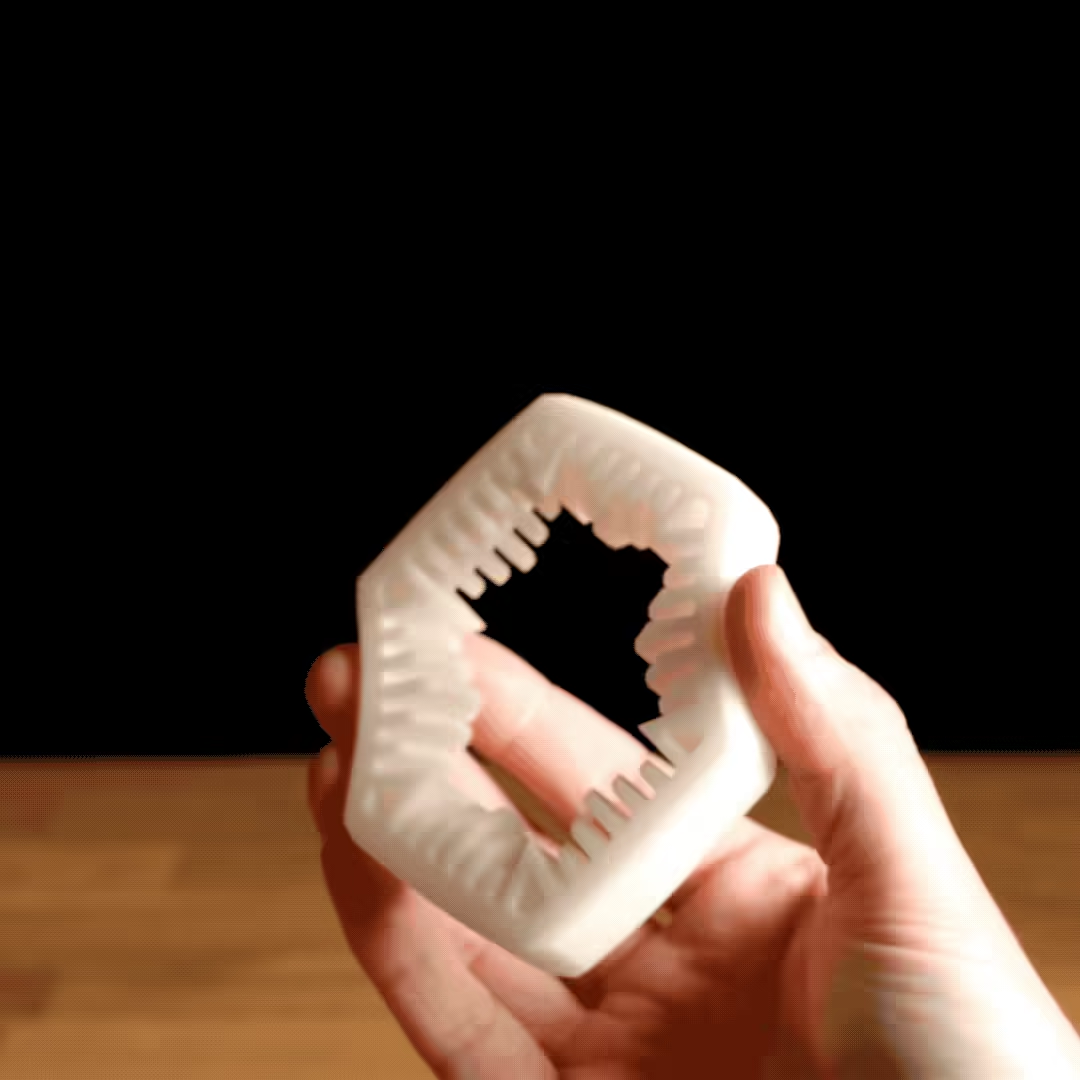
The manufacturing process isn’t the only reason Prusa says its new TPU should solve your TPU-printing anxiety. There’s also the a chemical modification of the polymer, which isn’t explained in detail, but the company says the TPU, in its final state, is harder to deform. This prevents filament from being entangled in the extruder gears.
This new polymer formula offers very low moisture absorption, although drying may be necessary when stored in high-moisture conditions, Prusa says. The material’s inherently high elasticity and impact resistance remain, even at low temperatures (as low as -50 °C). This material is resistant to microbial degradation, Prusa says, and comes with good temperature resistance (HDT 78.6 °C at 1.80 MPa), and chemical resistance (mostly to oil and grease).
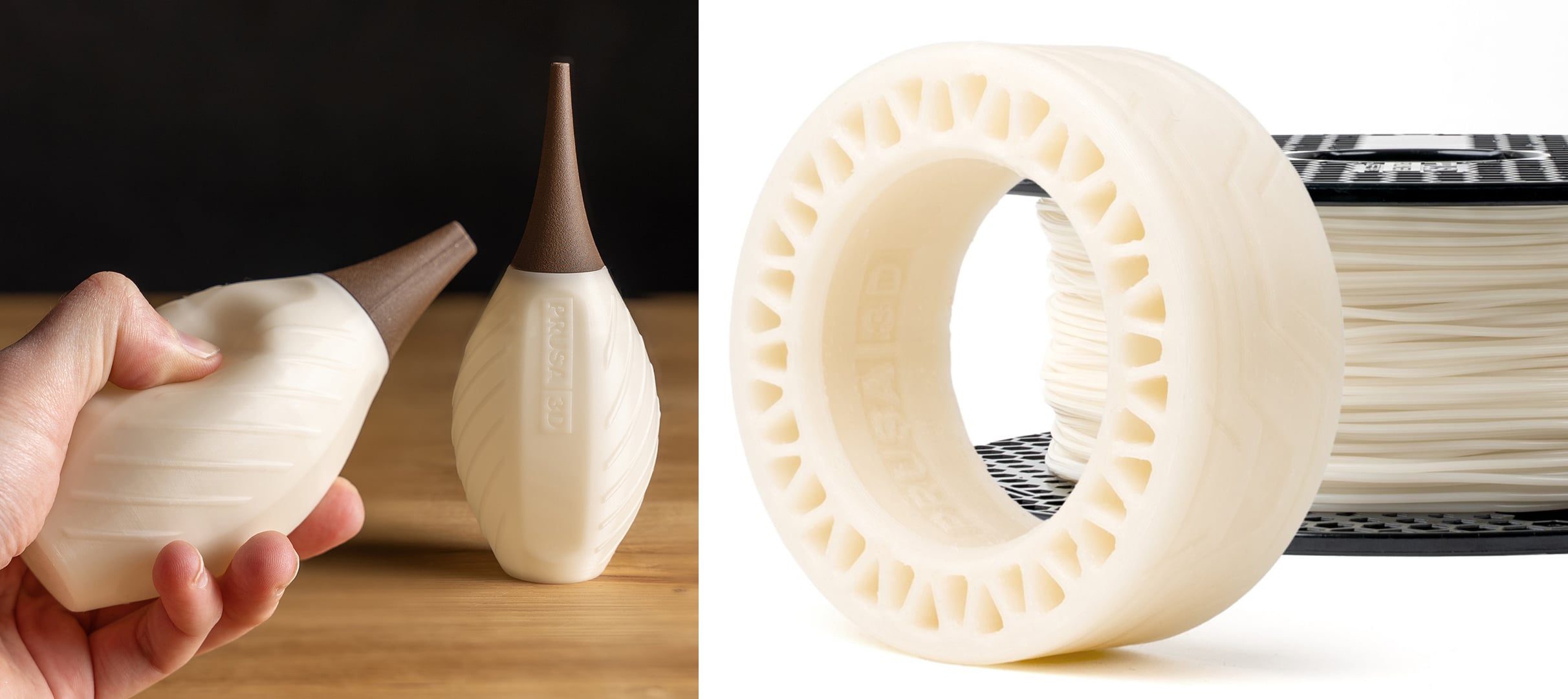
If you’re printing this TPU on a Prusa MK4/S, Core One, or XL, the Prusa extruder, Nextruder, is built in a way that makes printing soft filaments easier, Prusa says. The filament guide (part of the Original Prusa 3D printer kit) creates a slight tension, which helps with more reliable feeding to the Nextruder.
For professionals use, Prusa says its TPU 95A is “virtually indestructible” when 3D printing parts with 100% infill in thick layers. Industrial applications, such as spacers for heavy machinery, are an ideal use case, but there’s also the ability to make a very strong connection between flexible and rigid parts of the same object when using the interlocking infill option in PrusaSlicer printing on the multitool version of XL.
For now, Prusament TPU 95A is available in one color: natural. This is a warm white, creamy color that resembles Prusament PLA Vanilla White. Current retail for one 500g spool is $34.99.
How to Print with Prusament TPU 95A
Prusa has prepared profiles for Core One, XL, MK4S, MK4, and Prusa Pro HT90 in PrusaSlicer. Other printers (MK3S+ and older) are compatible as well, however, print profiles may be missing and some tweaking (such as loosening the idler) might be required. You should read the Prusament TPU 95A material guide for extra printing tips, such as “a brim is necessary for very small or very large objects.”
- Supported PrusaSlicer profiles: Core One, XL, MK4S, MK4, Prusa Pro HT90
- Nozzle temperature: 220-240 °C
- Heatbed temperature: 55-75 °C
- Print Speed [mm/s]: up to 30
- Recommended print sheets: Satin and PA Nylon
- Cooling Fan Speed [%]: 30 – 50
- Drying before printing: not necessary (only when issues like stringing or nozzle clogging occur)
Prusament TPU 95A: Mechanical properties of 3D printed testing specimen
You May Also Like:

License: The text of "Prusa Debuts TPU Filament Designed to Fix the Hassles of Printing with Flexibles" by All3DP is licensed under a Creative Commons Attribution 4.0 International License.
CERTAIN CONTENT THAT APPEARS ON THIS SITE COMES FROM AMAZON. THIS CONTENT IS PROVIDED ‘AS IS’ AND IS SUBJECT TO CHANGE OR REMOVAL AT ANY TIME.