
OpenAI Is Back With Another Text-to-3D-Model Generator

Shap-E is a step up from the recent, point cloud-based Point-E, featuring more-realistic textures and lighting.
OpenAI has released Shap-E, a new, AI-driven text-to-3D-model generator that at first glance appears similar to its recent Point-E.
Shap-E learns to generate 3D models by training an encoder to convert 3D objects into mathematical representations called implicit functions, then training a diffusion model to generate new 3D models based on those representations. The results are models with more-realistic textures and lighting effects – and that are created more quickly – than those generated by Point-E.
With Point-E, diffusion models are used to create 3D point clouds, which are then converted to mesh. A point cloud is a collection of individual points in 3D space that represent the shape of an object. These points are not connected, nor do they include explicit information about an object’s surface or structure. Here, the results are comparably rudimentary and low-resolution (though nonetheless impressive, in terms of a technological showcase).
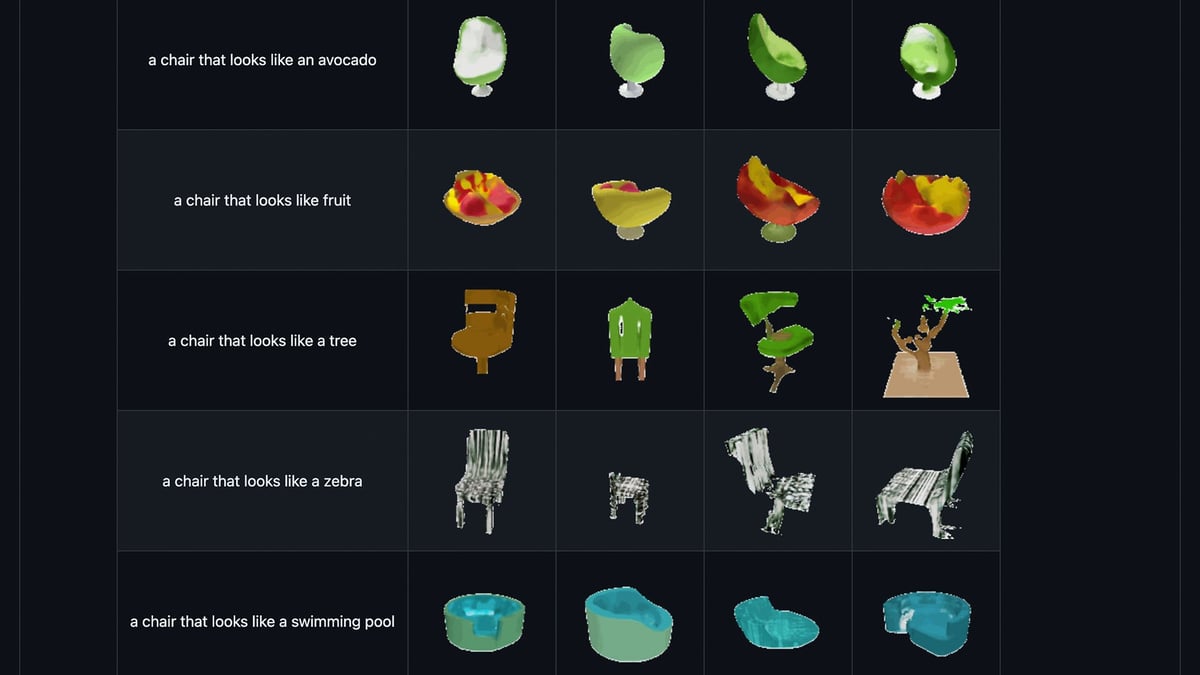
Of course, as with Point-E, there still seems to be a long way to go until these types of model generators are useful to 3D printing without a human touch. Still, Shap-E is another exciting step toward realizing that achievement, with the implications of such innovative tech taking shape (no pun intended) being far-reaching and game-changing from multiple standpoints.
For those interested, an in-depth research paper dives further into the science behind Shap-E’s function, applications, limitations, and more is available for download.
You’ve read that; now read these:
License: The text of "OpenAI Is Back With Another Text-to-3D-Model Generator" by All3DP is licensed under a Creative Commons Attribution 4.0 International License.