New Shoebox-Sized 3D Printer for Ceramic Crowns Could Have Implications Beyond Dental

Shining 3D's new Ceramix-Nano is a dental crown-making appliance, rather than general-purpose 3D printer. Could this concept apply to other industries?
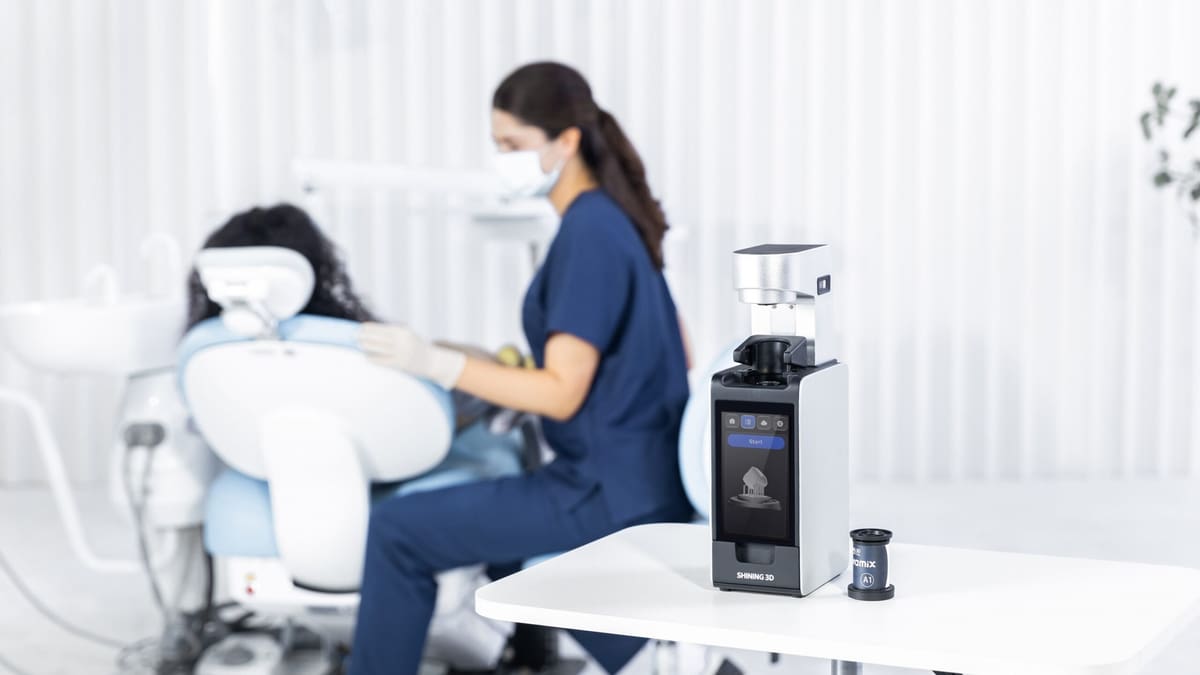
3D printing permanent, patient-specific, ceramic dental crowns is now just a matter of popping a material capsule into a tiny appliance the size of an espresso machine and waiting 14 minutes.
The new Ceramix-Nano from Shining 3D, available starting today, combines printing and curing into a compact chairside system that may point toward a broader shift in how professional additive manufacturing may reach more markets with very specific applications. The appliance approach, with its automation and easy of use, could apply to custom jewelry wax mold making, audiology and custom ear products, and, in a larger format, custom surgical guides, medical tools, molds for small part casting, along with general tooling.
Early visions of desktop 3D printing often imagined universal machines producing almost anything, anywhere. Professional adoption often follows a narrower path: small, tightly controlled systems making a limited range of validated parts from approved materials and authenticated files.
Dentistry fits that model particularly well. Restorations are small, valuable, patient-specific, and based on geometry that can already be captured digitally. A compact printer can therefore replace part of a centralized laboratory and delivery chain without turning the clinic itself into a factory.
Seen this way, the Ceramix-Nano is not a miniature universal manufacturing platform. It is closer to a distributed production terminal. The design work happens in software, the process parameters come from the supplier, the material arrives in a controlled package, and only the final manufacturing step takes place beside the patient.
That constrained model may prove far more scalable than open-ended desktop fabrication.
Inside the Ceramix-Nano
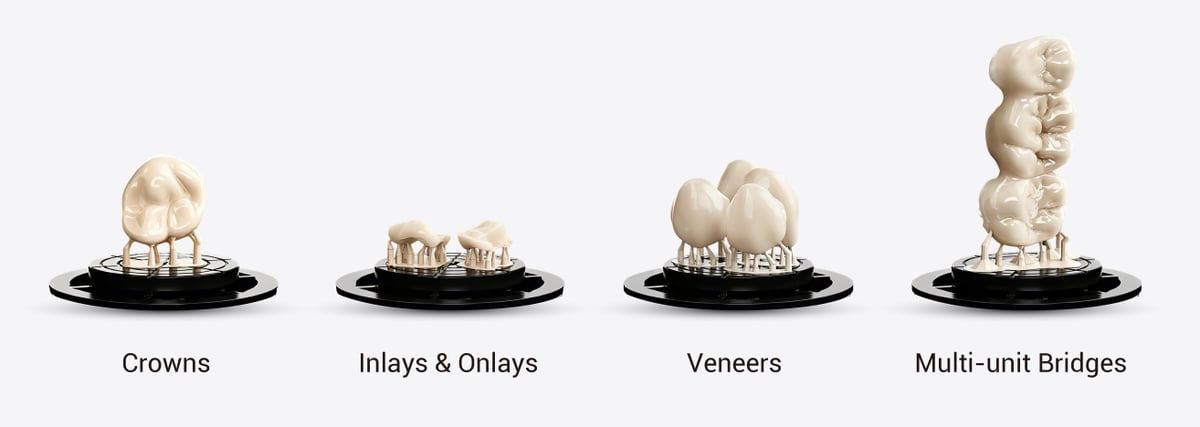
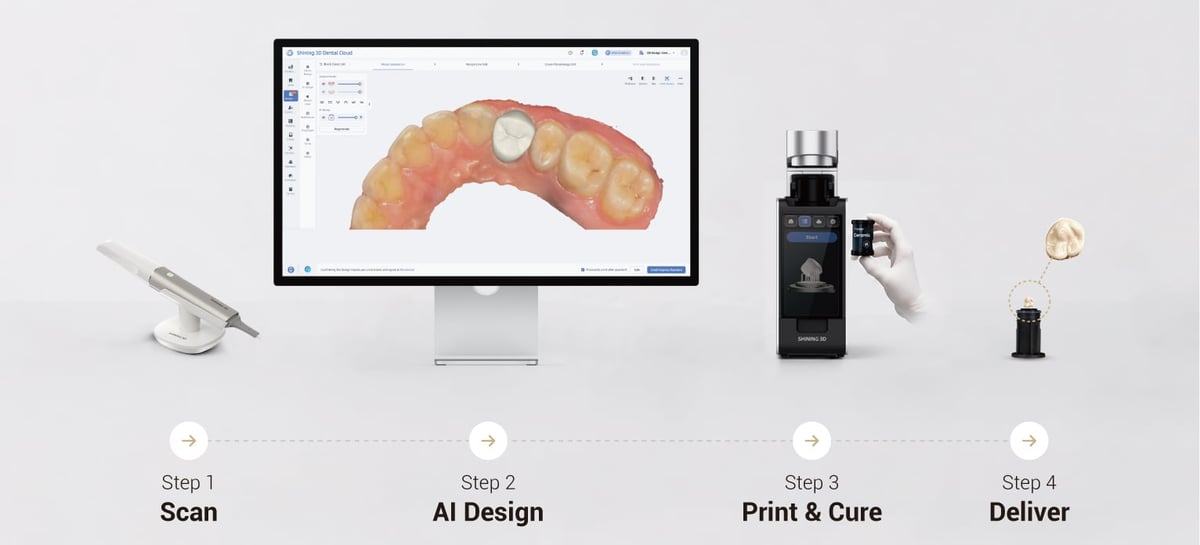
The Ceramix-Nano system supports crowns, veneers, inlays, onlays, and Maryland bridges. Shining 3D puts the print time at eight to 11 minutes, followed by a three-minute cure in the same machine. Add scanning and automated design, and the company says a restoration can move from digital impression to cementation in as little as 30 minutes. For a dental practice, that could mean placing a permanent restoration in one appointment rather than fitting a temporary and waiting for an outside laboratory to deliver the final part. (There’s no mention of polishing or other manual finishing.)
The Ceramix-Nano replaces the typical open resin vat with a prefilled capsule containing a measured quantity of ceramic-filled material. (This is a technology also offered by SprintRay’s Midas.) Scanning the capsule’s QR code prompts the machine to identify the resin, load the corresponding settings, stir the material, and begin printing. Shining 3D says one capsule can produce up to three restorations.
Resin printing usually asks the operator to manage material, maintain the vat, prepare the build platform, wash the finished part, cure it, and keep the process calibrated. The Ceramix-Nano tries to compress much of that work into a tightly controlled, application-specific routine.
In other words, it is less a 3D printer than a crown-making appliance and that distinction matters beyond dental printing. Additive manufacturing may spread more quickly outside specialist workshops not because printers become marginally faster, but because the machinery, materials, software, and post-processing disappear behind a much simpler and highly automated workflow, often focused on a specific application.
Scanner, automated design software, validated material, printer, and curing process are increasingly sold as one connected workflow. The individual machine matters, but the system around it matters more.
Shining 3D has released little detail about the technology under the hood. Even so, the Ceramix-Nano belongs to a growing class of systems designed around thick, highly filled functional resins rather than conventional prototyping materials. At 87 x 131 x 276 mm, the Ceramix-Nano is substantially smaller than a typical desktop resin printer.
Shining 3D already supplies intraoral scanners and dental-printing equipment, allowing it to present the Ceramix-Nano as one part of a complete production system rather than a standalone machine.
Shining 3D says it needs neither dedicated laboratory space nor a separate curing machine. It connects to Shining Flow, the company’s cloud-based scan, design, and print platform, which is said to generate a crown design in under two minutes and send the finished file directly to the printer.
The Ceramix-Nano’s immediate relevance lies in dentistry, but the wider lesson is about product design.
Shining 3D is packaging a difficult material, automated design, printing, and curing into a device meant for a clinician rather than a manufacturing technician. It is not the first company to take that route, but its arrival reinforces a likely direction for professional 3D printing: fewer visible process steps, more tightly controlled materials, deeper software integration, and machines sold around a finished result rather than printing capability alone.
Printer Availability
The Ceramix-Nano is available from June 18 through authorized Shining 3D Dental distributors in North America and Asia. The price, $5,000 – $6,000, may vary by region. European and other regional launches are expected to follow.
License: The text of "New Shoebox-Sized 3D Printer for Ceramic Crowns Could Have Implications Beyond Dental" by All3DP Pro is licensed under a Creative Commons Attribution 4.0 International License.