Kiri Engine Can Now Export 3D Gaussian Splats as Meshes

The update enables users to export as both PLY and OBJ files – and the algorithm behind the feature will soon be open-sourced.
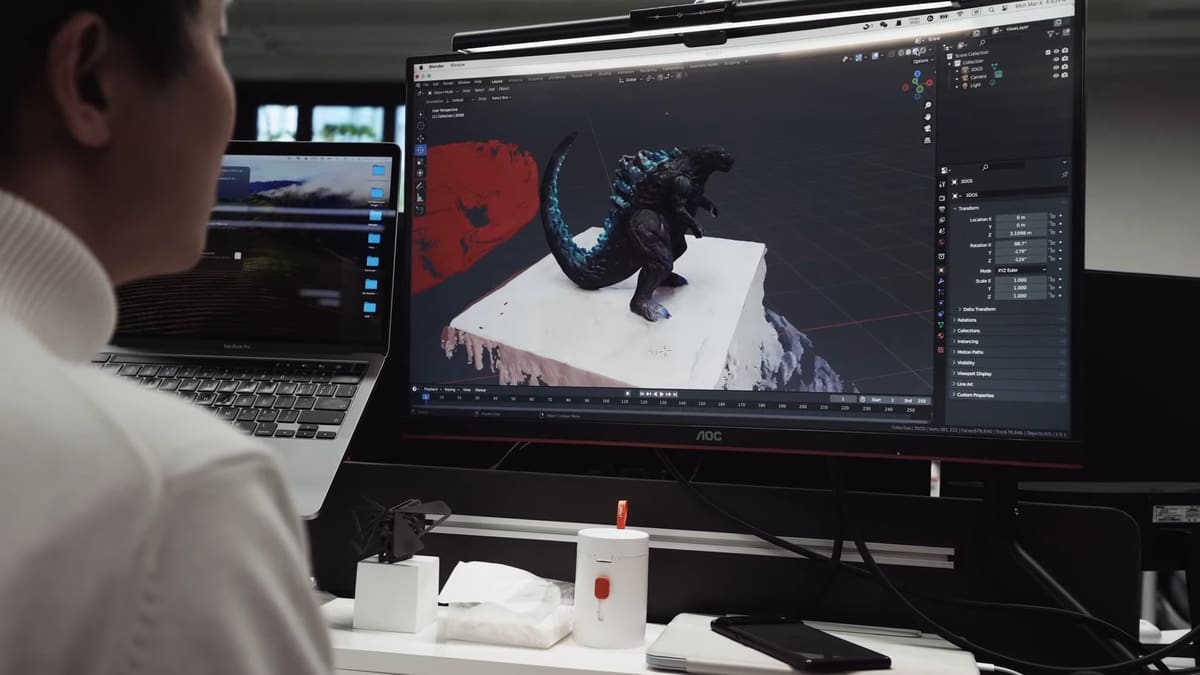
Kiri Innovations has released an update for its Kiri Engine photogrammetry software that enables users to export 3D Gaussian Splatting (3DGS) files to mesh. The move comes as part of an effort to make the app “more accessible”, according to a blog post from the company.
At its core, the Kiri Engine app leverages photogrammetry to generate point clouds from smartphone-captured scans of real-world objects, which are then meshed and combined to create 3D models. Our coverage of the app in 2022 was positive, and although it had its limitations, we called it the “first viable option with a future” for Android (the app is also available on iOS).
Kiri Innovations has previously introduced in-app editing tools for files produced from 3DGS – a technology capable of turning short videos into 3D scenes – as well as add-ons for Unreal Engine, so those files could be imported. Now, it has taken things a step further, with a feature that allows users to export 3DGS files in both their native PLY format and as 3D mesh, which is known as OBJ format – and which is much more commonly used by 3D software.
To use the feature, users create a 3DGS scan and select the “Include Mesh” option when uploading. This will allow them to export their model as both PLY and OBJ files.
The algorithm that drives the feature was created by researcher Chongjie Ye and his team, Kiri Innovations says. In a few months, it will be open-sourced to allow others to test and experiment with it. Those interested can check out Chongjie’s GitHub.
There’s also a bit more information on both 3DGS technology and the 3DGS to mesh feature on Kiri Innovation’s blog post.
You’ve read that; now read these:
License: The text of "Kiri Engine Can Now Export 3D Gaussian Splats as Meshes" by All3DP is licensed under a Creative Commons Attribution 4.0 International License.