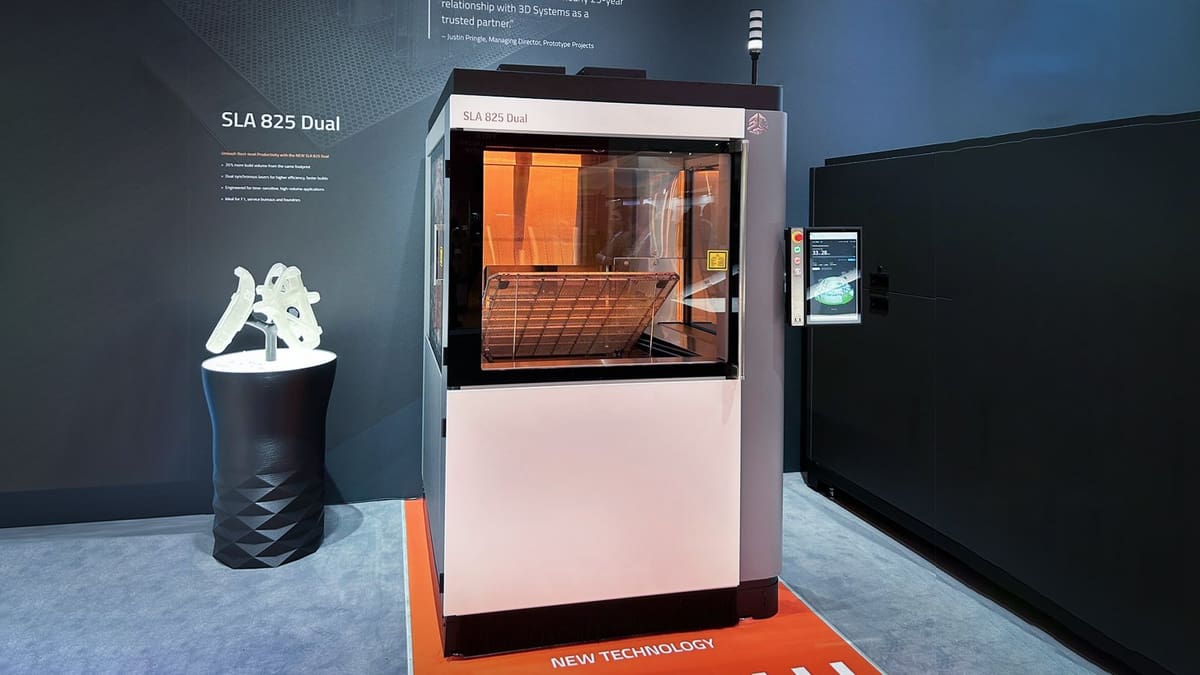
How Large-Format SLA 3D Printing Can Cut Industrial Tooling Costs by $200,000

While desktop printing shifts to LCD, industrial giants like 3D Systems are betting big on lasers again and slashing production timelines from months to mere days on large tooling.
The landscape of additive manufacturing (AM) is, no doubt, undergoing a dramatic transformation as manufacturers pivot from rapid prototyping to full-scale digital manufacturing. This shift is especially evident in the resurgence (of sorts) of laser-based stereolithography (SLA) technology, the pioneering 3D printing process patented in 1988.
SLA with lasers never really went away, but it did shift away from the desktop and benchtop 3D printer segment to find its highest adoption rate so far in large-format resin 3D printing.

At time when desktop machine makers, like Formlabs, are shifting to fast and affordable LCD resin technologies, major industrial brands, such as 3D Systems, are going all in on size, launching colossal new high-speed SLA systems (some with multiple lasers), confirming the technology’s new role as an industrial workhorse particularly suited for large-scale tooling.
Recent SLA market research backs this up, highlighting tooling – jigs, fixtures, and molds – as one of the fastest-growing application areas for the technology, particularly in sectors like automotive and aerospace where custom tools are always in demand.
Another industry report, from Mordor Intelligence, notes that while laser-based SLA still held 32.58% of the vat photopolymerization market in 2024, supported by deep material libraries and long-standing process expertise, DLP is gaining ground quickly with a projected 27.40% CAGR, “fueled by oxygen-permeable optics and dual-cure resins that allow truly isotropic parts.”
According to the report, SLA manufacturers are responding with “larger build volumes and improved laser path optimization,” as we’ve seen in the new machines from 3D Systems, Stratasys, and UnionTech in 2025. As a specific driver of growth in vat photopolymerization, the report points to “EV battery pack prototyping shifting to large-format SLA tools.”
The Resin Tech that Scales
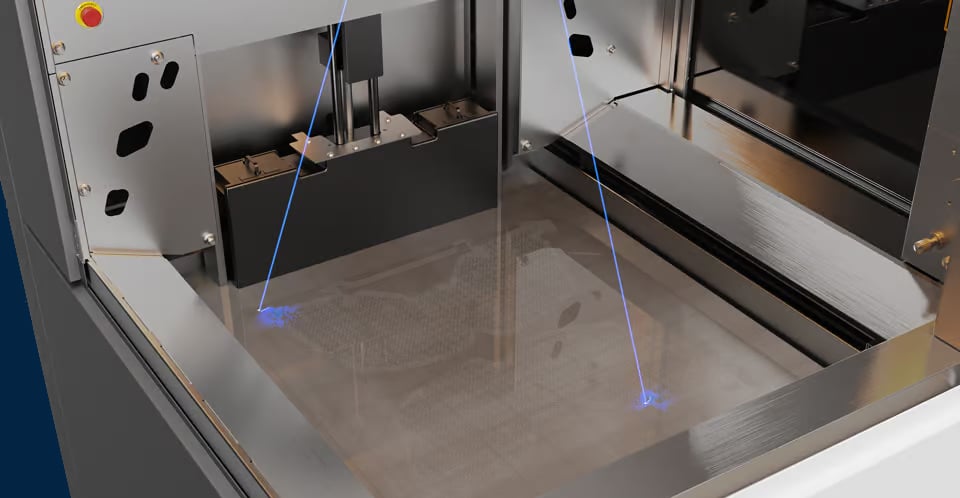
SLA has always been the choice for larger resin parts for the simple fact that, as projection-based resin 3D printers get larger, pixel sizes grow and resolution plummets. Lasers, on the other hand, produce essentially the same resolution regardless of size.
As the demand grows for everything from 3D printed large tooling and injection molds to aerodynamic prototypes and large end-use parts, the outlook for large-format laser-based resin 3D printing looks bright.
Let’s take a look at why some resin 3D printer manufacturers are going all in on large-scale, laser-based resin 3D printing and the manufacturing problems they say this technology can solve.
New Hardware Ushers in the Age of Production
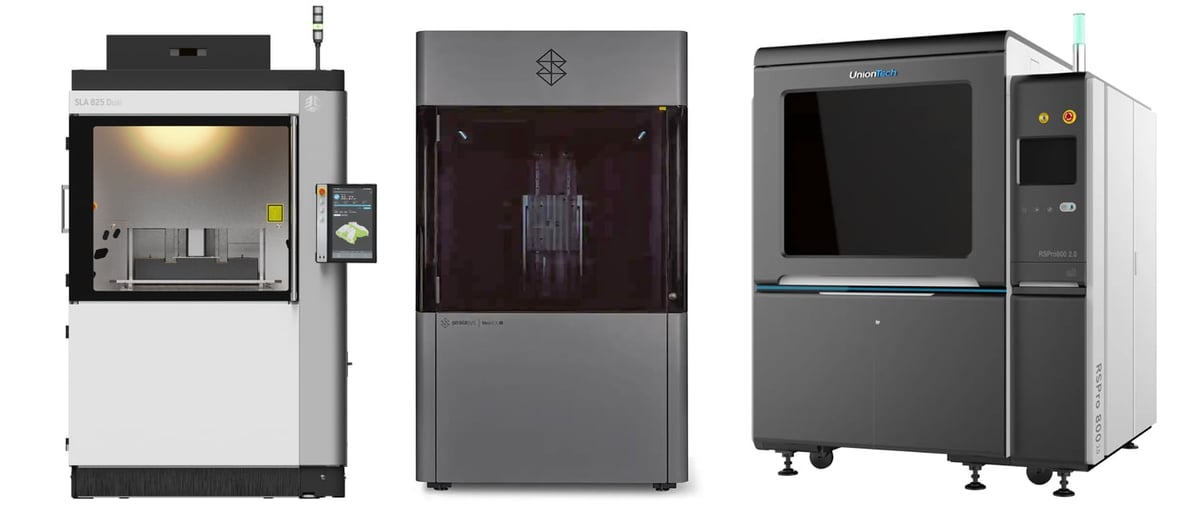
In 2025, we saw the launch of:
- 3D Systems SLA 825 Dual, 830 × 830 × 550 mm (above left)
- Stratasys Neo800+, 800 × 800 × 600 mm (above center)
- UnionTech RSPro 800 X, 800 × 800 × 550 mm (above right)
Even SLA 3D printers manufacturers that did not have brand new machines in 2025 had their large-format editions on display at the 2025 Formnext, including Kings 3D SLA-800Pro and the DWS XCell 900S.
*Not all printer manufacturers release the same data points.
SLA’s New Role in Large-Format Tooling
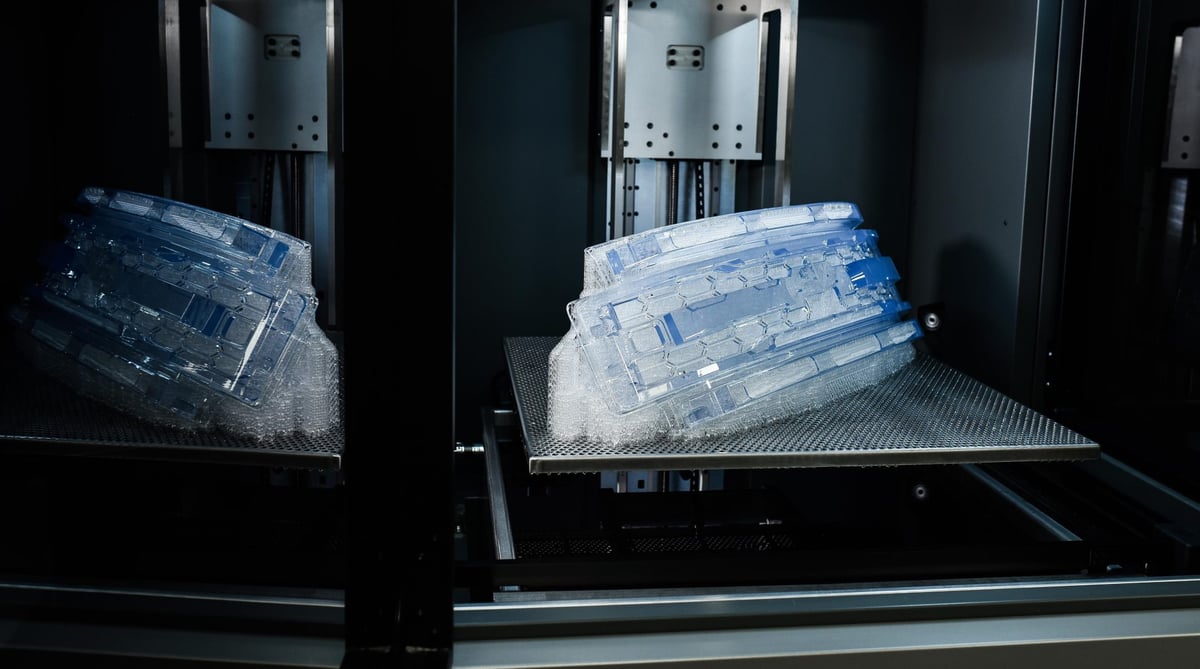
The integration of large-format SLA into industrial workflows is beginning to influence traditional manufacturing practices, particularly in injection molding, which one of the most widely used methods for producing plastic parts. The speed, precision, and smooth surface finish inherent to SLA make it a strong fit for rapid tooling and the production of injection mold inserts.
3D Systems points to its customer Vaupell, a 70-year-old supplier of aerospace components and subassemblies, that turned to SLA 3D printing for investment casting patters that deliver faster and at a fraction of the cost of traditional methodologies.
Andy Reeves, a Vaupell sales engineer for new business development, estimates that a specific 26-inch diameter part pattern can be produced with 3D Systems’ QuickCast resin on a 3D Systems SLA ProX 800 in two to three days for approximately $6,000 to $15,000. A wax tool for the same part could take anywhere from several months to more than a year at a cost of $200,000 to $300,000.
The tire industry, especially in China, has embraced SLA for large-format tire molds that meet the needs for complex tread patterns and fast prototype iterations. One company, Lichond Mould, introduced additive manufacturing technology with a production line of industrial RA600 SLA 3D printers specially designed for the tire mold industry by UnionTech in 2019. UnionTech introduced its latest and largest tire mold 3D printer, the RA900, last month at Formnext.
While other resin 3D printing methods – such as DLP and MSLA/LCD – can be used for mold and pattern fabrication, traditional laser-based SLA has characteristics that align especially well with the demanding conditions of injection molding and metal casting. Its strengths in resolution, surface quality, part density, and material performance have historically made it the preferred approach for high-performance tooling and continue to do so today.
Superior Surface Finish and Precision
The highly controlled movement of a focused UV laser enables SLA systems to achieve a level of surface smoothness and dimensional accuracy that is important for functional tools. Many industrial SLA printers use variable beam sizes, allowing operators to choose between faster builds (larger spot size) and higher detail (smaller spot size).

In general, laser-based SLA is still regarded as producing the best surface finish among resin 3D printing technologies, though the reality is more nuanced. Results depend on factors such as overall part size, resin formulation, voxel/pixel behavior in non-laser systems, and hardware quality.
Laser-based SLA also tends to produce parts that are dense and relatively isotropic, thanks to the way successive layers chemically bond. This uniformity is important for molds that must withstand high clamping forces and the elevated temperatures of the injection process.
One of the most important factors, however, is likely the materials unique to large-format SLA. High-performance SLA resins are specifically engineered for these industrial environments. Ceramic-filled and composite formulations offer high thermal resistance, dimensional stability, and strong wear properties. High-stiffness resins help mold inserts maintain their shape under pressure, while high-temperature resins reduce cycle times by minimizing cooling requirements.
In essence, while DLP has grown popular for fast batch production of smaller components, and LCD/MSLA systems offer an affordable entry point for prototyping, laser-based SLA remains the most suitable option for functional tooling and machine options are growing with increased demand. Its combination of precision, low anisotropy, high-density parts, and robust material properties positions it well for applications where molds must endure significant thermal and mechanical stress.
You May Also Like:



License: The text of "How Large-Format SLA 3D Printing Can Cut Industrial Tooling Costs by $200,000" by All3DP Pro is licensed under a Creative Commons Attribution 4.0 International License.