Google Just Dropped the Plans for This Wild Rotary Keyboard – And You Can 3D Print It

To be clear, this Google-branded DIY keyboard is not an official Google product. But it is officially peculiar, and if you want to build one for yourself, the files and a build guide are now online.
As has apparently become tradition, Google Japan’s Gboard team has released its annual April Fools-day like product in October. Unlike most April Fools’ Day pranks, the Gboard Dial Version is very real, and the files have been published for all to 3D print and DIY.
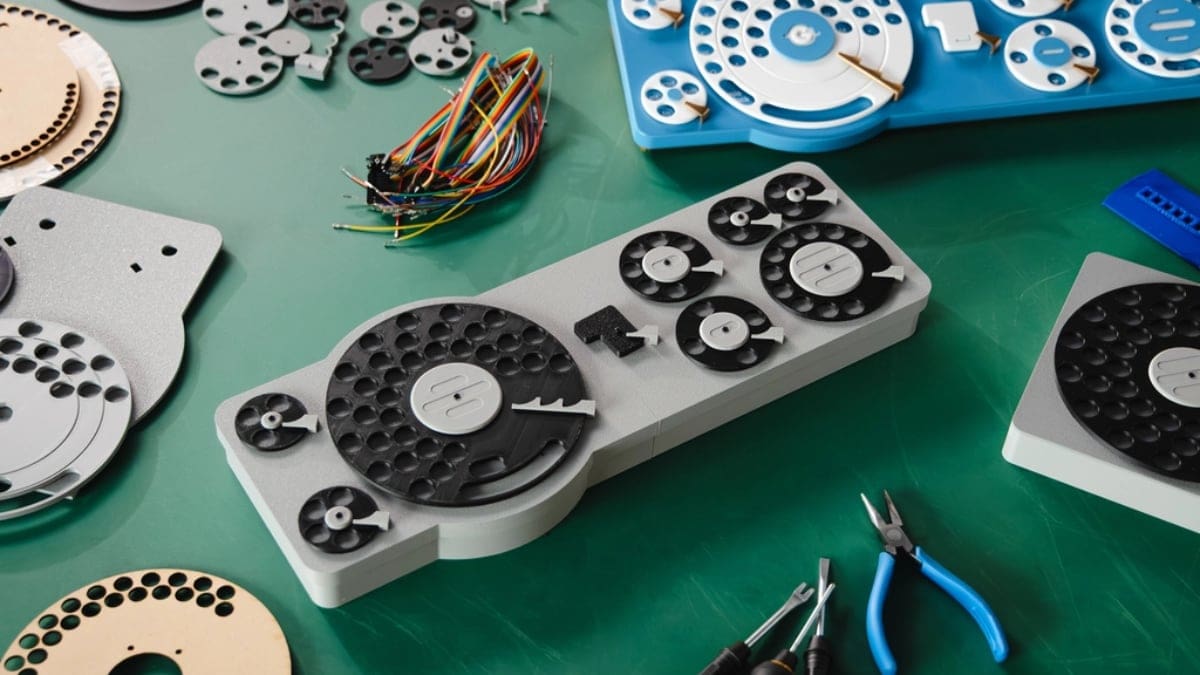
The project, which only came to our attention via Reddit (credit to Redditor bobre737 for posting) highlights the everyday inconvenience and inelegance of prodding a keyboard. The Gboard Japan team proposes a solution in the form of an expansive slab that incorporates all common keys from a traditional keyboard across nine independent rotary dials. To use it, simply place your finger on the desired character or function, and rotate to the stop, before lifting and moving on to the next “key”. Even the return key is its own special little rotor, spinning on the spot.
It is, in a word, silly. A silly solution to a non-existent problem. But the mere fact that not only does the concept exist, but seemingly the full project documentation, files, and build guide have been created and shared is magnificent. It could have just been a thin, video-deep ad for Gboard, but instead, it’s a practical, deliberately unproductive project to sink your teeth into.
What Was Released?
If you want to build your own Gboard Dial Version, you’ll find (almost) everything you need on GitHub. The projects repo includes STLs for the printable components, alongside a detailed build guide with photographs, and a list of components including a Raspberry Pi Pico for the project’s brains. There are some gaps still, with a single-dial version primarily using off-the-shelf components for a speedier build, and the full, nine-dial version as seen in the video, awaiting the Gerber data for you to be able to manufacture the various, necessary sensor boards.
Unlike a traditional analog rotary telephone, which obviously inspired the style and functionality of the Gboard Dial Version, the project uses photosensors. This introduces some consideration with regards to the light transmissivity of the filament you print the encoder components from, though no specific instruction beyond “it needs to be non-transparent” is given.
We haven’t built the Gboard Dial Version and can’t speak to the accuracy of the instructions given, but certainly the project is a fun distraction and gave us a chuckle. You can check out the full project over on GitHub.
Read more recent news:
- AI Boom Forces Raspberry Pi to Raise Prices on Key Models
- Why 20,000 People Just Pledged $20M for the Snapmaker U1 3D Printer
- Bambu Lab's Next Big Move Isn't a Printer, It's a Store
Tired of Reading? Try Listening
License: The text of "Google Just Dropped the Plans for This Wild Rotary Keyboard – And You Can 3D Print It" by All3DP is licensed under a Creative Commons Attribution 4.0 International License.