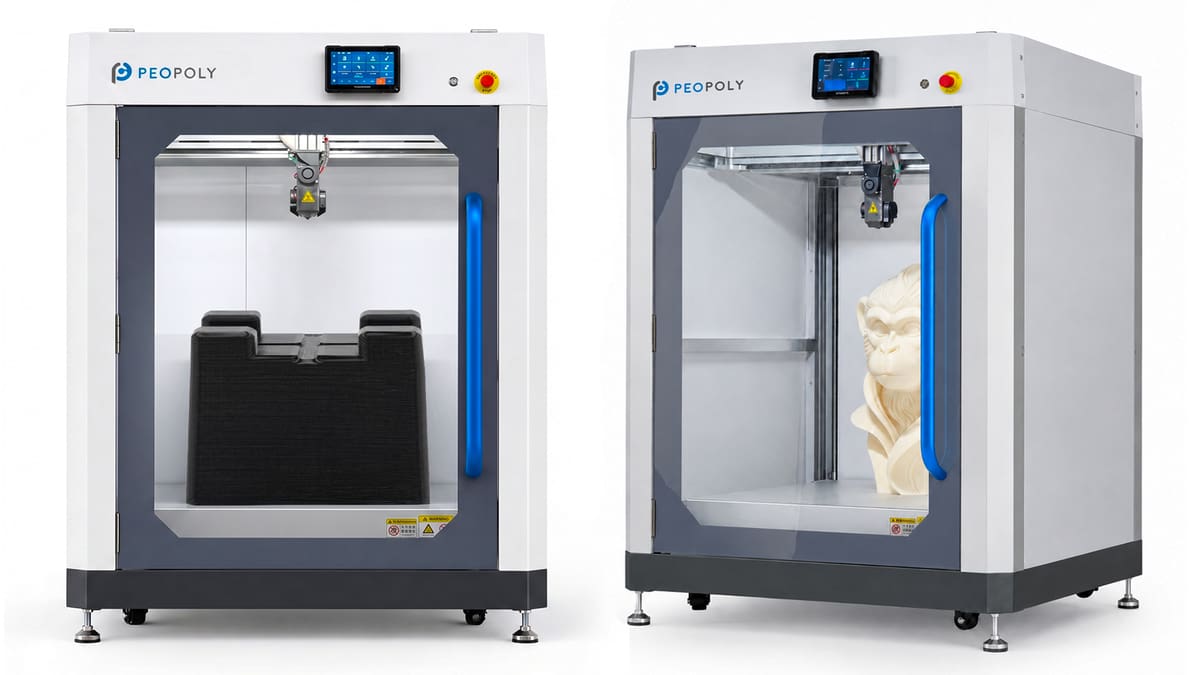
Goodbye Filament: Peopoly’s New Giga 800 Brings Large-Format Pellet Printing to the $15K Mark

With a massive 800mm build volume and a 3kg/hour extrusion rate, Peopoly’s pellet-fed disruptor is built to slash material costs by 90% and replace expensive industrial systems.
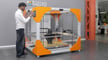
Peopoly, the Shenzhen-based company known for its popular large-format resin 3D printers, and the sister company to filament-maker Siraya Tech, just launched the Giga 800, a large-format FDM 3D printer designed to ease adoption of economical pellet-based printing for under $20,000. Unlike filament-based FDM printers, printing with raw polymer pellets can reduce material costs by up to 80% to 90% compared with spooled filament.
The Giga 800, now open to beta adopters, offers an large 800 × 800 × 800 mm build volume, a closed-loop servo CoreXY motion system, and a custom pellet extrusion engine capable of reaching a 3 kg/hour maximum flow rate, the company says.
A notable part of Peopoly’s pitch is accessibility. The Giga 800 runs on Klipper firmware and uses Orca Slicer, with WiFi integration, so there’s no forcing teams into proprietary industrial software. Peopoly says the workflow is intended to feel familiar to users scaling from desktop or farm-based FDM printing.
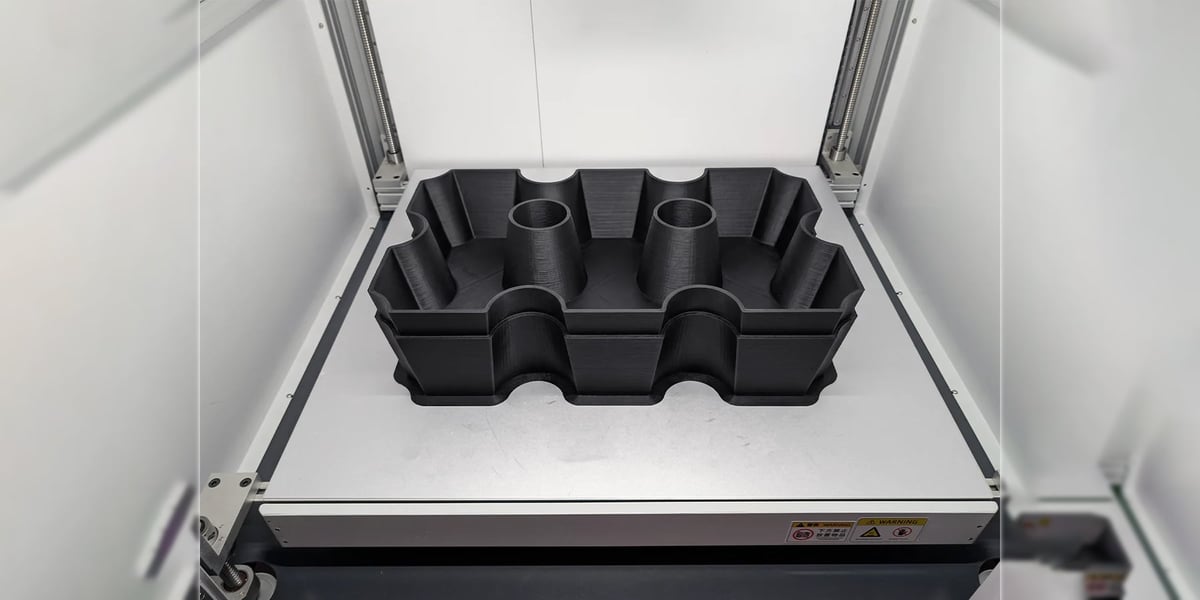
In fact, the Giga 800 doesn’t have a lot of competition on the market and seems to be filling a gap between desktop and industrial pellet systems. For example, on the smaller end, there’s Piocreat’s G5 Ultra (~$5,700) that isn’t enclosed and has a small gravity-fed pellet hopper. Re3D’s GigabotX 2 XLT is closer the same build volume, but doesn’t get as hot and retails for nearly twice as much (~$26,000). The newer G1 ($13,000) from Ginger Additive offers a square meter build volume but lower resolution and flow rate.
On the more industrial end, Pollen AM P Series at about $65,000 is less than half the size, while, 3D Systems EXT 800 Titan Pellet, which is also smaller, can print at 14 kg/hour, but now you’re well into the six-figures in price.

Peopoly says the Giga 800 is ideal for large composite molds, automotive fixtures, structural tooling, architectural models, outdoor art pieces, flexible prototypes, and high-rigidity engineering parts. Material capability ranges from PLA up to carbon-fiber nylon and includes flexibles like TPU and PEBA. A high-temperature variant capable of printing with PEI-CF and PEKK-CF, the Giga 800 HT, is still in development, the company says.
Pellet Printing Without the Trial and Error?
To reduce the tuning burden often associated with raw pellet printing, Peopoly says it has partnered with the Siraya Tech Material Science Team to ship the Giga 800 with tested Orca Slicer profiles for a wide range of materials. These are intended to provide calibrated flow, retraction, and temperature settings for supported pellet materials, including carbon-fiber nylons and flexible TPU.
The machine is also described as suitable for offline, air-gapped use. Because it runs open-source Klipper firmware, Peopoly says organizations can audit the software and operate the printer without forced cloud connectivity or telemetry.
Addressing Oozing, Stringing, and Motion Reliability
This is not Peopoly’s first FDM. The company launched the Magneto X in 2023, which stood out for its linear motors, a novel motion system in consumer 3D printers that does away with belts, pulleys, and the stepper motors to drive them.
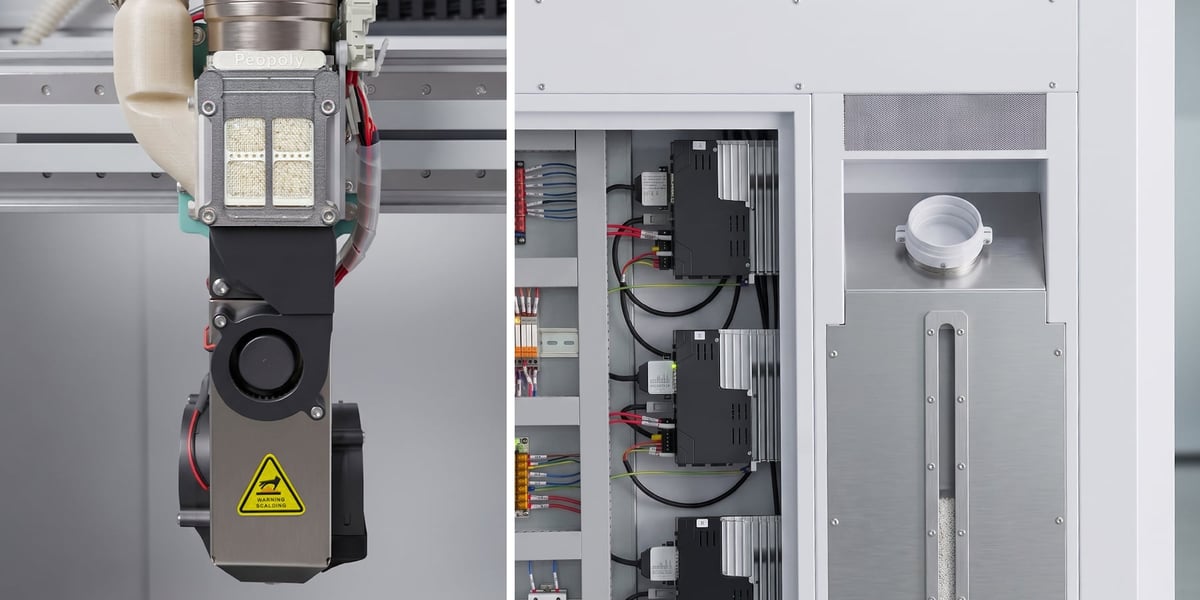
The Giga 800 is driven by belts, pulleys, and two motors working together to move the toolhead in X and Y. At the center of the motion is a dual-zone heated screw extruder with a hardened, wear-resistant large-diameter nozzle. Peopoly says the system is designed to process high-temperature, fiber-filled engineering pellets while maintaining stable melt control and avoiding polymer degradation or jams.
Nozzle options range from 0.4 mm to 3.0 mm, and the hot end reaches up to 400°C. The heated bed reaches 120°C, while the fully enclosed, passively insulated chamber is said to reach approximately 60°C by retaining heat from the bed and nozzle.
The pellet feed is integrated into the machine through a self-contained, moisture-sealed metal hopper, eliminating the need for an external pneumatic feeding system or air compressor. Peopoly says this reduces shop-floor noise, saves space, and helps protect moisture-sensitive materials such as nylon and PET from humidity-related degradation.
Peopoly says the Giga 800 addresses the oozing, stringing, and limited geometry control commonly associated with pellet extrusion with active mechanical material retraction paired with Klipper Pressure Advance, intended to produce cleaner travel moves, sharper corners, and less post-processing.
The printer also uses a closed-loop servo-driven CoreXY motion system, heavy-duty linear rails, and ball screws. Peopoly says the servo system is intended to prevent skipped steps and layer shifts on large, high-mass prints where traditional stepper-based motion systems may struggle.
A specialized heated bed coating is also included, which Peopoly says provides adhesion during printing and self-release after cooling.
Peopoly Giga 800 Technical Specifications
Availability: Soon
The Giga 800 is currently in an early adopter, beta evaluation phase and is not being sold through standard retail ordering. Peopoly says companies and print farms interested in scaling pellet production can apply for early access.
You May Also Like:

License: The text of "Goodbye Filament: Peopoly’s New Giga 800 Brings Large-Format Pellet Printing to the $15K Mark" by All3DP Pro is licensed under a Creative Commons Attribution 4.0 International License.