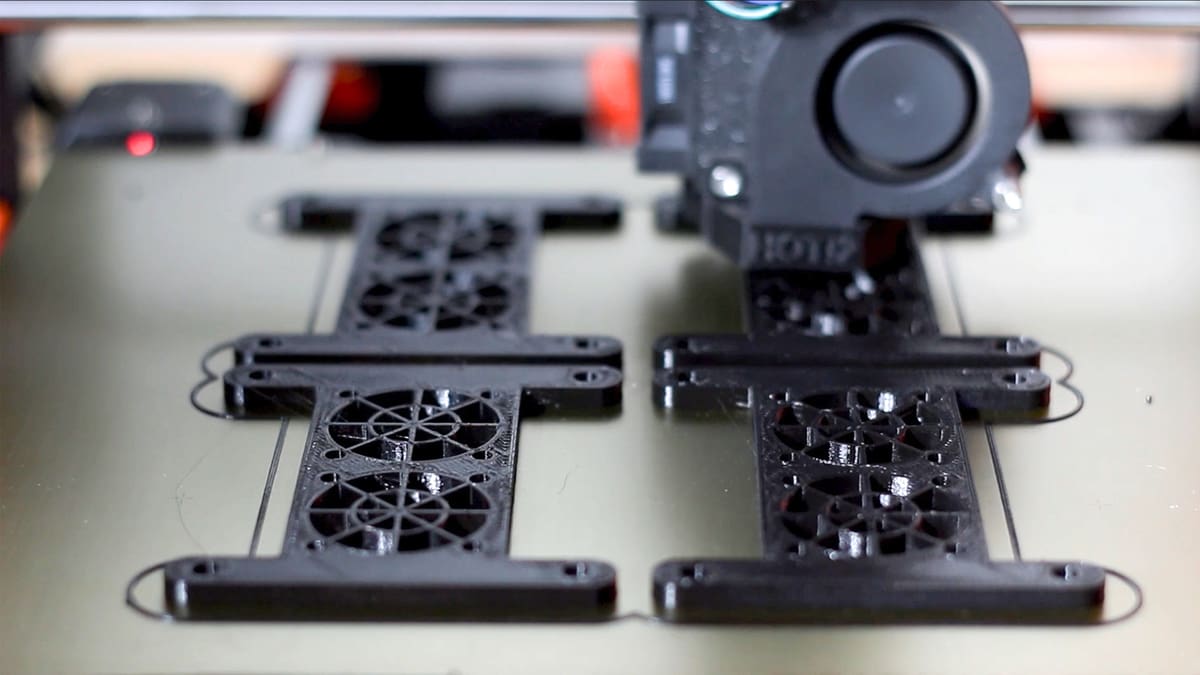
Forget Carbon Fiber, Carbon Graphene Makes Nylon Composite Filament Twice as Strong

With a reported Z axis tensile strength of 60 MPa, the new graphene mesh outperforms 3DXTech by 2.5x and significantly surpasses industry-standard Stratasys Nylon 12CF.
Carbon fiber-filled nylon just got a lot stronger with the introduction of PA1205 carbon fiber filament from Silicon Valley–based Lyten, an advanced materials and battery technology company focused on commercializing a proprietary three-dimensional carbon material.
Last week at the Performance Racing Industry (PRI) Show, Lyten unveiled a 3D printing filament that it says could reshape performance manufacturing in motorsports, aerospace, and defense.
Setting Lyten PA1205 apart is the company’s proprietary Lyten 3D Graphene “supermaterial”. Unlike standard engineering filaments that rely on chopped carbon fiber for reinforcement, PA1205 uses a carbon structure designed to operate at a much smaller scale, closer to the polymer molecules themselves.
According to Lyten, the result is a material that delivers substantial gains in strength and impact resistance while addressing one of fused-filament fabrication’s long-standing weaknesses: poor layer-to-layer bonding.
Moving Beyond Carbon-Fiber Nylon
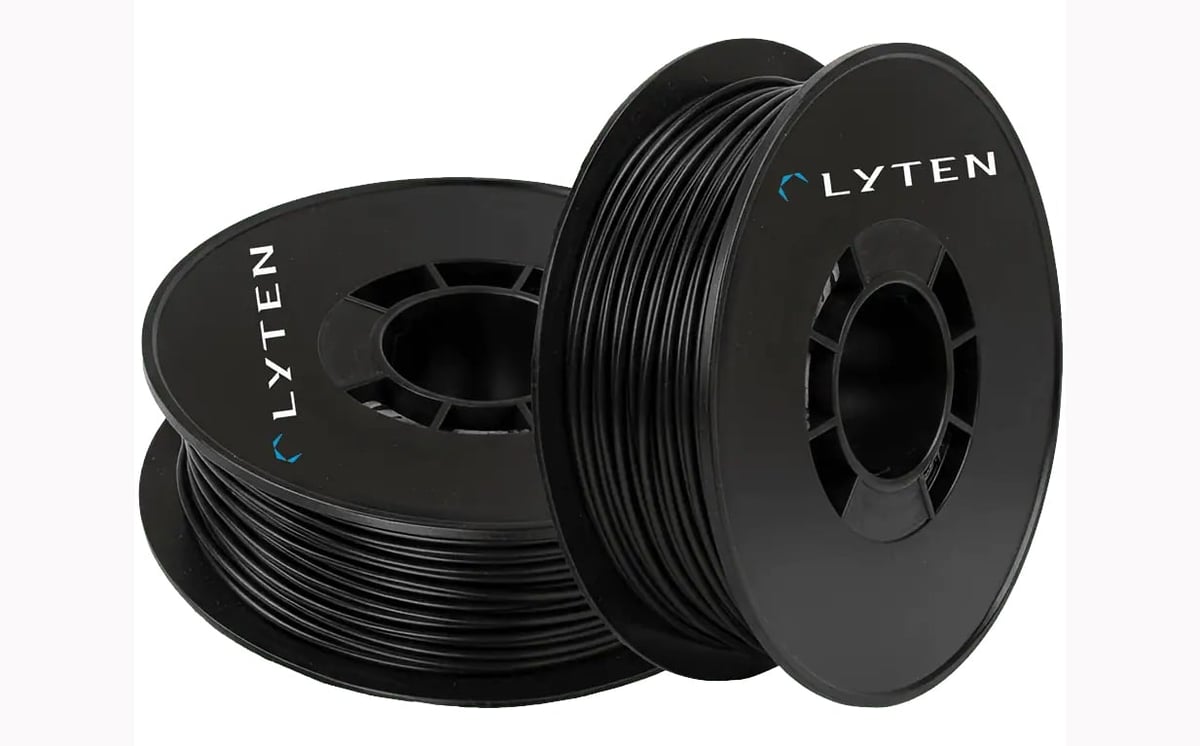
Most high-performance nylon filaments on the market today are reinforced with short, chopped carbon fibers. While effective at increasing stiffness, those fibers behave like tiny rigid rods embedded in plastic. They tend to reinforce parts primarily in the direction of the fibers, often improving in-plane strength but leaving printed components vulnerable along the Z-axis. The trade-off is familiar to many engineers: stiffer parts that are also more brittle and more likely to fail between layers.
Lyten’s approach is fundamentally different. Rather than adding fibers, it used graphene, a form of carbon made of a single layer of atoms arranged in a two-dimensional honeycomb lattice. It is essentially one atom thick and is the basic building block of other carbon materials like graphite and carbon nanotubes. In the filament, the material forms a nano-scale, three-dimensional carbon network dispersed throughout the nylon. Instead of acting like isolated reinforcements, this interconnected carbon structure functions more like a fine mesh woven through the polymer.
The practical implication, according to the company’s published technical data, is more uniform reinforcement across all print directions. Lyten reports that PA1205 delivers large increases in tensile strength in the X and Y axes compared with typical carbon-fiber-filled PA12 filaments, meaningful gains in the Z axis—where FDM parts are traditionally weakest—and dramatically higher impact resistance.
An analogy often used by materials engineers applies here: carbon-fiber nylon is like adding short sticks to concrete, while Lyten’s carbon network resembles a continuous reinforcing lattice that touches everything. By reinforcing the material at the molecular scale rather than with discrete fibers, Lyten says it can improve strength and toughness simultaneously, rather than trading one for the other.
Designed for Extreme Environments
Lyten positions PA1205 for applications where weight, heat resistance, and mechanical reliability are critical. The filament’s published specifications indicate a high heat-deflection temperature (approximately 162 °C compared to, for example, Markforged Onyx at 145 °C) and a density of about 1.08 g/cm³ (Markforged Onyx = 1.2 g/cm³), placing it squarely in the category of lightweight, high-temperature engineering plastics.
Just as notably, the company says the filament is designed to run on standard industrial FDM printers without specialized hardware, a claim that, if borne out in practice, could lower the barrier to adoption for racing teams and manufacturers already using additive processes. The price of the new material is $150 / 1kg.
“By utilizing our 3D Graphene supermaterials, our PA1205 actually improves every metric of strength without compromising manufacturability,” Lyten CEO Dan Cook said in a statement released at the show.
From Motorsports to Aerospace

While motorsports is the most visible proving ground for the new filament, Lyten is clear about its broader ambitions. The company is targeting aerospace and defense markets, where additive manufacturing is increasingly used for lightweight structural components, tooling, and low-volume production runs.
PA1205 is already being deployed internally by Lyten Motorsports, the company’s Indianapolis-based subsidiary that produces 3D printed and composite parts for racing applications. Lyten says the material is being used in functional components, though independent certification and validation will ultimately determine its suitability for safety-critical systems.
The filament launch comes as Lyten continues to expand the reach of its 3D graphene platform, which it applies across batteries, sensors, composites and adhesives. Industry observers note that the company’s strategy reflects a growing focus on materials—not machines—as the next major lever for advancing additive manufacturing performance.
As engineers and manufacturers push 3D printing deeper into demanding, real-world applications, materials like PA1205 highlight a central question for the industry: whether new forms of carbon reinforcement can finally overcome the mechanical compromises that have long limited printed parts. For Lyten, PRI 2025 marks its clearest attempt yet to answer that challenge.
- * ISO 179 Charpy notched and ASTM D256 notched Izod are not directly comparable impact strength measurements.
- **ISO and ASTM flexural measurements are comparable for trend and order-of-magnitude, but not interchangeable.
You May Also Like:

Listen to All3DP’s News Podcast:
License: The text of "Forget Carbon Fiber, Carbon Graphene Makes Nylon Composite Filament Twice as Strong" by All3DP Pro is licensed under a Creative Commons Attribution 4.0 International License.