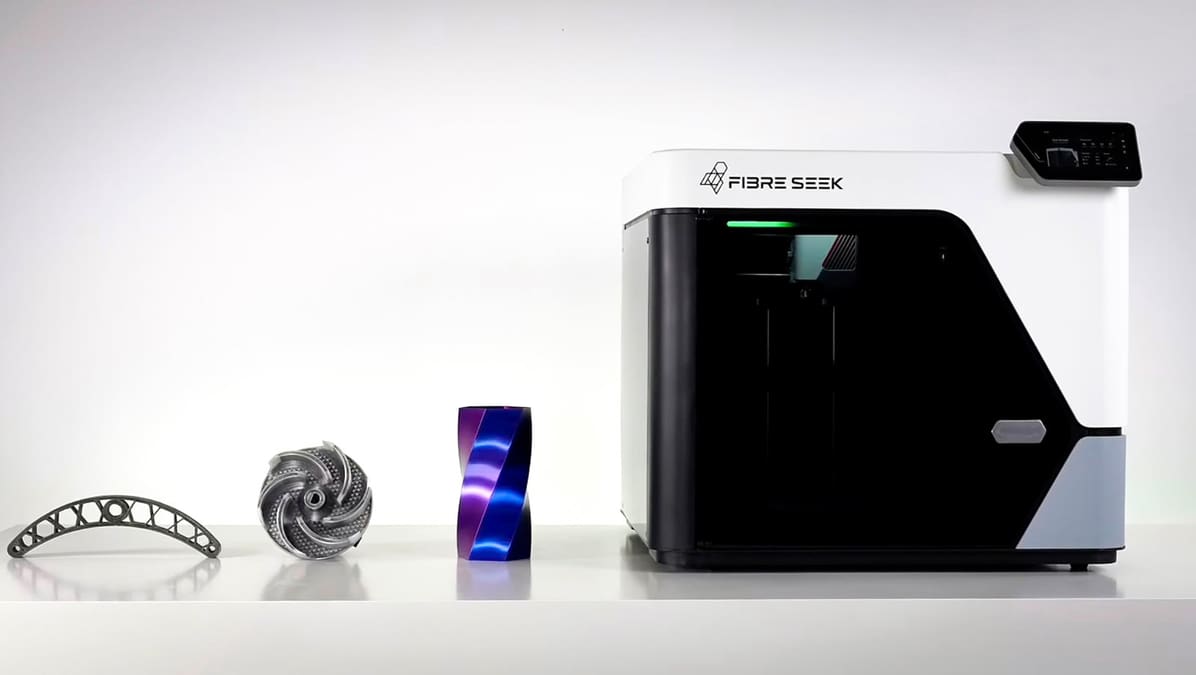
New Sub-$3K Continuous Fiber 3D Printer Threatens Markforged’s Dominance Securing $2M on Kickstarter

The FibreSeeker 3, a rebrand of industrial maker Anisoprint, challenges the desktop composite monopoly with an open-source focus and a new co-extrusion process that promises 900-MPa tensile strength.
A new-ish player in desktop additive manufacturing has arrived on Kickstarter with a promise to redefine what carbon fiber reinforced 3D printing is all about.
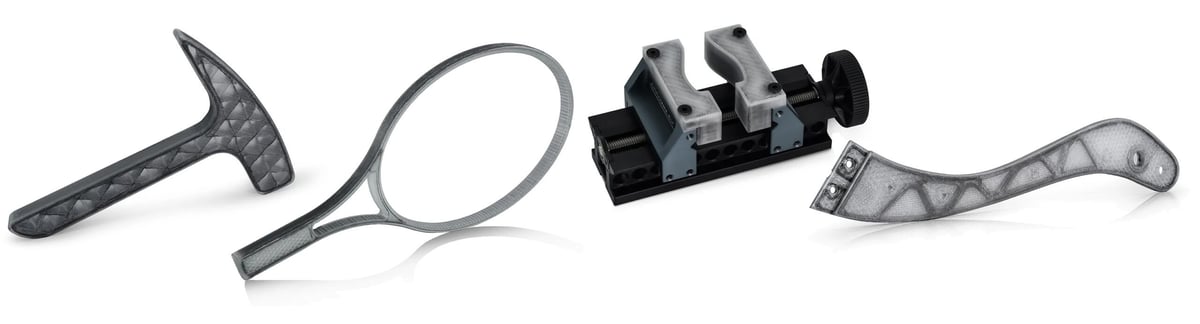
The FibreSeeker 3 ($2,795), described in the campaign as a “personal continuous fiber 3D printer,” is positioned as a machine capable of delivering components with CNC-level strength because unbroken, continuous strands of carbon fiber are embedded in the print. Continuous carbon fiber 3D printing had been the near-exclusive domain of 3D printer maker Markforged, with its extremely popular Mark Two ($16,000). But now, China-based FibreSeek, a rebrand of the industrial 3D printer maker Anisoprint, is focused on making this niche technology more accessible and applicable to a wider range of prints and products.
What if this wasn’t just for a billion-dollar rocket or a million-dollar racing car,” says company founder and CEO Ryan Liu in the Kickstarter video, “What if we turned this technology into a product that engineers, creators, and even students could access … right at their desk.”
This idea appears to be hot. The company has raised more than $2M on Kickstarter in its first three days.
The Tech Behind FibreSeeker 3
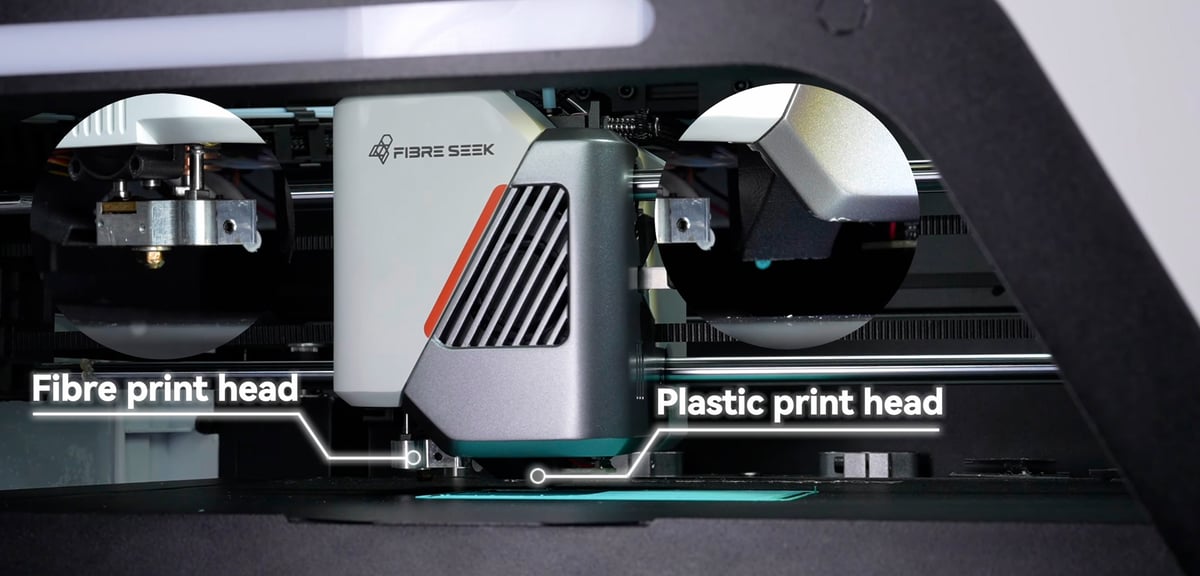
At the heart of the FibreSeeker 3 system is a process the company calls Composite Fibre Co-extrusion (CFC). This technology is unlike the carbon-fiber reinforced filament you may know, like Bambu Lab PLA-CF where the chopped-up bits of carbon fiber embedded in the PLA are only for aesthetic purposes, or PA6-CF where chopped carbon fibers are blended with nylon for structural strength and stiffness. CFD embeds full-length continuous fiber strands directly into the molten thermoplastic during extrusion.
A dual-extruder design allows one nozzle to print plastic (PLA, ABS, PC, etc.). Next, the FibreSeek Kickstarter videos are a bit unclear; one says the other side of the dual extruder extrudes a continuous string of fiber “sealed in place with a bonding resin.” Yet another explainer video seems to go into more detail, saying that the second extruder actually combines a thermoplastic and the continuous fiber: “We use pre-impregnated fibers with high fibre volume fraction, which are heated and softened in the melting chamber alongside thermoplastic materials before being co-extruded.”
Essentially, there are three spools of material involved, one is continuous fiber and the other two could be any range of materials, including a chopped carbon fiber nylon that’s then extruded with the continuous carbon fiber and laid down on a part that’s built mostly from a third material, such as an unfilled nylon.
This enables highly controlled fiber placement, letting users reinforce specific load paths within a part as designated by the machine’s software. The company likens it to rebar in concrete.
Fibreseek vs. Markforged
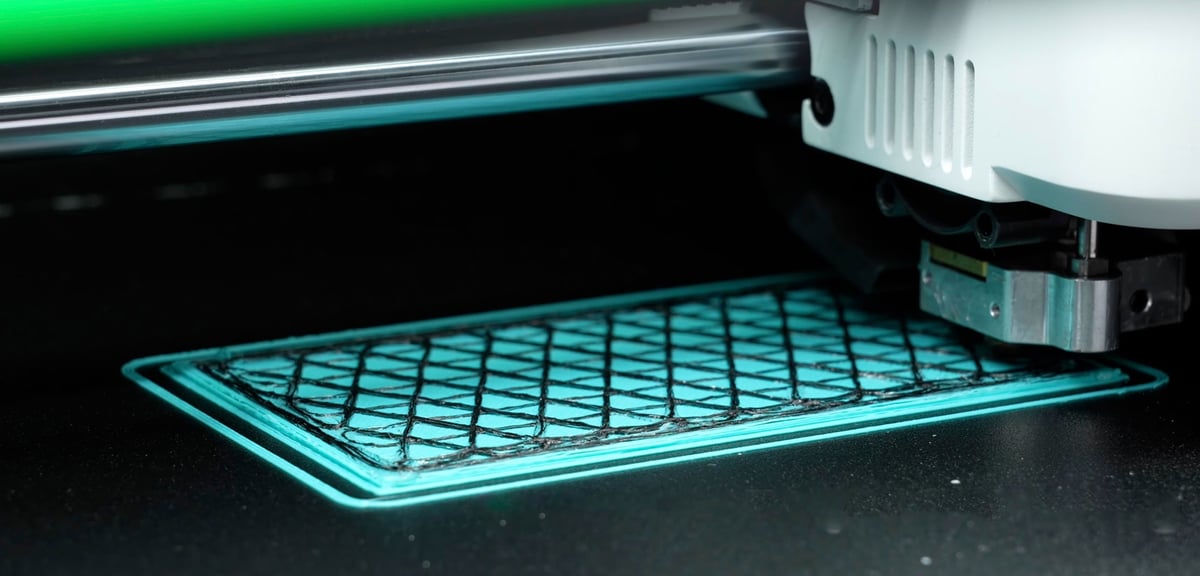
If you’re familiar with continuous carbon fiber 3D printing, you may be wondering how FibreSeek compares to the long-time leader in desktop continuous fiber 3D printers, Markforged.
Markforged’s Continuous Fiber Reinforcement (CFR) also uses two nozzles: one prints the thermoplastic base, such as the company’s proprietary Onyx, and the second lays down continuous fiber (carbon, fiberglass, or Kevlar) inside selected regions of the part.
The continuous fiber is delivered as a pre-impregnated (prepreg) filament with a thin plastic coating. As it’s placed, that coating melts and bonds to the already-printed thermoplastic matrix.
Fibreseek’s technology is different, but functionally, these are both in the same family of technology.
A Closer Look at FibreSeeker 3
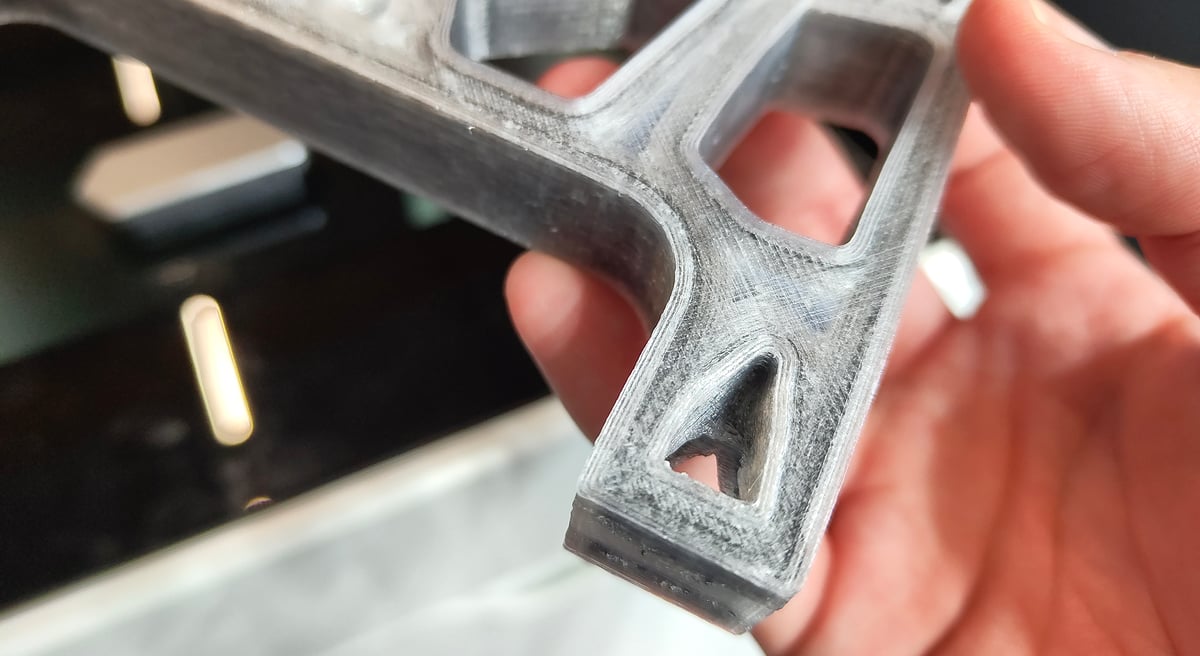
FibreSeek claims that the FibreSeeker 3 can produce parts with tensile strengths reaching as high as 900 MPa, which is performance that, according to the campaign text, rivals aerospace-grade aluminium while weighing substantially less. (Markforged claims a tensile strength of 800 MPa.)
Speed is another highlighted advantage. The printer reportedly achieves print speeds up to 500 mm/s when printing with just one polymer, but laying down continuous carbon is described at a speed of “20cc/h”. Material-wise, that’s the volume of a ping pong ball. So the areas of your part not reinforced with fiber will print on par with say, the Bambu Lab H2C, while the process of applying the fiber is considerably slower. We’d love to compare speeds to Markforged, but that company never released figures.
Its large-format build volume supports the production of sizable prototypes and end-use parts without the need for segmenting designs into smaller sections.
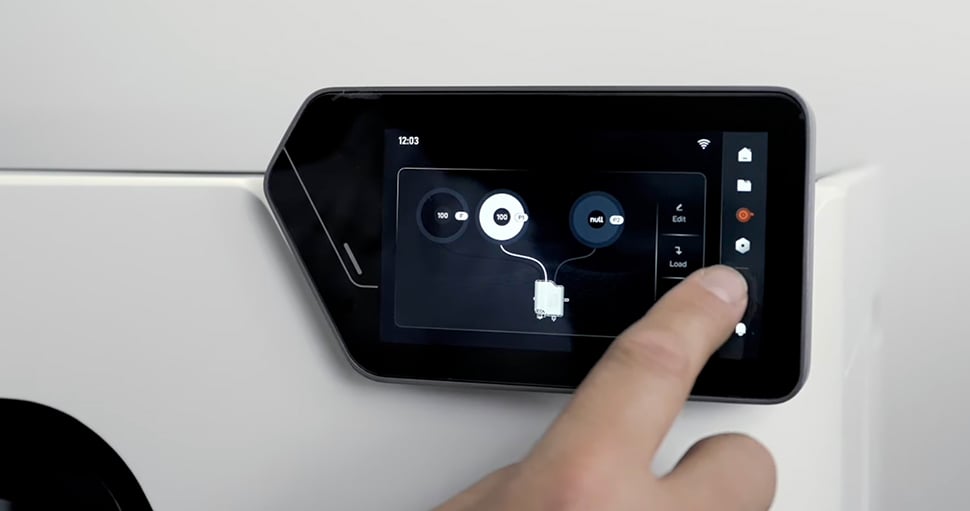
Adding to its workflow-oriented approach, the printer includes a built-in HD camera for real-time print monitoring and employs motion-correction algorithms that the company says maintain ±0.05 mm dimensional accuracy even at high printing speeds. A 5-inch full-color touchscreen allows detailed monitoring of temperatures, speeds, and progress, and enables one-tap firmware updates. Automatic bed levelling, smart calibration and filament run-out detection further aim to remove common pain points for everyday users.
To accommodate different requirements, the FibreSeeker 3 includes three printing modes that operate distinctly and are represented on the machine by colored indicators. High Speed Mode uses only one nozzle to print standard materials. High Strength Mode combines the main nozzle and the CFC nozzle to generate reinforced parts with a tunable balance of strength, weight, and material cost. Hyper Strength Mode uses just continuous fiber and the resin binder to produce extremely strong internal structures.
Materials: More Than Nylon
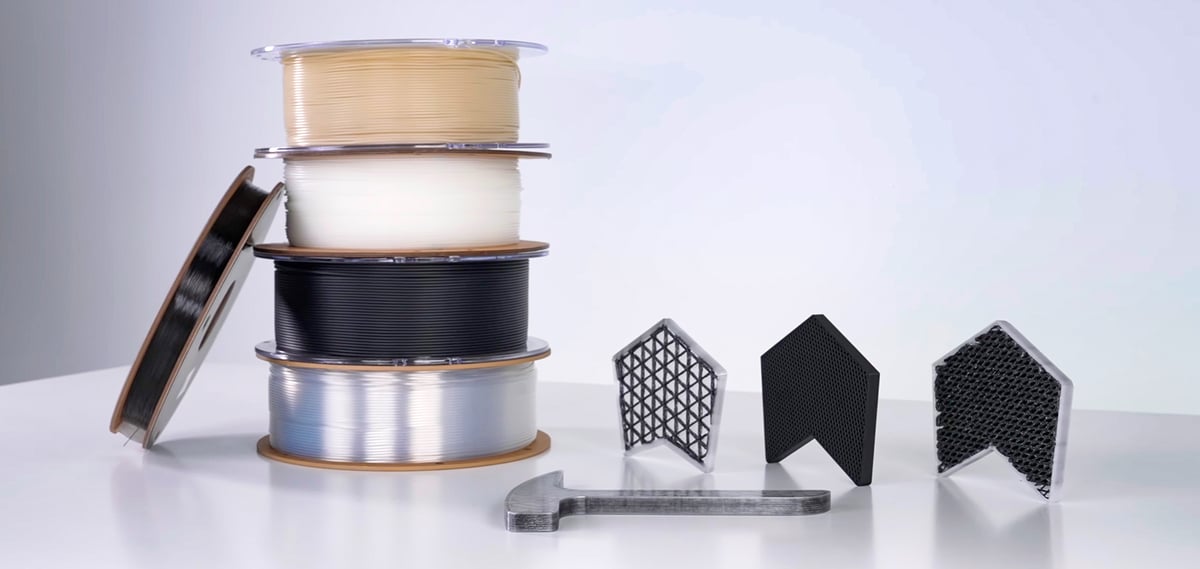
Fibreseek says that its continuous fiber material is proprietary and priced at $49 for 500 meters of material. The accompanying polymer doesn’t have to be FibreSeek’s. The company says it “supports open-source compatibility for third-party PLA and PETG plastics,” which is different from saying it is open source. “FibreSeeker 3 also features a professional printing mode that unlocks full open-source access to material settings, enabling parameter adjustments for various plastics and fibres, with a reminder for users to thoroughly understand parameters and test materials.” This “unlocking” may imply an extra fee or upgrade.
That said, being able to embed continuous carbon fibers in potentially any materials you like (keeping in mind the unit’s 350ºC hot end and 65ºC chamber), is a huge step forward for this technology. Markforged’s proprietary materials were a common hurdle to wider adoption.
Software to Place the Fibers
Behind the hardware is a custom slicer designed to analyze load distribution, fiber placement, and material usage automatically before generating optimized toolpaths.
You can customize supports, define fiber-reinforcement zones through mask-based tools, and export open-format G-code. Compatible file imports include STL, STEP, and OBJ.
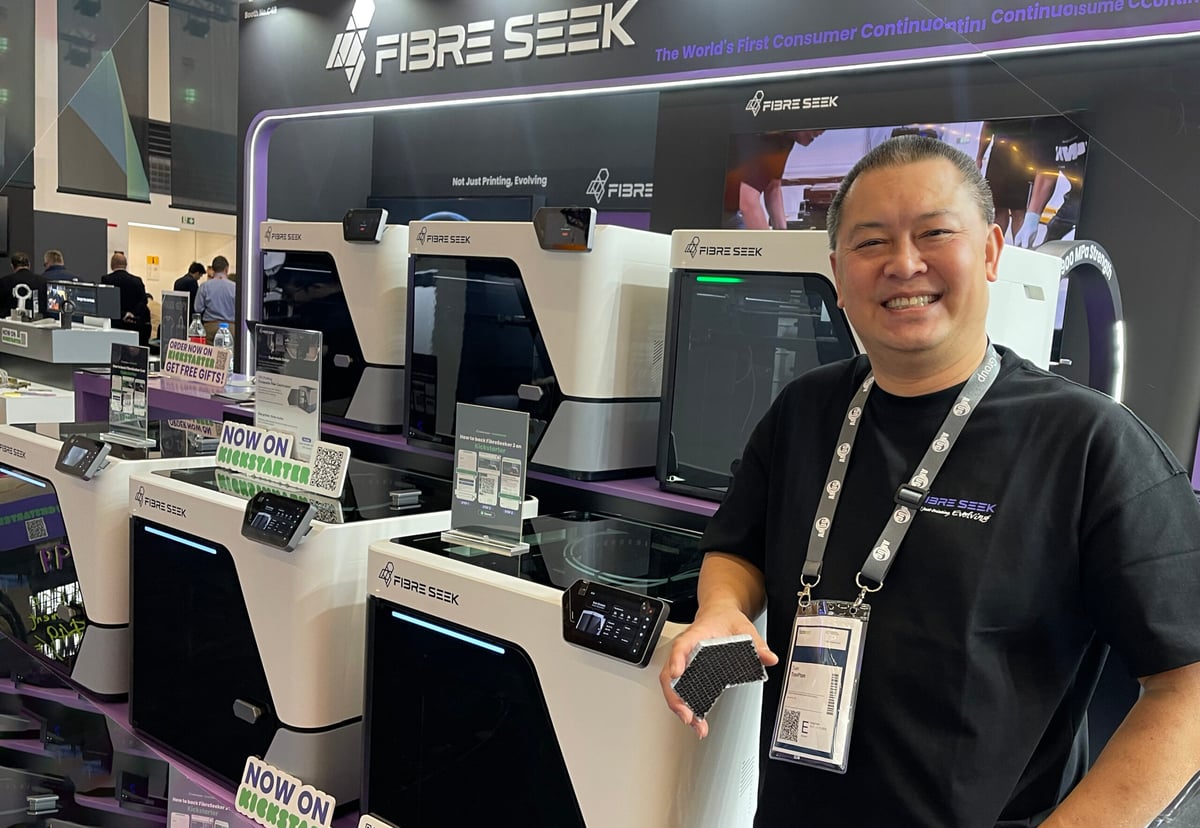
FibreSeeker 3 presents a compelling vision: accessible continuous-fiber composite manufacturing without the expense and complexity typically associated with industrial equipment. If the machine performs as promised, it could mark a significant advancement in desktop additive manufacturing and open new possibilities for producing structural, load-bearing, end-use parts far beyond the capabilities of traditional consumer 3D printers.
 Editor's Note – This article highlights a Kickstarter crowdfunding campaign. Kickstarter is not a shop; campaigns are under no legal obligation to deliver on crowdfunding promises, nor offer refunds on unfulfilled campaign rewards.

For more insight, read our article 8 Things to Watch for When Backing a 3D Printing Kickstarter.
You May Also Like:
Listen to All3DP’s News Podcast:
License: The text of "New Sub-$3K Continuous Fiber 3D Printer Threatens Markforged’s Dominance Securing $2M on Kickstarter" by All3DP Pro is licensed under a Creative Commons Attribution 4.0 International License.