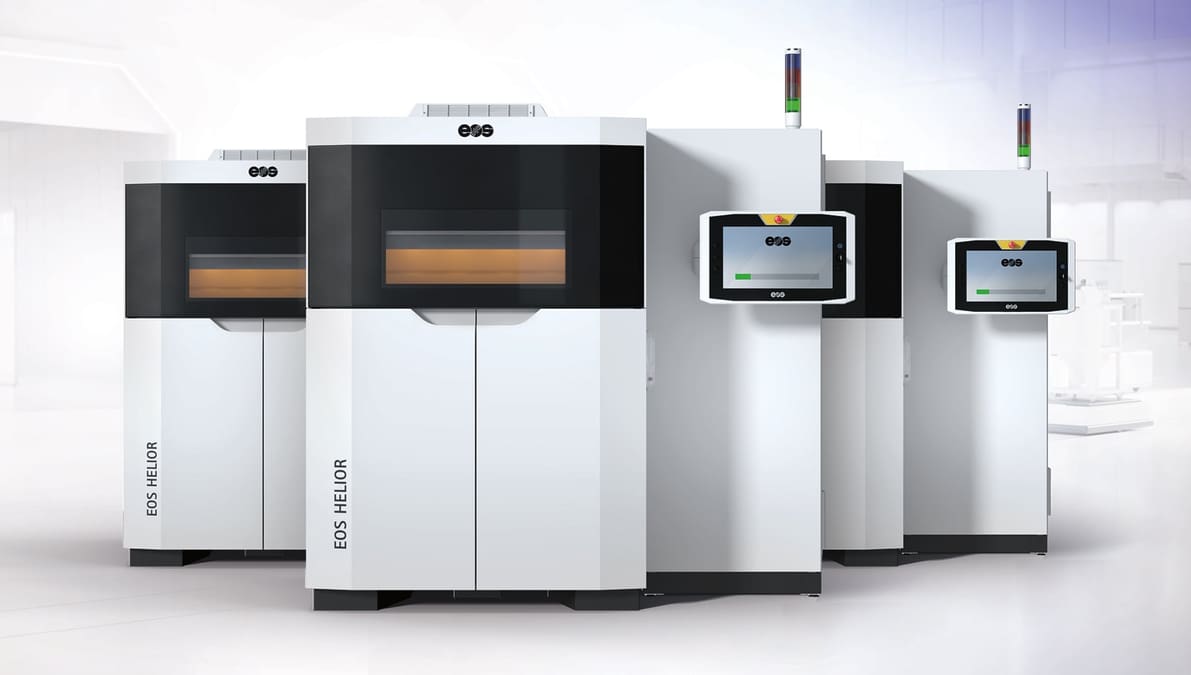
EOS Launches Helior: a New Triple-Laser SLS Printer Built for 24-Hour Production

With three lasers and a new adjustable recoater, EOS is targeting faster build cycles and less post-processing work for high-volume polymer production.
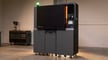
EOS today launched its latest nylon, large-format selective laser sintering (SLS) 3D printer called Helior. It offers the same build volume of the company’s established P 770 and equips it with more laser power and new powder recoating system to deliver more parts per day, EOS says.
Although EOS officially stands for Electro Optical Systems, its initials also happen to spell the name of Eos, the Greek goddess of dawn. Helior sounds suspiciously like Helios, Eos’ brother and the Greek sun god, which could also make the machine’s 24-hour production thematically fitting. We’re just guessing at the name’s pedigree, of course, but it’s better than “P 770” at any rate.
New Triple Laser System
The Helior operates with three 70-W lasers compared to the P 770’s two and claims up to “60% higher throughput” than the P 770 and “80% higher throughput in comparison to the EOS P 760 or comparable competitive machines,” EOS told All3DP.
EOS also has not yet provided an explicit build rate in liters per hour (L/h) for Helior like it does for the P 770 (5.6 L/h) however, it does say a 154-liter build volume at 10% packing density is completed in a 24-hour cycle.
The smaller EOS P 500 can also complete a build in a day, but Helior’s chamber is more than twice the size.
In addition to size and throughput, EOS is also tackling some of the labor-intensive work surrounding each build that also contributes to throughput.
Addressing Easer Part Excavation
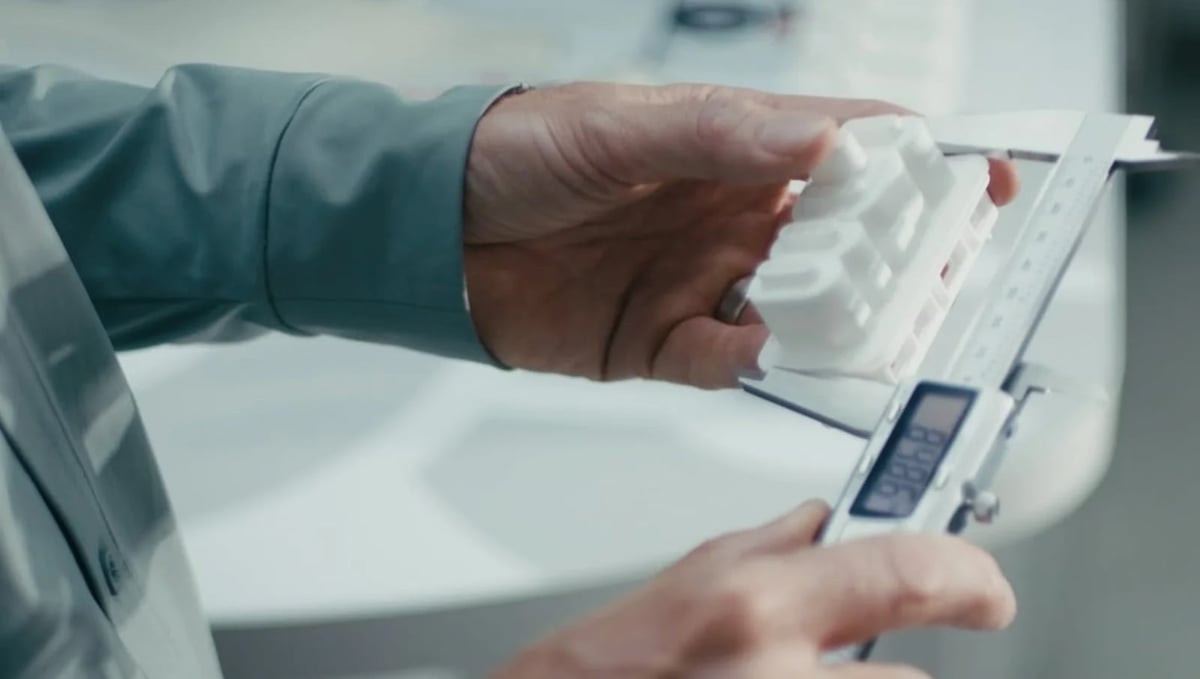
One of its more interesting developments is an independently adjustable roller recoater, which works alongside “geometry-aware exposure parameters” to produce a less dense powder cake.
EOS claims this combination can reduce post-processing effort, potentially easing the process of extracting finished parts from the surrounding unsintered powder.
That’s a notable change in emphasis from the P 500’s dual-roller recoater, which EOS promotes for its ability to compact powder into a homogeneous, even bed. Rather than focusing exclusively on how efficiently powder is deposited and fused, Helior’s design also considers how easily the resulting build can be unpacked. For manufacturers producing multiple jobs each week, that could be at least as consequential as faster laser exposure.
Helior also has what EOS calls “3D EOSAME” for improved part homogeneity throughout the chamber, “Smart Scaling” software intended to compensate for dimensional deviations that arise during printing, and “advanced exposure parameters” that adjust laser energy input according to the geometry of individual parts, rather than treating every feature identically.
Not all of these features are completely new. The P 770 uses EOSAME to homogenize energy input across its dual-laser exposure area while Smart Scaling was already available on the P 396 by 2020.
Helior looks like a substantial step forward in production capacity, however, it initially offers less flexibility in material choice.
At launch, it supports PA 2200 and PA 2220 HighReuse, with further qualifications planned according to customer demand, EOS says. The P 770, by comparison, already supports a much broader portfolio spanning PA 11 and PA 12 materials, TPU, glass-filled formulations and flame-retardant powders. Manufacturers considering Helior’s additional output capacity will therefore have to weigh it against their existing material requirements.
EOS is positioning the machine within a broader production workflow rather than as a standalone printer. It supports closed powder feeding and automated unpacking through peripheral equipment developed with AM Solutions, alongside integrated monitoring and open data access.
Automation is hardly unfamiliar territory for the company — both the P 500 and P 770 already offer powder-handling and production accessories — but Helior brings these elements together around its higher-throughput build process.
According to EOS Chief Technology Officer Joachim Zettler, the system can support a full week of build jobs and produce more than 1,000 liters before requiring maintenance operations.
Beta-Tested at AM Service Providers
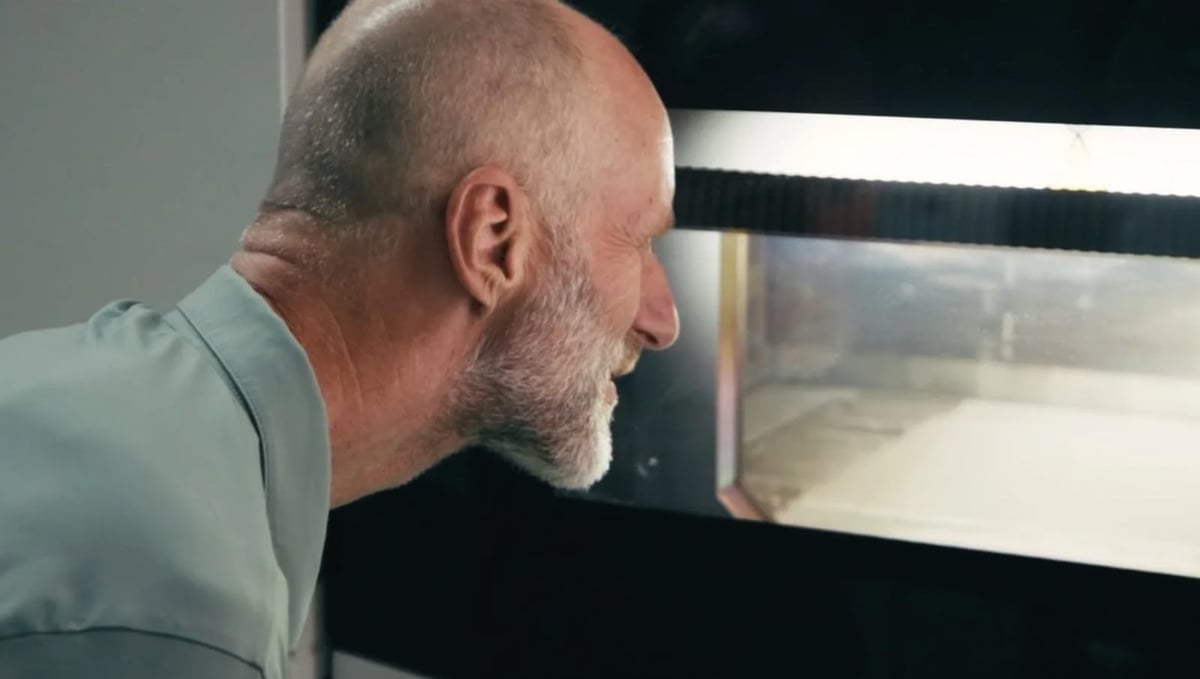
Five contract manufacturers have already participated in the Helior Pioneer Program: FKM Additive Manufacturing, Prototal Group, Materialise, Shapeways and Formrise.
Matthias Henkel, managing director of FKM Additive Manufacturing, says the system fits the company’s single-shift operation, allowing it to complete a full build each day while improving machine utilization and simplifying production planning.
Helior will become commercially available in December. EOS is presenting the machine at Formnext in Frankfurt, Nov. 17-20, in Hall 12.0, Booth D71.
You Might Also Like:

License: The text of "EOS Launches Helior: a New Triple-Laser SLS Printer Built for 24-Hour Production" by All3DP Pro is licensed under a Creative Commons Attribution 4.0 International License.