Custom Tooling for Food Tech, This Nozzle Went from Design to 3D Print in a Day

By eliminating complex assembly and traditional lead times, this food-safe, single-piece nozzle demonstrates how additive manufacturing is ready for food manufacturing.
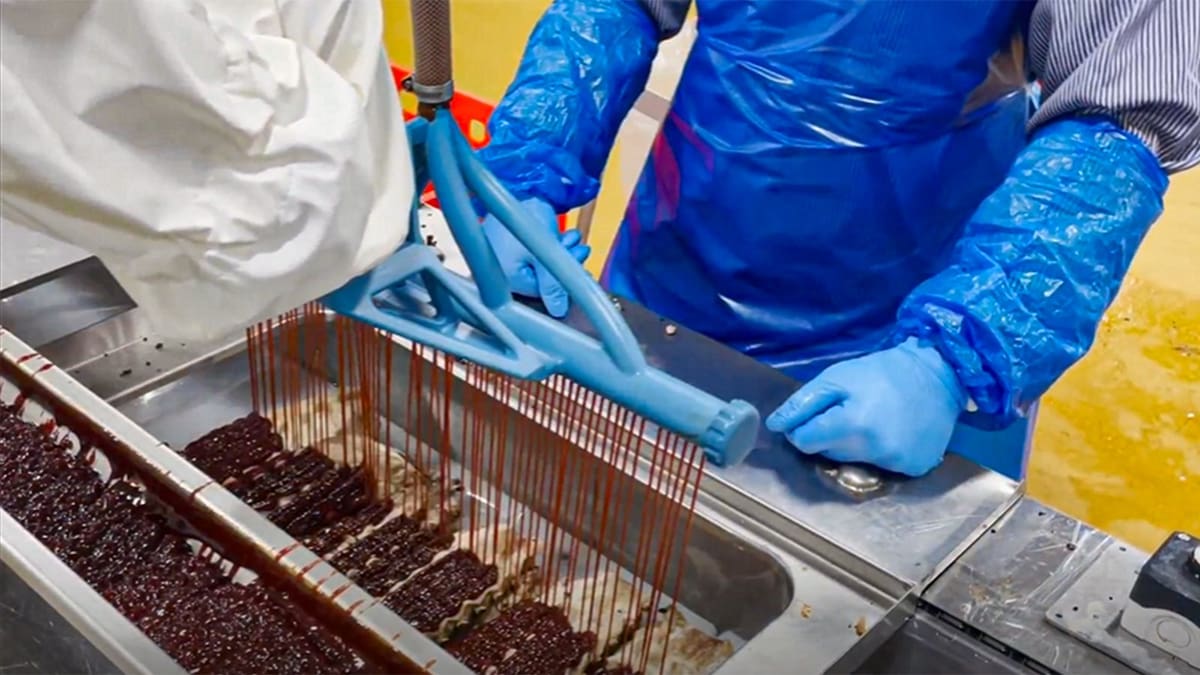
When Danish automation specialist BILA set out to help a client automate the messy job of applying BBQ marinade to spareribs, they weren’t just looking for another stainless-steel nozzle. They needed a smarter, faster, cheaper, and more easily customizable solution, which led them to 3D printing. Here’s how.
The project was technically demanding: create an automation solution that can apply marinade reliably across trays of spareribs, handling viscous fluids and irregular surfaces without clogging or wasting product. That sort of process calls for custom tooling, which, in a traditional fabrication, usually means long lead times and high costs.
Instead of traditional methods, BILA’s initial idea was that the manifold part of the nozzle assembly could be 3D printed in stainless steel. For this component, it turned to the Danish Technological Institute (DTI) for help for its range of additive manufacturing technologies on-site, which could handle the prototyping and final production.
By switching to 3D printing, BILA and DTI could rethink how quickly such a tool could be developed. Instead of waiting on machining or complex assemblies, they were able to move directly from design to a physical, testable nozzle quickly.
In fact, according to DTI, the design was developed within half a day, underscoring how quickly functional parts can go from concept to reality.
Half a Day from Design to 3D Printed Nozzle
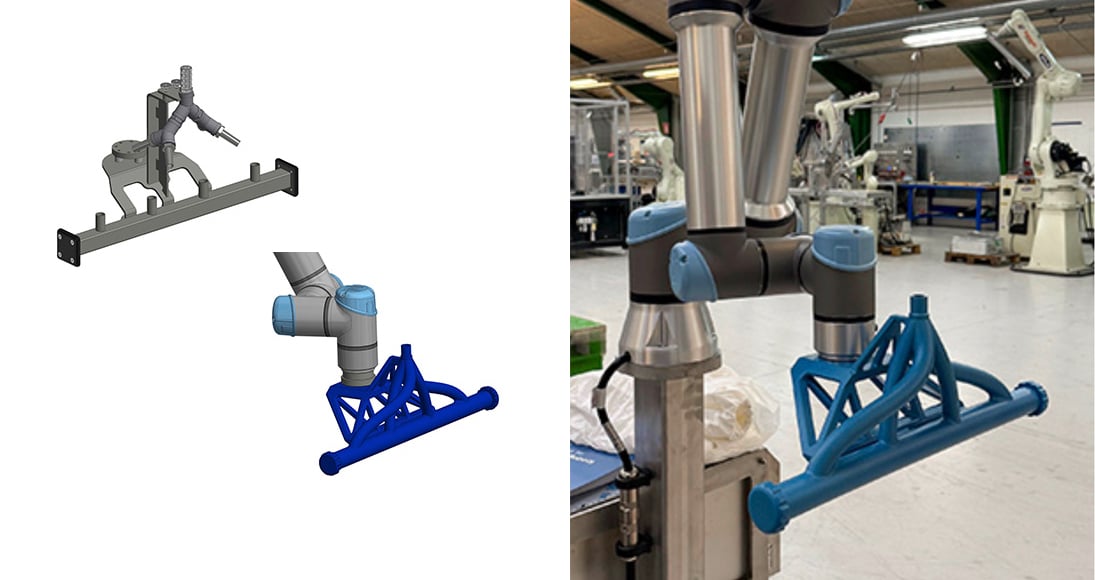
The quick design development highlights one of additive manufacturing’s biggest advantages in industrial environments: the ability to iterate and deliver application-specific tooling at incredible speed.
DTI’s Kristian Rand Henriksen, business manager and 3D printing specialist, received the 3D file from BILA’s mechanical engineer, and quickly assessed that the proposed stainless steel manifold solution, which would then assembling it with other components, would be too expensive.
Instead, he proposed that the entire nozzle assembly be printed in blue, metal-detectable nylon (developed by DTI) that is approved for food contact. This material is significantly cheaper than stainless steel and it was perfect for this component, since it doesn’t require load-bearing capability.
DTI printed a first version, which BILA tested and discovered that the holes needed to be slightly larger to let out enough BBQ marinade. Fortunately, it’s easy to adjust a digital design for 3D printing, and once the new design was ready, the final version was printed and worked perfectly, according to DTI.
“With traditional manufacturing, this custom machine tool would require several suppliers, 2D drawings, and assembly of multiple parts,” says DTI. “3D printing made it possible to produce the entire nozzle in a single piece – and the design was developed within half a day.”
Manufacturing in one piece eliminated need for assembly work and joints, making cleaning much easier—a major advantage in the food industry, where hygiene is crucial.
Beyond the culinary novelty, the project serves as a compelling demonstration of how additive manufacturing can accelerate tooling development within the food-processing sector. This project illustrates a broader shift toward on-demand, application-specific tooling that could help redefine how automation is adopted across the food industry.
You May Also Like:
License: The text of "Custom Tooling for Food Tech, This Nozzle Went from Design to 3D Print in a Day" by All3DP Pro is licensed under a Creative Commons Attribution 4.0 International License.