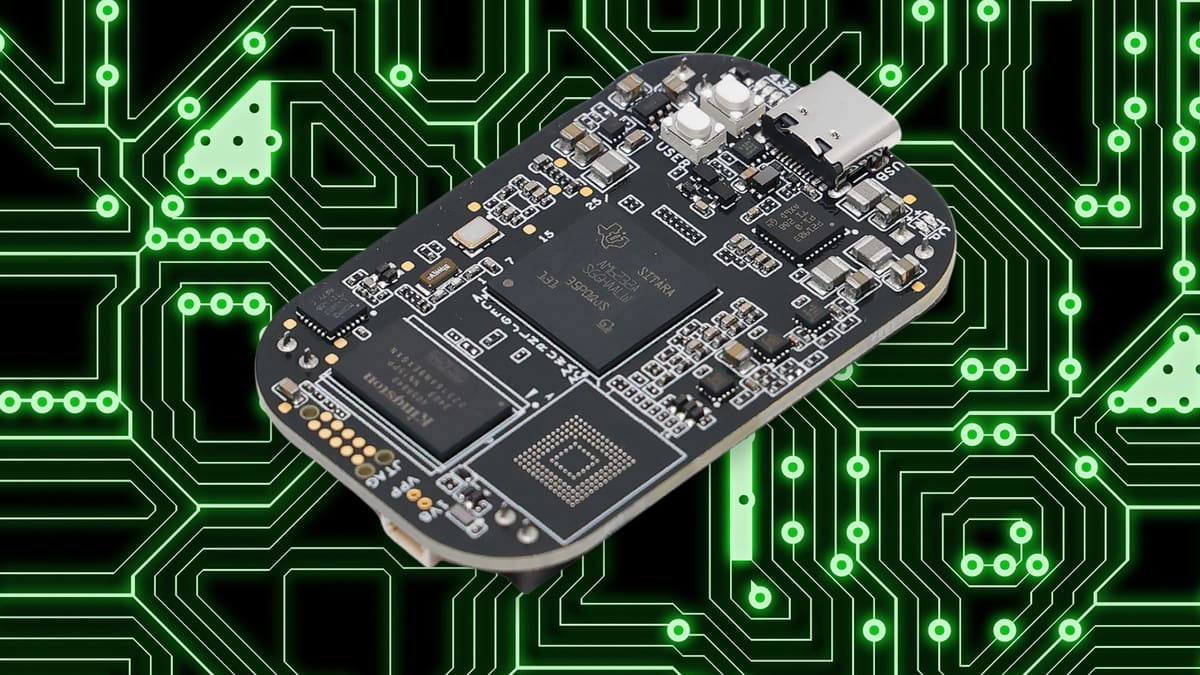
BeagleBoard Refreshes PocketBeagle 2 Just Months After Its Release

The PocketBeagle 2 just got an update, and thanks to the new GPU on board, there's more you can do with it!
BeagleBoard has quietly refreshed its palm-sized PocketBeagle 2 with a new revision: the Rev A1.
The original board, which launched just three months ago, featured a dual-core 1-GHz AM6232 Sitara processor without a graphics processing unit (GPU). The new Rev A1 steps things up with a more powerful quad-core AM6254 Sitara and now includes a 3D-capable GPU – an impressive feat given the board’s compact footprint. The processor also boasts a higher clock speed at up to 1.4 GHz. The other specifications remain mostly unchanged: same footprint, same pin-out, and familiar features like USB-C and an onboard lithium battery charger.
So what does this mean for users? With a GPU on board, the PocketBeagle 2 can now handle lightweight AI workloads like Tiny-Yolo or MobileNet-v3 inference. Previously, only boards like the Raspberry Pi Zero 2 or Orange Pi Zero offered similar capabilities at this size. Now, PocketBeagle 2 sets itself apart with its onboard Cortex-M0+ microcontroller, enabling real-time tasks to run alongside AI workloads – a rare combination in this form factor. Potential use cases include ultra-small mobile robots, handheld retro gaming consoles, or even kiosks looping 1080p signage all day without breaking a sweat.
Despite the upgrades, there’s still no HDMI port. That being said, developers can expose the SoC’s MIPI-DPI/LVDS lanes via a display cape and let the Graphics core drive full 3D dashboards or lightweight user interfaces, all while staying under the board’s typical 4W power consumption. This would be ideal for battery-powered wearable devices or field-data loggers that can be charged through the onboard charger.
But if you don’t want to go through all that hassle and don’t mind a higher power consumption, a USB-C hub with an HDMI output can be connected to the PocketBeagle 2’s USB-C port and will do the job as well.
The best news of all: the $29 price hasn’t changed. For a full list of retailers, detailed specifications, and additional resources, check out the official BeagleBoard website.
Read more recent news:
License: The text of "BeagleBoard Refreshes PocketBeagle 2 Just Months After Its Release" by All3DP is licensed under a Creative Commons Attribution 4.0 International License.