Bambu Lab’s H2D Is the Latest Safety-Certified Consumer 3D Printer

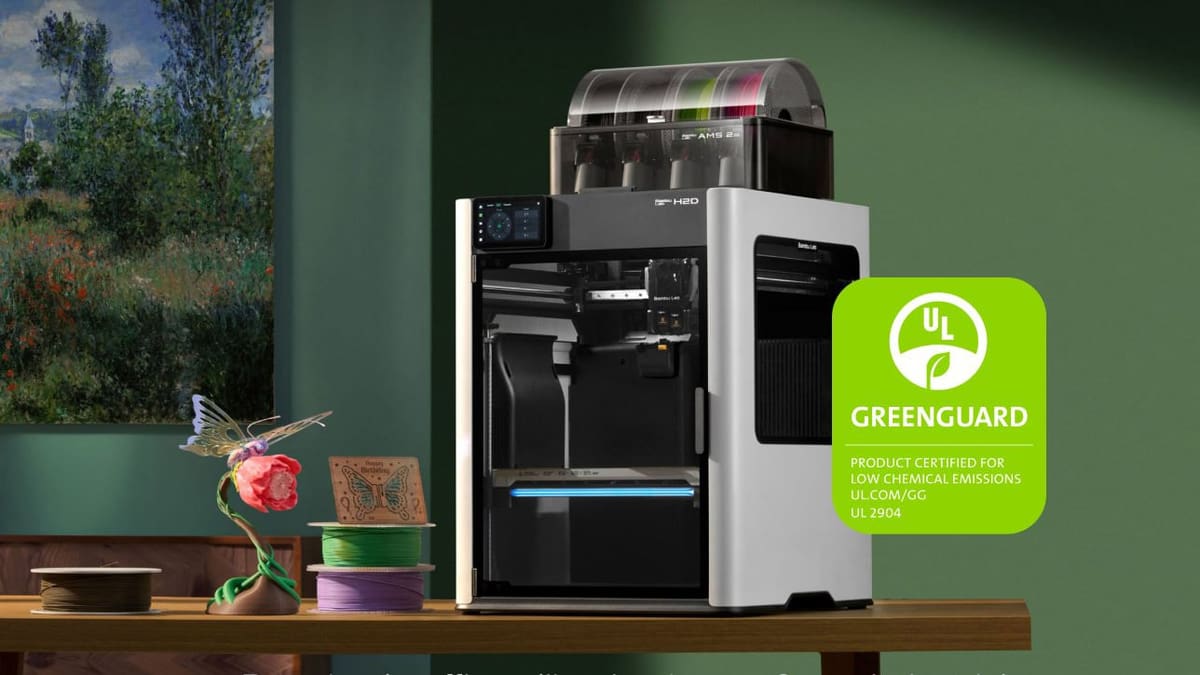
The company quietly rolled out graphics on its store page to indicate UL Greenguard safety certification for the H2D printer with some Bambu Lab materials, which suggests emissions are within safe parameters.
Bambu Lab launched its highly anticipated H2D 3D printer and multi-functional making machine earlier this year to a healthy mix of fanfare and trepidation. Something that deserved more attention, however, was the UL 2904 safety certification for 3D printing with some materials on the H2D.
The company’s PLA Basic, PETG HF, and Support for PLA/PETG materials have been certified under UL 2904 “Greenguard for 3D Printers.” It’s a standard by UL Solutions, a third-party certification body, that measures conformance to current safety standards of ultrafine particles (UFPs) and volatile organic compounds (VOCs) in non-industrial environments.
We covered the standard at length late last year when Prusa Research certified its Original Prusa MK4S bedslinger when printing with Prusament PLA and PETG. The short version is that the certification is a great assurance that an unbiased party has rigorously tested the device and materials to ensure they meet accepted health and safety standards.
The long version is that testing measures emissions for a target environment of a 30.6 m3 office (12 x 10 x 9 ft). Maximum UFP allowance is set to 20 billion particles per gram of feedstock, and 300 billion particles per hour, while VOCs must be below acceptable levels for “non-cancer chronic reference exposure levels” of each compound based on thresholds from organizations like the California Department of Public Health. UL Solutions stops shy of declaring certified products “safe” themselves, but it’s the next closest thing without having some perceived liability.
Exactly how safe 3D printer emissions are, at home or in non-industrial environments, has been a prominent question in the minds of 3D printing enthusiasts for a long time. It’s great to see more manufacturers opting into such certifications, which means there are clear, open guidelines that concerned users and institutions can consult when making their decisions. And, the more who opt in, the more pressure there is for other manufacturers to follow suit.
So, breathe easy if you’re 3D printing with Bambu Lab’s H2D, but maybe take a closer look at your ventilation if you’re printing with uncertified materials or using the H2D’s other functions.
Read more recent news:
License: The text of "Bambu Lab’s H2D Is the Latest Safety-Certified Consumer 3D Printer" by All3DP is licensed under a Creative Commons Attribution 4.0 International License.
CERTAIN CONTENT THAT APPEARS ON THIS SITE COMES FROM AMAZON. THIS CONTENT IS PROVIDED ‘AS IS’ AND IS SUBJECT TO CHANGE OR REMOVAL AT ANY TIME.