AI Data Center Cooling: The Breakout Market for 3D Printed Copper?

With AI processors pushing traditional thermal management to its limits, metal 3D printer makers are pivoting to produce complex, pure copper liquid cold plates for next-generation data centers.
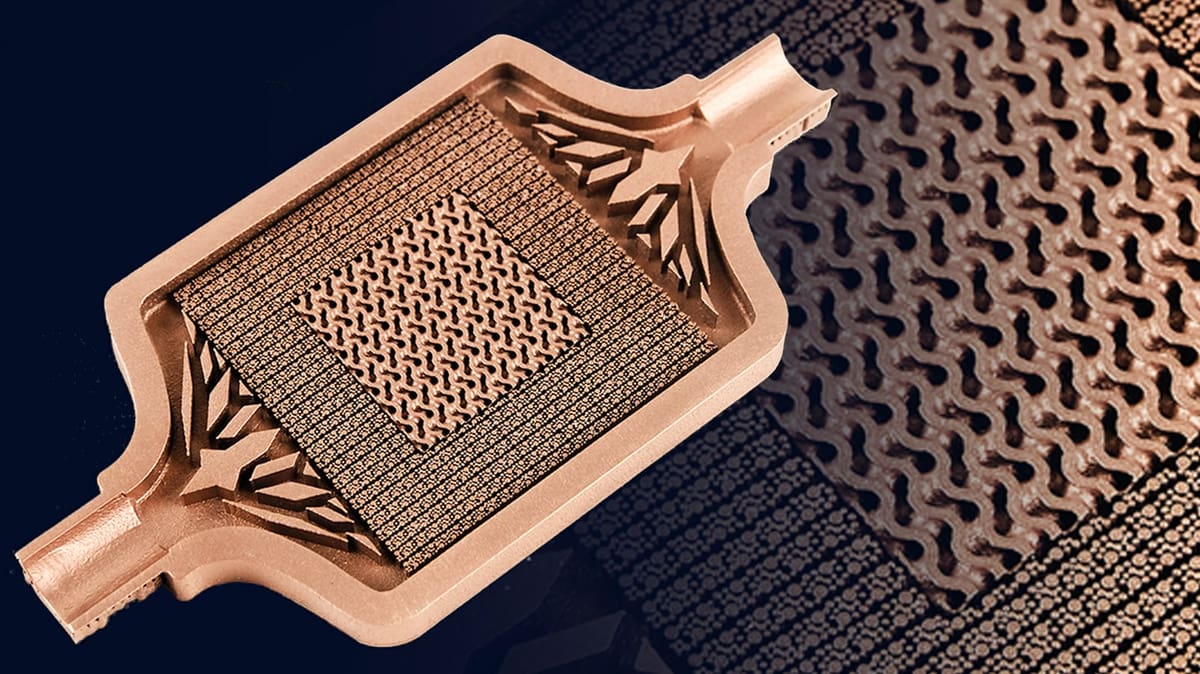
The rapid buildout of AI data centers is creating a new source of demand for copper, and metal additive manufacturing companies are eager to target a particularly demanding part of that market: cooling.
Copper demand from data centers is forecast to more than double by 2040, according to S&P Global. Much of that copper will go into electrical infrastructure, cabling, and connections, but S&P specifically identifies cooling as another source of consumption as AI hardware moves toward liquid cooling and copper cold plates.
3D printing those copper cold plates could cut data center cooling energy by 98%, according to researchers at the University of Illinois Urbana-Champaign who used a mathematical algorithm and an advanced 3D printing method to manufacture a specifically dense cold plate.
While this does not mean a boom in 3D printed copper is imminent. Most data-center copper is conventionally manufactured, and there is no reliable figure yet for how much cooling hardware is made with additive manufacturing. There are, however, increasingly concrete signs that copper laser powder bed fusion (LPBF) suppliers see AI cooling as an important emerging application.
Printing Copper for AI Cooling
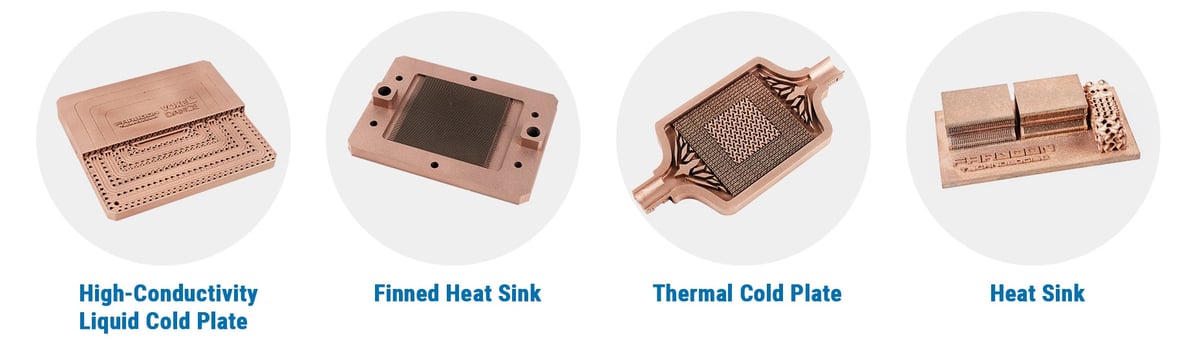
The latest example comes from Chinese metal additive manufacturing company Addireen, which just launched its latest copper LPBF 3D printer and lists pure-copper liquid cold plates for AI servers, power electronics, and high-heat-flux chips among the machine’s intended applications. It claims a pure-copper build rate of up to 24.24 cm³/h at 40-micron layers.
In August, Addireen published results from a project using green-laser LPBF to manufacture a pure-copper liquid cold plate for server cooling components. Instead of machining and joining multiple pieces, the company printed the cooling channels and surrounding structure as a single copper component, with walls down to 0.4 mm and an average build time of 0.75 hours per part.
Today, among 3D printer manufacturers, the emphasis is increasingly on production rather than proving that pure copper can be printed. Addireen says it has expanded production capacity for its green-laser systems to as many as 50 machines per month. In September, the company launched AddireenNow, an online metal additive manufacturing platform combining quotation, design review, production, post-processing, and inspection.
That strategy tracks a broader change in the potential market for copper.

AI Makes Cooling a Copper Problem
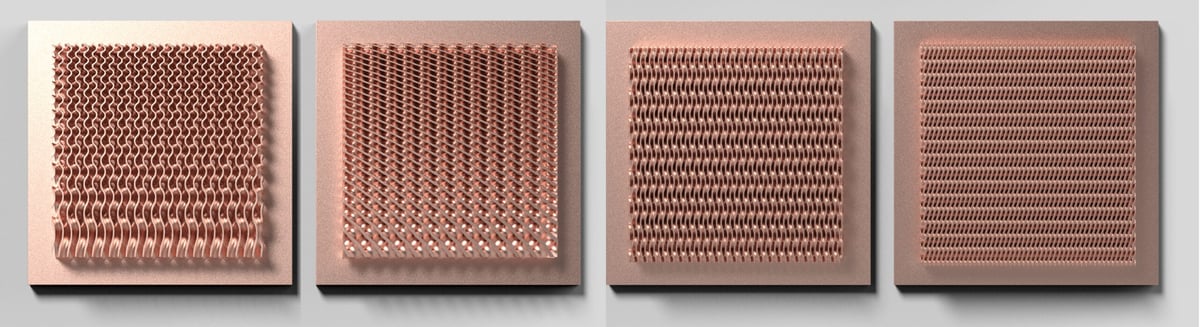
As processors consume more power, removing heat from tightly packed servers is becoming increasingly difficult. Direct-to-chip liquid cooling transfers that heat through cold plates installed directly against processors and other high-power components. Copper is particularly attractive there because of its high thermal conductivity. Additive manufacturing potentially adds another ingredient: geometry.
LPBF can produce internal microchannels, lattice structures, and flow paths that are difficult to machine, as well as consolidate a brazed or welded assembly into a single component. These capabilities aren’t automatically better — powder removal, surface condition, inspection, and cost all remain constraints — but they are especially relevant to compact heat exchangers and cold plates.
Copper is already widely used in direct-to-chip liquid cooling for AI servers. Supermicro’s current Vera Rubin data-center architecture, for example, specifies 576 copper cold plates, while companies including Alloy Enterprises and Centamil have recently introduced copper cooling hardware specifically for high-density AI infrastructure. As processor heat loads rise, that creates a growing application area for complex, high-conductivity copper parts. Currently, most of these are conventionally manufactured but including geometries that additive manufacturing can potentially produce more efficiently.
Addireen and others are on the march to promoting LPBF as the better solution for copper parts for electronics.
Chinese printer manufacturers BLT and Farsoon have also been highlighting copper additive manufacturing for thermal-management applications this year.
BLT showcased pure-copper cold plates for high-heat-flux electronics at TCT Asia, including designs based on gradient minimal surfaces, and says it has produced more than 100,000 copper and copper-alloy parts on its metal AM platforms. Farsoon, meanwhile, has been promoting copper-alloy LPBF for liquid-cooling hardware, explicitly linking the application to rising thermal loads in AI and high-performance computing. Germany’s EOS has continued to expand qualified copper processes for its M 290 1kW and M 300-4 1kW systems.
The Addireen’s new printer, the XH-M350G-2HR, enters a relatively small group of production LPBF platforms built around green lasers for copper, but with a larger rectangular build volume and dual-laser configuration. Conventional infrared lasers used in LPBF can process copper alloys, yet green wavelengths make highly conductive pure copper easier to process.
A New Market, but Not Yet a Proven Boom
For copper LPBF, AI data centers bring together several favorable trends: rapidly growing infrastructure investment, increasing copper consumption, escalating thermal loads, and cooling components that can benefit from complex internal geometries. What remains unclear is scale.
There is not yet reliable market data showing how many data-center cold plates are additively manufactured or what share of growing data-center copper consumption could ultimately flow into LPBF powder.
For now, the evidence points to an emerging application rather than an established mass market. But with S&P Global expecting data-center copper demand to more than double between 2025 and 2040, thermal management gives copper LPBF machine makers a substantial new industry to pursue and a reason to push pure-copper printing from specialized applications toward higher-volume production.
You May Also Like:

License: The text of "AI Data Center Cooling: The Breakout Market for 3D Printed Copper?" by All3DP Pro is licensed under a Creative Commons Attribution 4.0 International License.