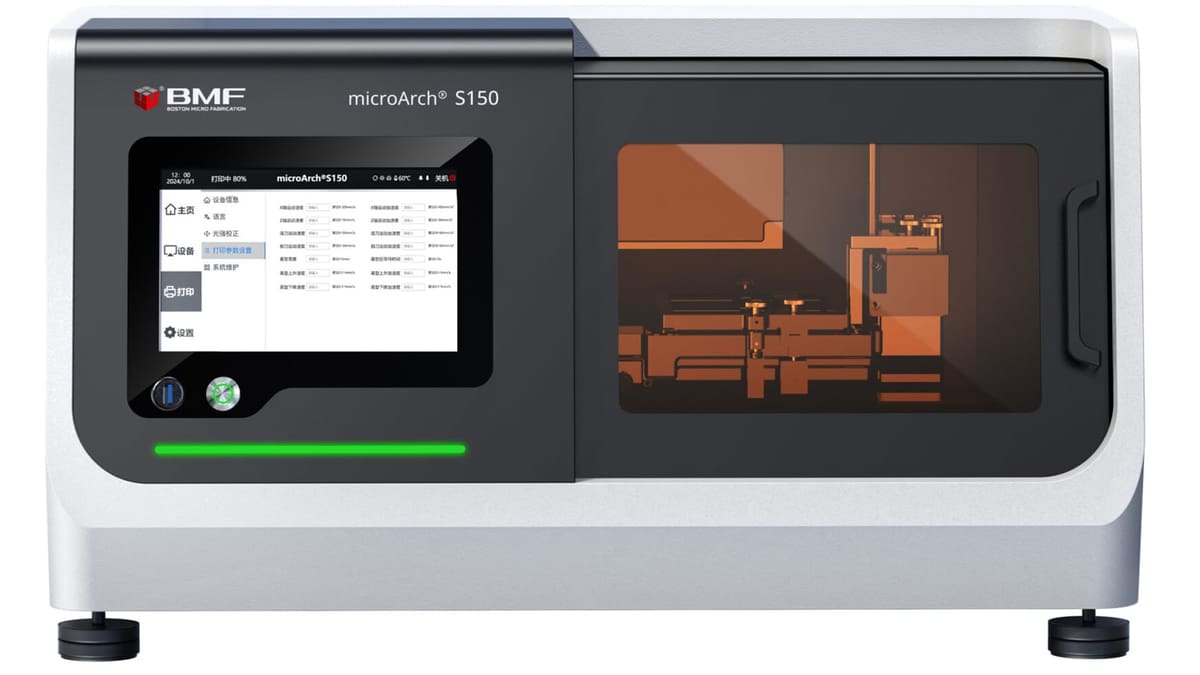
9x Faster Micro 3D Printing: Inside BMF’s New MicroArch S150 Ultra

BMF announced the MicroArch S150 Series, pairing a new S150 Ultra with the existing S150 to create a two-tier accessible entry point into 25-micron-resolution resin printing.
Orders are expected to open in Q2 2026, with the first public showing at the Rapid + TCT expo in Boston in April.
The S150 Ultra is the news here. The base MicroArch S150 was first shown at TCT Asia in March 2025 as a cost-effective successor to the now-discontinued P150. Between now and then the specs have not changed. There’s still a 80 × 48 × 50 mm build volume, 25-micron optical resolution, ±3 micron positional accuracy, packed into a 70-kg desktop footprint. BMF’s “series launch” framing introduces the Ultra as the speedy upgrade.
S150 Series = S150 + S150 Ultra (two-tier system)
What makes the Ultra worth separating out its claim that it’s up to 9x faster than the base S150 at the same resolution. BMF has not published distinct spec sheets for the two models – the product page lists a single set of specifications – so the basis for that multiplier is unclear. Whether it comes from faster layer exposure, quicker z-stage movement, or a different projection strategy entirely is not addressed in any available source.
The S150 will offer a wider range of materials whereas the S150 Ultra is focused on higher speed.
BMF says the S150 is making micro-scale 3D printing more accessible.
“The S150 series is a 25-micron system where all of the parameters that you would need are already preloaded onto the touchscreen,” says Peter Ho, BMF’s product manager. “You choose your material, you choose your layer height, you press print and the part comes out.”
The pair share identical external dimensions and the same feature set: HEPA13 filtration, UV-C sterilization, a DLC-coated build platform, and what BMF describes as one-touch operation. That “accessible” messaging is deliberate. BMF is not competing with desktop resin printers from the likes of Formlabs or Elegoo – its technology, projection micro-stereolithography, cures full layers at once at near micron-scale resolution, occupying the gap between conventional DLP and two-photon polymerization systems from Nanoscribe and UpNano.
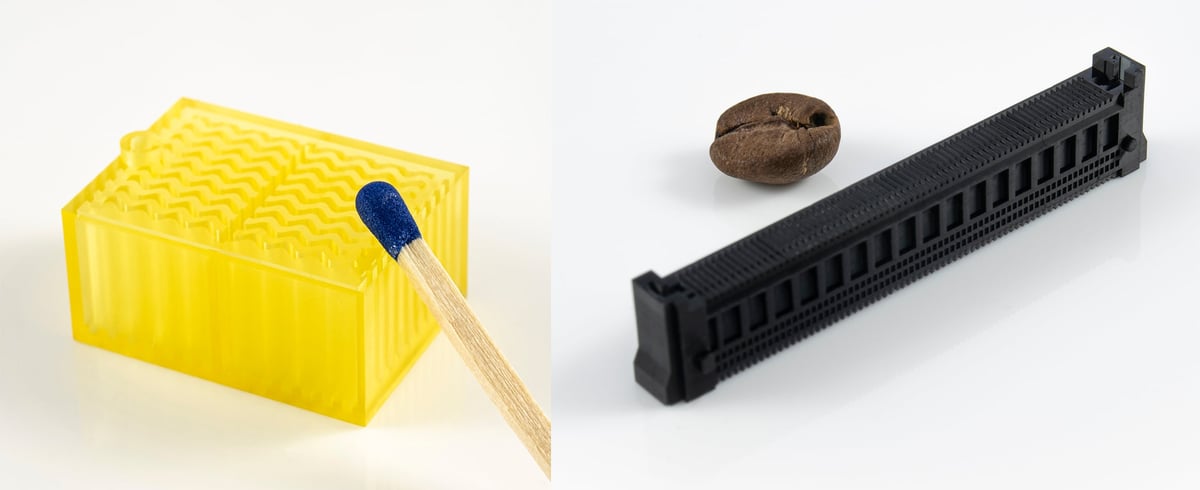
The real competition is arguably, not 3D printing at all, but micro-injection molding and CNC micro-machining. Labs running those processes can prototype and produce low-volume runs faster on a system that fits on a bench.
Applications include:
- Microfluidics
- Fiber optic connectors
- Biomedical devices
- Electronics and micro-components
No pricing has been disclosed for either model. BMF operates on a quote-basis across its entire lineup, so whether “accessible” extends to cost remains an open question. The company claims 30% year-over-year growth in 2023 backed by roughly $69M in funding through a 2023 Series D.
S150 & S150 UltraTech Specs
License: The text of "9x Faster Micro 3D Printing: Inside BMF’s New MicroArch S150 Ultra" by All3DP Pro is licensed under a Creative Commons Attribution 4.0 International License.