
3D Printing Could Make Hydropower Finally Worth the Cost at 50,000+ U.S. Dams

After a 3D printed turbine prototype successfully passed a grueling six-year continuous operational test, the ORNL-backed technology is now ready to scale, offering a cost-cutting blueprint to unlock clean energy at thousands of U.S. dams.
3D printing could help bring hydropower to thousands of small dams where traditional manufacturing is too expensive, slow, or complex to make economic sense. A rugged, 3D printed turbine prototype that has successfully run continuously for over six years under intense water pressure, proving the long-term durability of additive manufacturing in extreme environments, is primed for expansion.
Developed by the Oak Ridge National Laboratory (ORNL), a U.S. Department of Energy research facility, and Wisconsin hydropower engineering startup Cadens, this micro-hydropower system leverages carbon-fiber-reinforced polymers and 3D printed molds to cut production costs by 85% and slash manufacturing lead times by 90%.
The US. has around 90,000 dams, but fewer than 3% generate electricity, according to Oak Ridge National Laboratory (ORNL), which says about 51,000 of them have micro-hydropower potential, meaning they could generate up to 100 kW each. But because small hydropower sites are rarely one-size-fits-all — water levels and flow conditions can change by season — manufacturing custom turbine parts with traditional manufacturing is too costly.
That is where 3D printing comes in. Cadens developed “Turbine Builder” software to help define the right hydropower components for a given site, yet it needed a practical way to manufacture those custom parts affordably. The company worked with ORNL to test whether additive manufacturing could produce components tough enough for long-term operation under water pressure.
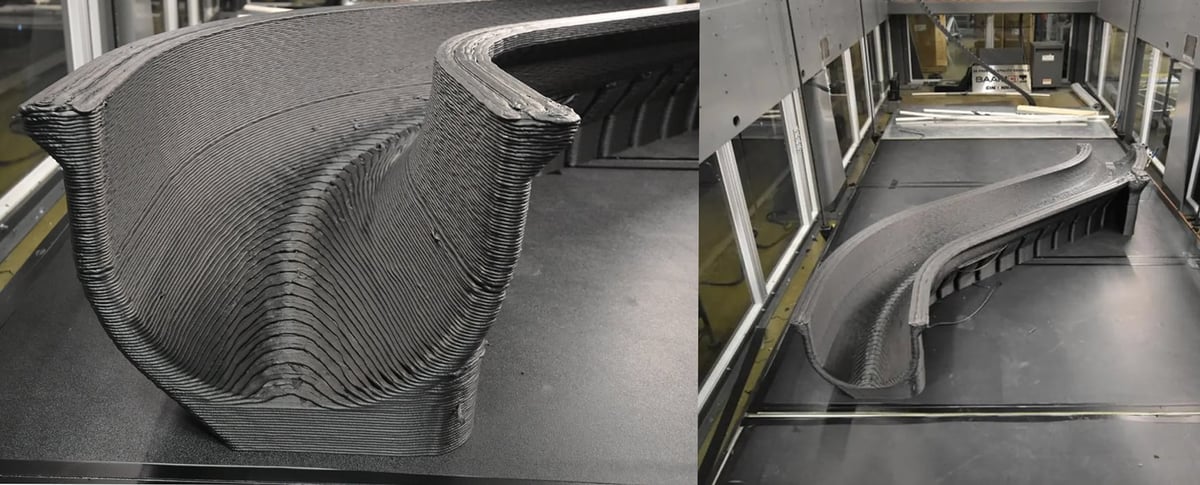
Team combined standard, off-the-shelf infrastructure with custom 3D printed parts. A large PVC pipe formed the main waterway, while printed polymer components were made to fit the system. One major part, the draft tube, was printed in two halves using 20% carbon-fiber-reinforced ABS before being sealed into a 688-pound unit.
For the runner housing, which encloses the turbine, the team used 3D printing in a different way. Rather than print the final part directly, they printed a mold and cast the housing in fiberglass, then CNC machined and sealed it for accuracy and durability.
According to ORNL, the team used big-area additive manufacturing, CAD, and a 3D Platform Workbench 400 Series System to produce key parts for the prototype, including the draft tube, wall thimble, runner housing mold, PVC end fitting, pipe supports, and a runner system for a Fixed-Kaplan S-turbine.
The finished prototype was installed at Cadens’ facility and has been running continuously for more than six years. The 30-foot-long testbed includes several 3D printed parts, including the intake adapter, runner, and end cap flanges, and has helped the team collect data for future turbine designs.
ORNL says the project shows that 3D printing can produce high-quality hydropower components with performance comparable to traditional manufacturing, while reducing costs. The lab reports a potential cost reduction of 40% per kW compared with conventional approaches.
Cadens is now using the project to support further scaling and cost reduction, as well as new designs that can handle real-world field conditions such as debris and biofouling. The work was sponsored by the U.S. Department of Energy Advanced Materials and Manufacturing Technologies Office under CRADA #NFE-18-07280.
You May Also Like:


License: The text of "3D Printing Could Make Hydropower Finally Worth the Cost at 50,000+ U.S. Dams" by All3DP Pro is licensed under a Creative Commons Attribution 4.0 International License.