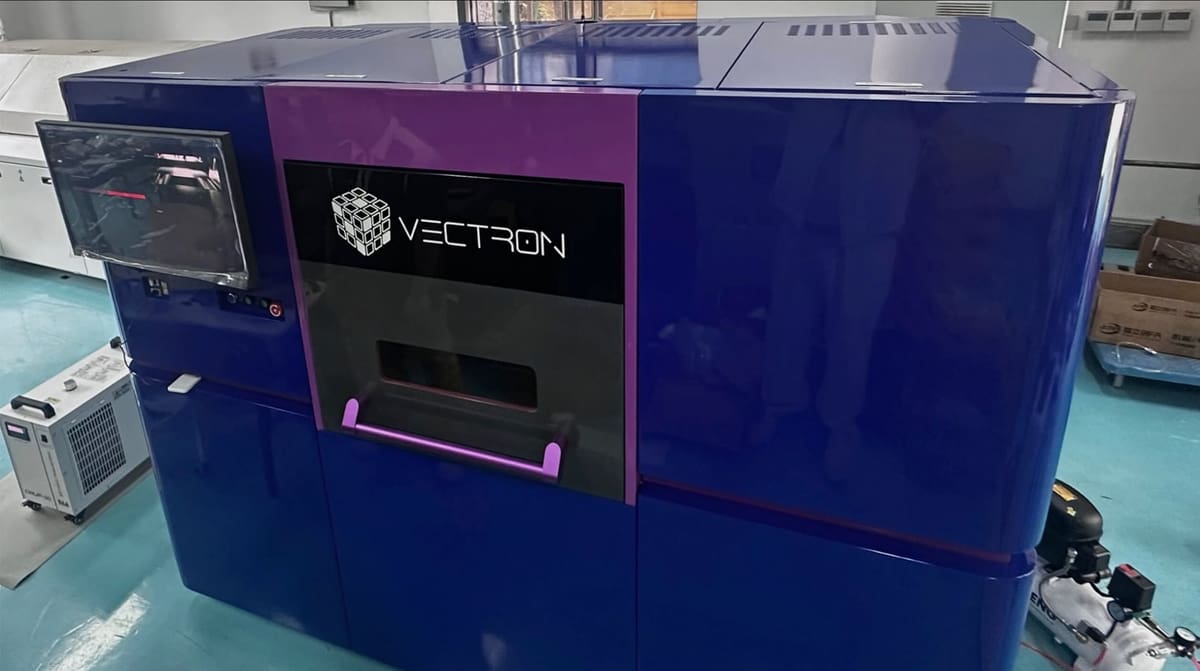
20x Faster Than SLS, 2x Faster Than MJF? Vectron’s New 3D Printer Makes Bold Claims

Vectron's voxel-based laser sintering process promises substantial productivity gains over established polymer powder bed fusion technologies, yet the data needed to evaluate those claims is behind an NDA.
For a company making some rather extraordinary claims about the speed and economics of its polymer 3D printing, Singapore-based Vectron is unusually guarded about the technical details of its technology.
The company, which introduced its VLS325 industrial polymer 3D printer at Formnext 2026, claims printing speeds up to 20 times those of conventional selective laser sintering (SLS) and twice those of Multi Jet Fusion (MJF). Yet prospective customers and partners seeking detailed specifications and sample parts are asked to sign a nondisclosure agreement (NDA).
Some additional information has surfaced in a recent paid “sponsored article” published by 3DPrint.com, including a build volume of 325 × 175 × 250 mm, an introductory price of $69,000, and planned deliveries in the second quarter of 2027. Yet, the technical benchmarks that would put Vectron’s more ambitious performance claims into perspective, however, remain conspicuously absent.
Thousands of Lasers Instead of One
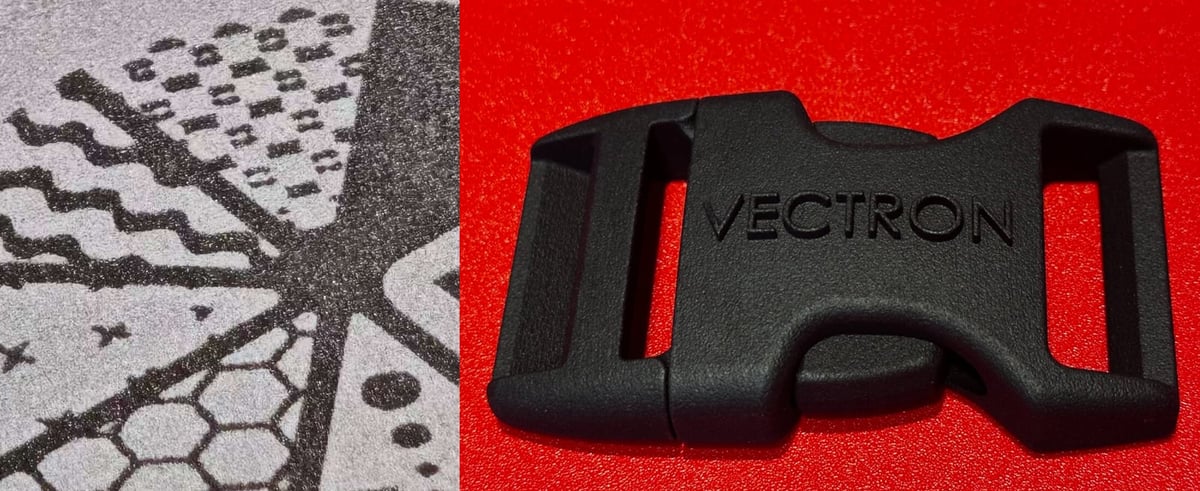
The technology itself is intriguing. Rather than scanning a laser across a bed of polymer powder, Vectron employs a matrix of thousands of individually controllable near-infrared laser emitters to fuse an entire cross-section simultaneously.
Each emitter produces its own spot on the powder bed, dispensing with galvanometers, moving mirrors, and shared projection optics. Vectron claims this architecture brings sintering times below two seconds per layer at 100 microns, regardless of the number or geometric complexity of the parts being printed.
The operative word here is sintering. Although Vectron describes a high-speed powder recoating mechanism, it does not quantify the duration of the complete layer cycle. Volumetric build rates, representative build times, and heating and cooling times are also absent, making meaningful productivity comparisons difficult.
Resolution Without the Numbers
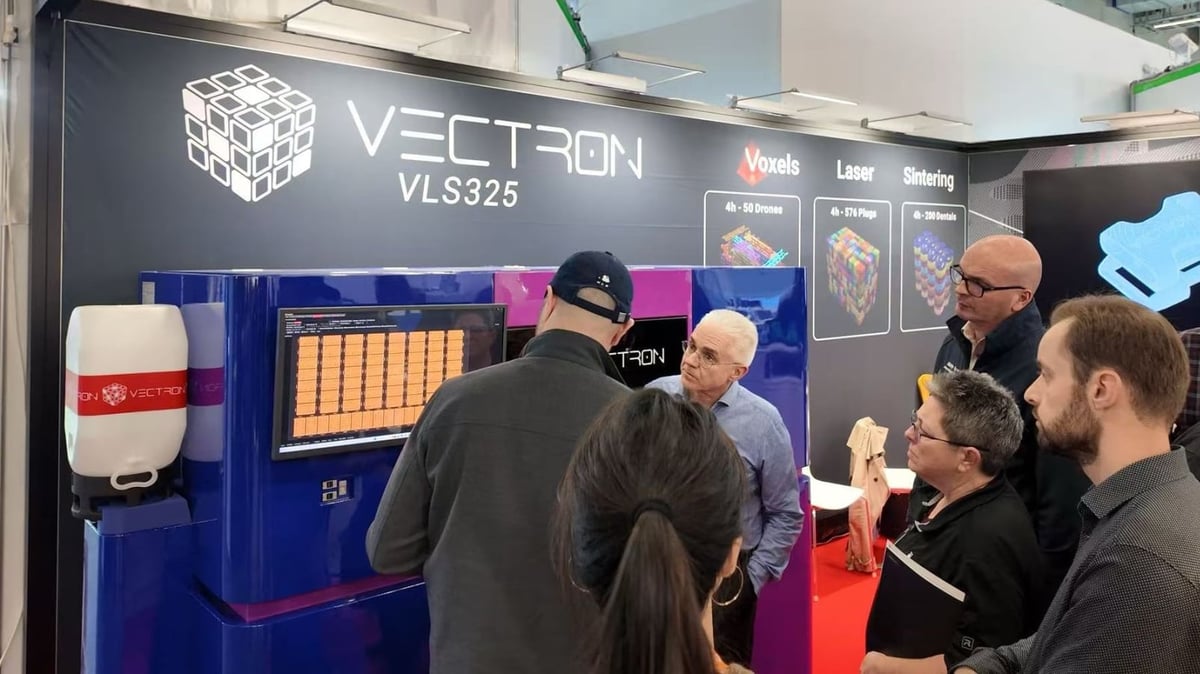
Another interesting aspect of Vectron’s technology is its claimed ability to achieve effective print resolution finer than the physical spacing of its laser emitters through software-controlled energy exposure.
The company references Energy-Domain Anti-Aliasing (EDAA) and sub-voxel slicing as means of reproducing fine features and functional mechanisms. Its website advertises a 100-micron voxel resolution, but provides no figures for physical emitter pitch, laser spot size, minimum printable feature size, dimensional accuracy, or surface roughness.
Similarly, Vectron attributes a uniform thermal history to its exposure method without publishing temperature distribution measurements or data on the consistency of mechanical properties across the build area.
Unlike MJF, Vectron’s process does not require fusing agents. The company lists commercially available PA12, PA11, polypropylene, and thermoplastic polyurethane (TPU) powders among its compatible materials.
Missing, however, are material qualification data, tensile strength, elongation at break, part density, mechanical anisotropy, and powder refresh rates. These are particularly pertinent given Vectron’s emphasis on serial production and lower manufacturing costs.
By the time the machine is ready to purchase, all will be revealed, hopefully.
The company showcases mascara brushes as an example of high-volume production, but does not disclose per-part costs, production yields, or the number of parts manufactured within a given time frame.
Should Vectron’s technology live up to its claims once the printers are commercially available, it could represent a significant leap forward for polymer additive manufacturing.
Prospective customers can request detailed specifications and sample parts directly from Vectron — provided they’re prepared to sign that NDA.

You Might Also Like:

License: The text of "20x Faster Than SLS, 2x Faster Than MJF? Vectron’s New 3D Printer Makes Bold Claims" by All3DP Pro is licensed under a Creative Commons Attribution 4.0 International License.